


























1 / 3
0
Views
0
Downloads



0.0
0
0 Likes
Identifying and Classifying 3D Solid Shapes
0 Views
0 Downloads
Paste this activity's link or code into your existing LMS (Google Classroom, Canvas, Teams, Schoology, Moodle, etc.).
Students can open and work on the activity right away, with no student login required.
You'll still be able to track student progress and results from your teacher account.
Information
Description
What It Is:
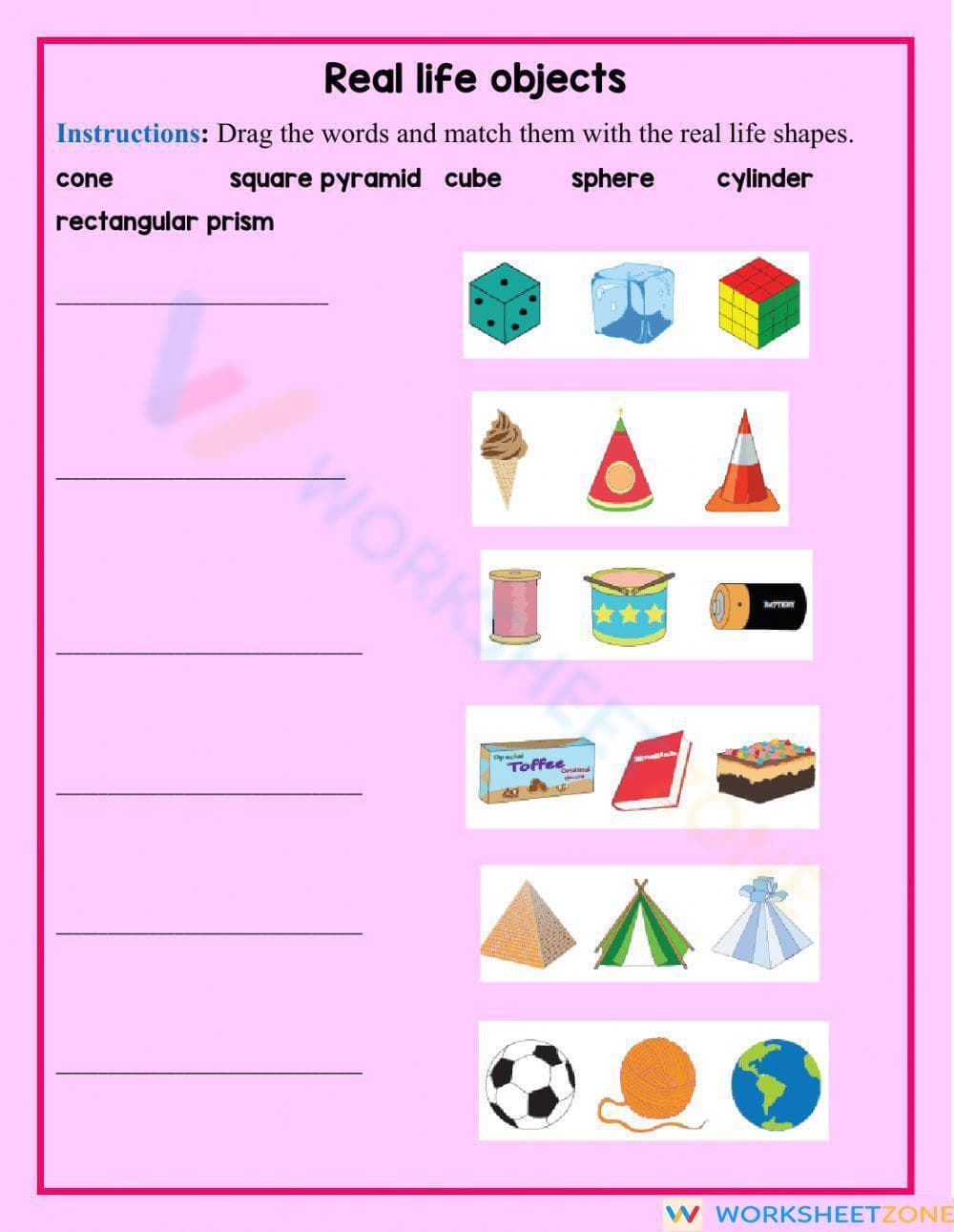
This is an educational worksheet focused on 3D or solid shapes. The worksheet presents a table where students need to identify and count the number of faces, edges, and vertices for different 3D shapes. The shapes included are a square pyramid, cone, cube, sphere, rectangular prism, and cylinder.
Grade Level Suitability:
This worksheet is suitable for grades 2-4. It reinforces basic geometry concepts related to 3D shapes and their properties. The shapes are common and easily recognizable, and the task of counting faces, edges, and vertices is appropriate for this age range.
Why Use It:
This worksheet helps students develop their understanding of 3D shapes and their attributes. It promotes spatial reasoning and counting skills. By completing the table, students reinforce their knowledge of faces, edges, and vertices, and learn to differentiate between various solid shapes.
How to Use It:
Students should first identify the 3D shape presented in each row. Then, they should count the number of faces, edges, and vertices for that shape and write the corresponding numbers in the appropriate columns of the table.
Target Users:
This worksheet is designed for elementary school students, particularly those in grades 2-4, who are learning about 3D shapes and their properties. It can be used as a classroom activity, homework assignment, or review exercise.
This is an educational worksheet focused on 3D or solid shapes. The worksheet presents a table where students need to identify and count the number of faces, edges, and vertices for different 3D shapes. The shapes included are a square pyramid, cone, cube, sphere, rectangular prism, and cylinder.
Grade Level Suitability:
This worksheet is suitable for grades 2-4. It reinforces basic geometry concepts related to 3D shapes and their properties. The shapes are common and easily recognizable, and the task of counting faces, edges, and vertices is appropriate for this age range.
Why Use It:
This worksheet helps students develop their understanding of 3D shapes and their attributes. It promotes spatial reasoning and counting skills. By completing the table, students reinforce their knowledge of faces, edges, and vertices, and learn to differentiate between various solid shapes.
How to Use It:
Students should first identify the 3D shape presented in each row. Then, they should count the number of faces, edges, and vertices for that shape and write the corresponding numbers in the appropriate columns of the table.
Target Users:
This worksheet is designed for elementary school students, particularly those in grades 2-4, who are learning about 3D shapes and their properties. It can be used as a classroom activity, homework assignment, or review exercise.


