


























0
Views
0
Downloads

0.0
0
0 Likes
Understanding A Balancing Act
0 Views
0 Downloads
Paste this activity's link or code into your existing LMS (Google Classroom, Canvas, Teams, Schoology, Moodle, etc.).
Students can open and work on the activity right away, with no student login required.
You'll still be able to track student progress and results from your teacher account.
Information
Description
What It Is:
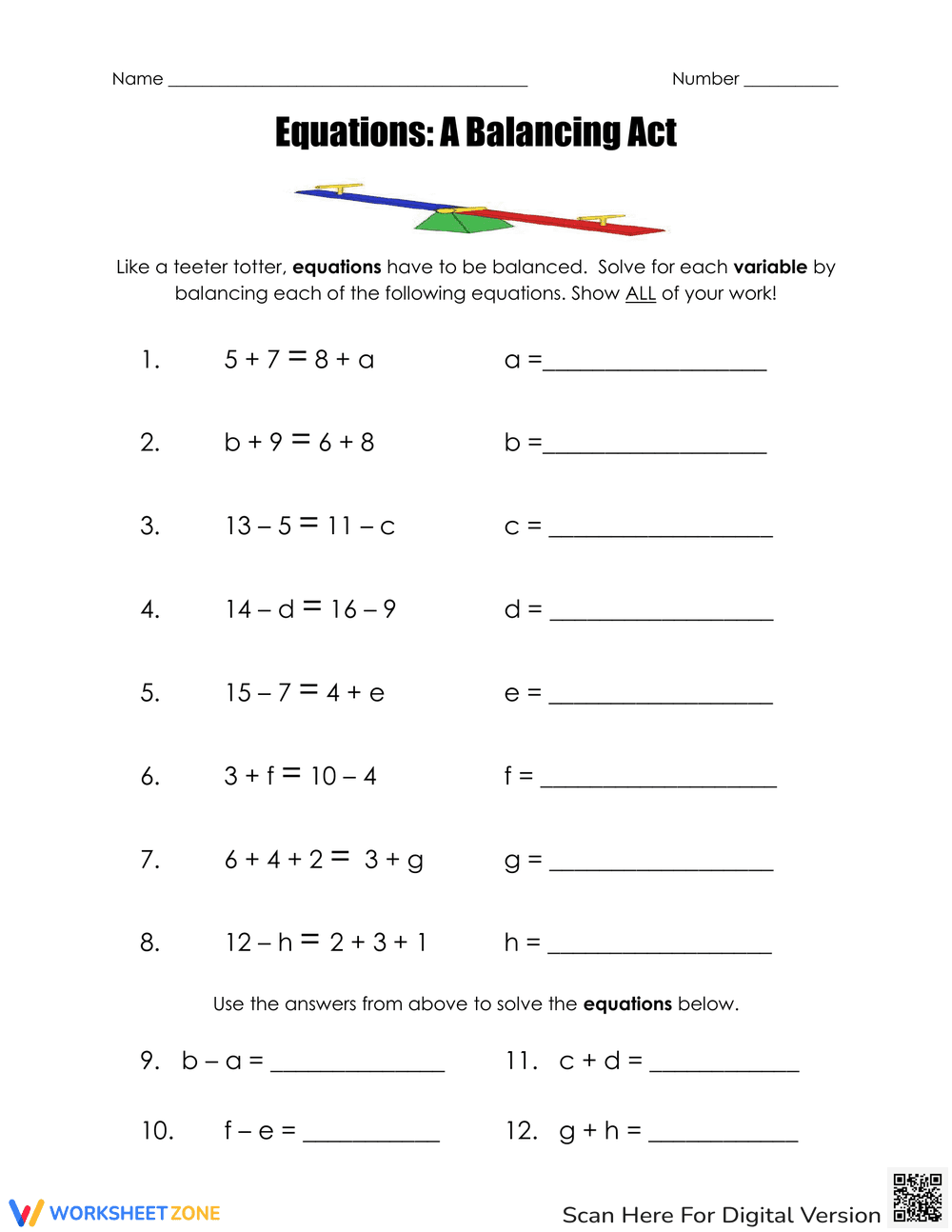
This is an educational worksheet titled 'Equations: A Balancing Act.' It features 12 algebraic equations where students need to solve for a variable (a, b, c, d, e, f, g, h). The first 8 equations are presented as simple addition and subtraction problems with one variable. The last four equations require using the solutions from the first 8 equations to solve new expressions. The worksheet includes a teeter-totter illustration to emphasize the concept of balanced equations.
Grade Level Suitability:
This worksheet is suitable for grades 3-5. It reinforces basic addition and subtraction skills while introducing the concept of algebraic equations and solving for variables. The equations are relatively simple and involve single-digit numbers, making it appropriate for students in these grade levels who are beginning to learn algebra.
Why Use It:
This worksheet helps students develop their understanding of algebraic equations as a balancing act. It reinforces basic arithmetic skills while introducing the concept of solving for unknowns. It promotes problem-solving skills, critical thinking, and the ability to apply previously learned solutions to new problems.
How to Use It:
Students should first solve each of the first eight equations for the given variable, showing their work. Then, they should use the solutions they found for a, b, c, d, e, f, g, and h to solve the final four equations. The worksheet encourages students to demonstrate all steps in their calculations to ensure accuracy and understanding.
Target Users:
This worksheet is targeted towards elementary school students, particularly those in grades 3-5, who are learning basic algebra concepts and equation solving. It can be used as a classroom activity, homework assignment, or supplemental practice for students who need extra support in understanding equations.
This is an educational worksheet titled 'Equations: A Balancing Act.' It features 12 algebraic equations where students need to solve for a variable (a, b, c, d, e, f, g, h). The first 8 equations are presented as simple addition and subtraction problems with one variable. The last four equations require using the solutions from the first 8 equations to solve new expressions. The worksheet includes a teeter-totter illustration to emphasize the concept of balanced equations.
Grade Level Suitability:
This worksheet is suitable for grades 3-5. It reinforces basic addition and subtraction skills while introducing the concept of algebraic equations and solving for variables. The equations are relatively simple and involve single-digit numbers, making it appropriate for students in these grade levels who are beginning to learn algebra.
Why Use It:
This worksheet helps students develop their understanding of algebraic equations as a balancing act. It reinforces basic arithmetic skills while introducing the concept of solving for unknowns. It promotes problem-solving skills, critical thinking, and the ability to apply previously learned solutions to new problems.
How to Use It:
Students should first solve each of the first eight equations for the given variable, showing their work. Then, they should use the solutions they found for a, b, c, d, e, f, g, and h to solve the final four equations. The worksheet encourages students to demonstrate all steps in their calculations to ensure accuracy and understanding.
Target Users:
This worksheet is targeted towards elementary school students, particularly those in grades 3-5, who are learning basic algebra concepts and equation solving. It can be used as a classroom activity, homework assignment, or supplemental practice for students who need extra support in understanding equations.


