


























1 / 4
0
Views
0
Downloads



0.0
0
0 Likes
Abiotic and Biotic Factors in Living Things
0 Views
0 Downloads
Paste this activity's link or code into your existing LMS (Google Classroom, Canvas, Teams, Schoology, Moodle, etc.).
Students can open and work on the activity right away, with no student login required.
You'll still be able to track student progress and results from your teacher account.
Information
Description
What It Is:
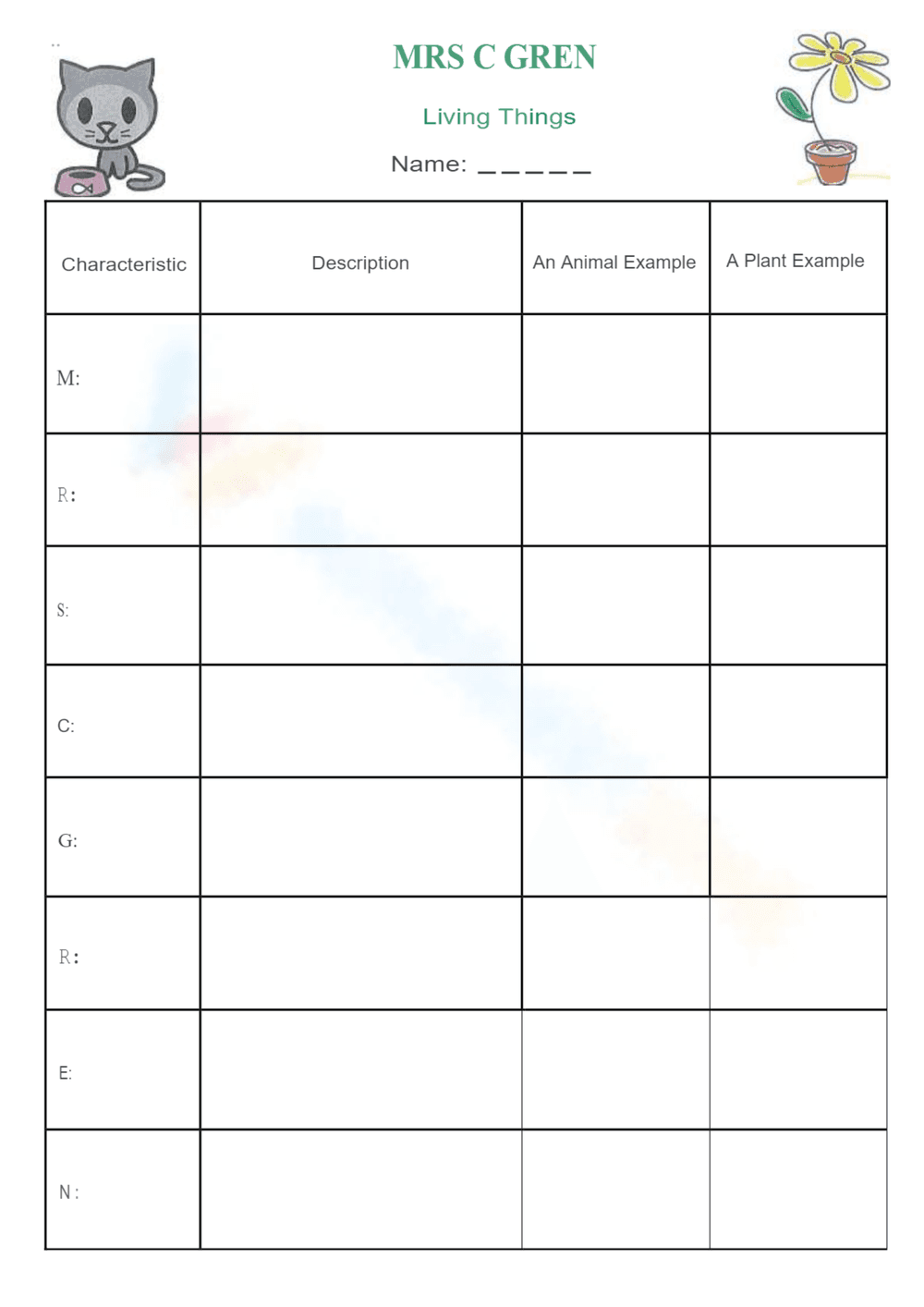
This is a science worksheet titled 'Living Things' designed by 'Mrs. C Gren'. It features a table with columns for 'Characteristic,' 'Description,' 'An Animal Example,' and 'A Plant Example.' The rows are labeled with the letters M, R, S, C, G, R, E, and N. Students are expected to describe the characteristic indicated by the letter, and provide examples of animals and plants that exhibit that characteristic.
Grade Level Suitability:
This worksheet is suitable for grades 2-4. The concepts are introductory to life science and require basic observation and classification skills. The simplified table format and the use of single-letter prompts make it accessible to younger learners.
Why Use It:
This worksheet helps students understand and classify the characteristics of living things. It encourages them to think about the similarities and differences between animals and plants. It reinforces vocabulary related to life science and promotes critical thinking and observation skills.
How to Use It:
Students should fill in the 'Description' column with a definition or explanation of the characteristic indicated by the letter in the 'Characteristic' column. Then, they should provide an example of an animal and a plant that demonstrates that characteristic in the respective columns. The letters likely stand for characteristics like Movement, Respiration, Sensitivity, Circulation, Growth, Reproduction, Excretion, and Nutrition.
Target Users:
This worksheet is designed for elementary school students learning about the characteristics of living things. It's suitable for classroom use, homework assignments, or as a review activity. It can be used by teachers, homeschool parents, or tutors.
This is a science worksheet titled 'Living Things' designed by 'Mrs. C Gren'. It features a table with columns for 'Characteristic,' 'Description,' 'An Animal Example,' and 'A Plant Example.' The rows are labeled with the letters M, R, S, C, G, R, E, and N. Students are expected to describe the characteristic indicated by the letter, and provide examples of animals and plants that exhibit that characteristic.
Grade Level Suitability:
This worksheet is suitable for grades 2-4. The concepts are introductory to life science and require basic observation and classification skills. The simplified table format and the use of single-letter prompts make it accessible to younger learners.
Why Use It:
This worksheet helps students understand and classify the characteristics of living things. It encourages them to think about the similarities and differences between animals and plants. It reinforces vocabulary related to life science and promotes critical thinking and observation skills.
How to Use It:
Students should fill in the 'Description' column with a definition or explanation of the characteristic indicated by the letter in the 'Characteristic' column. Then, they should provide an example of an animal and a plant that demonstrates that characteristic in the respective columns. The letters likely stand for characteristics like Movement, Respiration, Sensitivity, Circulation, Growth, Reproduction, Excretion, and Nutrition.
Target Users:
This worksheet is designed for elementary school students learning about the characteristics of living things. It's suitable for classroom use, homework assignments, or as a review activity. It can be used by teachers, homeschool parents, or tutors.


