


























0
Views
0
Plays

0.0
0
0 Likes
Differentiating Abstract and Concrete Nouns
0 Views
0 Plays
Paste this activity's link or code into your existing LMS (Google Classroom, Canvas, Teams, Schoology, Moodle, etc.).
Students can open and work on the activity right away, with no student login required.
You'll still be able to track student progress and results from your teacher account.
Information
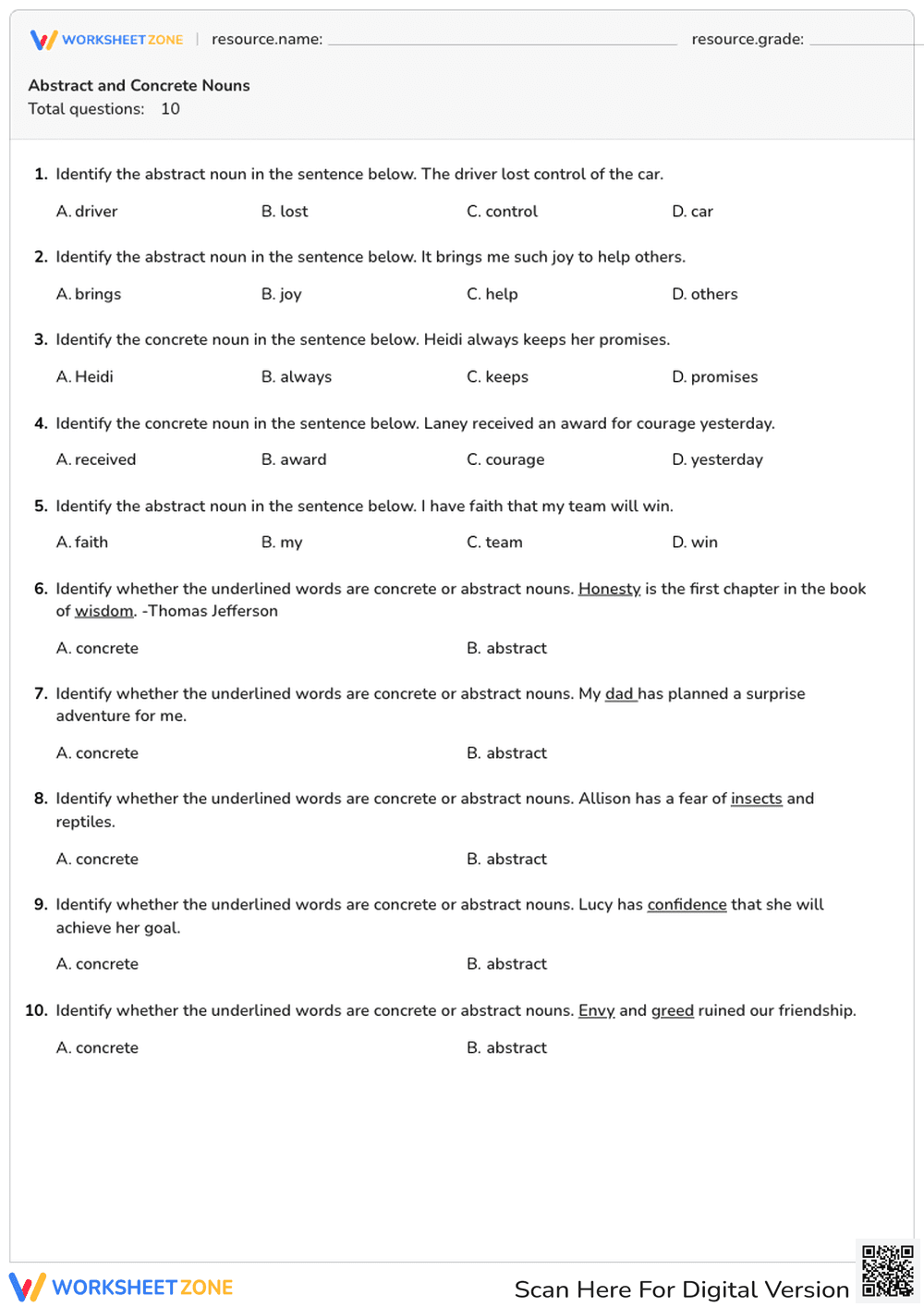
Description
What It Is:
This is an educational worksheet explaining abstract nouns. It defines abstract nouns as entities not perceivable by the five senses. The worksheet provides examples like 'Love is a strong emotion,' 'Honesty is the best policy,' 'It takes a lot of courage to raise your voice,' and 'You should not misuse the freedom you are given.' Each example highlights an abstract noun in bold.
Grade Level Suitability:
This worksheet is suitable for grades 4-6. The concept of abstract nouns can be introduced around this age, and the examples provided are relatively simple to understand. The vocabulary used is appropriate for this age range.
Why Use It:
This worksheet helps students understand the definition of abstract nouns and recognize them in sentences. It improves vocabulary and enhances understanding of parts of speech. It clarifies the difference between concrete and abstract nouns.
How to Use It:
Use this worksheet as an introduction to abstract nouns. Read the definition and examples aloud, then discuss each example to ensure comprehension. You can ask students to identify the abstract noun in each sentence. You can also create additional sentences with abstract nouns as a follow-up activity.
Target Users:
This worksheet is ideal for elementary and middle school students learning about nouns. It's also beneficial for ESL students who need to improve their English grammar and vocabulary. Teachers and homeschooling parents can use it as part of a language arts lesson.
This is an educational worksheet explaining abstract nouns. It defines abstract nouns as entities not perceivable by the five senses. The worksheet provides examples like 'Love is a strong emotion,' 'Honesty is the best policy,' 'It takes a lot of courage to raise your voice,' and 'You should not misuse the freedom you are given.' Each example highlights an abstract noun in bold.
Grade Level Suitability:
This worksheet is suitable for grades 4-6. The concept of abstract nouns can be introduced around this age, and the examples provided are relatively simple to understand. The vocabulary used is appropriate for this age range.
Why Use It:
This worksheet helps students understand the definition of abstract nouns and recognize them in sentences. It improves vocabulary and enhances understanding of parts of speech. It clarifies the difference between concrete and abstract nouns.
How to Use It:
Use this worksheet as an introduction to abstract nouns. Read the definition and examples aloud, then discuss each example to ensure comprehension. You can ask students to identify the abstract noun in each sentence. You can also create additional sentences with abstract nouns as a follow-up activity.
Target Users:
This worksheet is ideal for elementary and middle school students learning about nouns. It's also beneficial for ESL students who need to improve their English grammar and vocabulary. Teachers and homeschooling parents can use it as part of a language arts lesson.


