


























0
Views
0
Downloads

0 Likes
Abstract Nouns for Kids: Learning Intangible Ideas
0 Views
0 Downloads
Paste this activity's link or code into your existing LMS (Google Classroom, Canvas, Teams, Schoology, Moodle, etc.).
Students can open and work on the activity right away, with no student login required.
You'll still be able to track student progress and results from your teacher account.
Information
Description
What It Is:
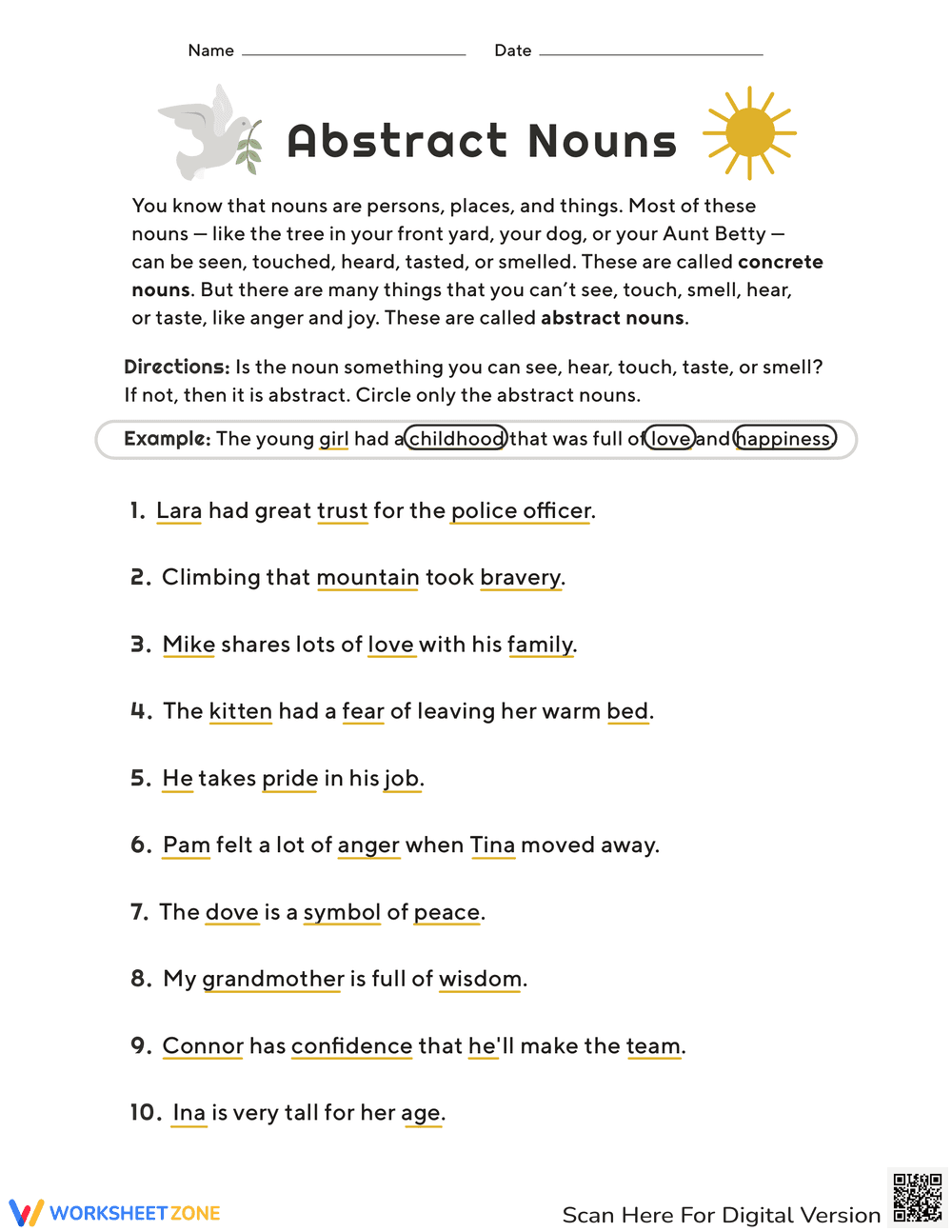
This is a worksheet designed to help students understand and identify abstract nouns. It provides a brief explanation of concrete and abstract nouns, then asks students to read sentences and circle the abstract nouns. An example is provided to illustrate the task, where 'childhood,' 'love,' and 'happiness' are circled. The worksheet contains ten sentences for practice, with some nouns already underlined to help students focus their attention.
Grade Level Suitability:
This worksheet is most suitable for grades 3-5. The concept of abstract nouns can be challenging for younger students, and the sentence structure and vocabulary are appropriate for this age range. The activity is also good for reinforcing basic noun identification skills.
Why Use It:
This worksheet provides a clear and concise way to teach the concept of abstract nouns. It helps students differentiate between concrete and abstract nouns by asking them to consider whether a noun can be perceived through the senses. It reinforces vocabulary and reading comprehension skills.
How to Use It:
Begin by reviewing the definitions of concrete and abstract nouns with students. Then, work through the example together, explaining why each circled word is an abstract noun. Have students complete the remaining sentences independently or in pairs, circling the abstract nouns. Review the answers as a class and discuss any challenging examples.
Target Users:
This worksheet is ideal for elementary school teachers, homeschool parents, and students learning about parts of speech. It is particularly useful for students who need extra practice identifying abstract nouns or who are struggling to understand the difference between concrete and abstract concepts.
This is a worksheet designed to help students understand and identify abstract nouns. It provides a brief explanation of concrete and abstract nouns, then asks students to read sentences and circle the abstract nouns. An example is provided to illustrate the task, where 'childhood,' 'love,' and 'happiness' are circled. The worksheet contains ten sentences for practice, with some nouns already underlined to help students focus their attention.
Grade Level Suitability:
This worksheet is most suitable for grades 3-5. The concept of abstract nouns can be challenging for younger students, and the sentence structure and vocabulary are appropriate for this age range. The activity is also good for reinforcing basic noun identification skills.
Why Use It:
This worksheet provides a clear and concise way to teach the concept of abstract nouns. It helps students differentiate between concrete and abstract nouns by asking them to consider whether a noun can be perceived through the senses. It reinforces vocabulary and reading comprehension skills.
How to Use It:
Begin by reviewing the definitions of concrete and abstract nouns with students. Then, work through the example together, explaining why each circled word is an abstract noun. Have students complete the remaining sentences independently or in pairs, circling the abstract nouns. Review the answers as a class and discuss any challenging examples.
Target Users:
This worksheet is ideal for elementary school teachers, homeschool parents, and students learning about parts of speech. It is particularly useful for students who need extra practice identifying abstract nouns or who are struggling to understand the difference between concrete and abstract concepts.


