


























0
Views
0
Downloads

0.0
0
0 Likes
Improve Spelling by Adding Endings to Words
0 Views
0 Downloads
Paste this activity's link or code into your existing LMS (Google Classroom, Canvas, Teams, Schoology, Moodle, etc.).
Students can open and work on the activity right away, with no student login required.
You'll still be able to track student progress and results from your teacher account.
Information
Description
What It Is:
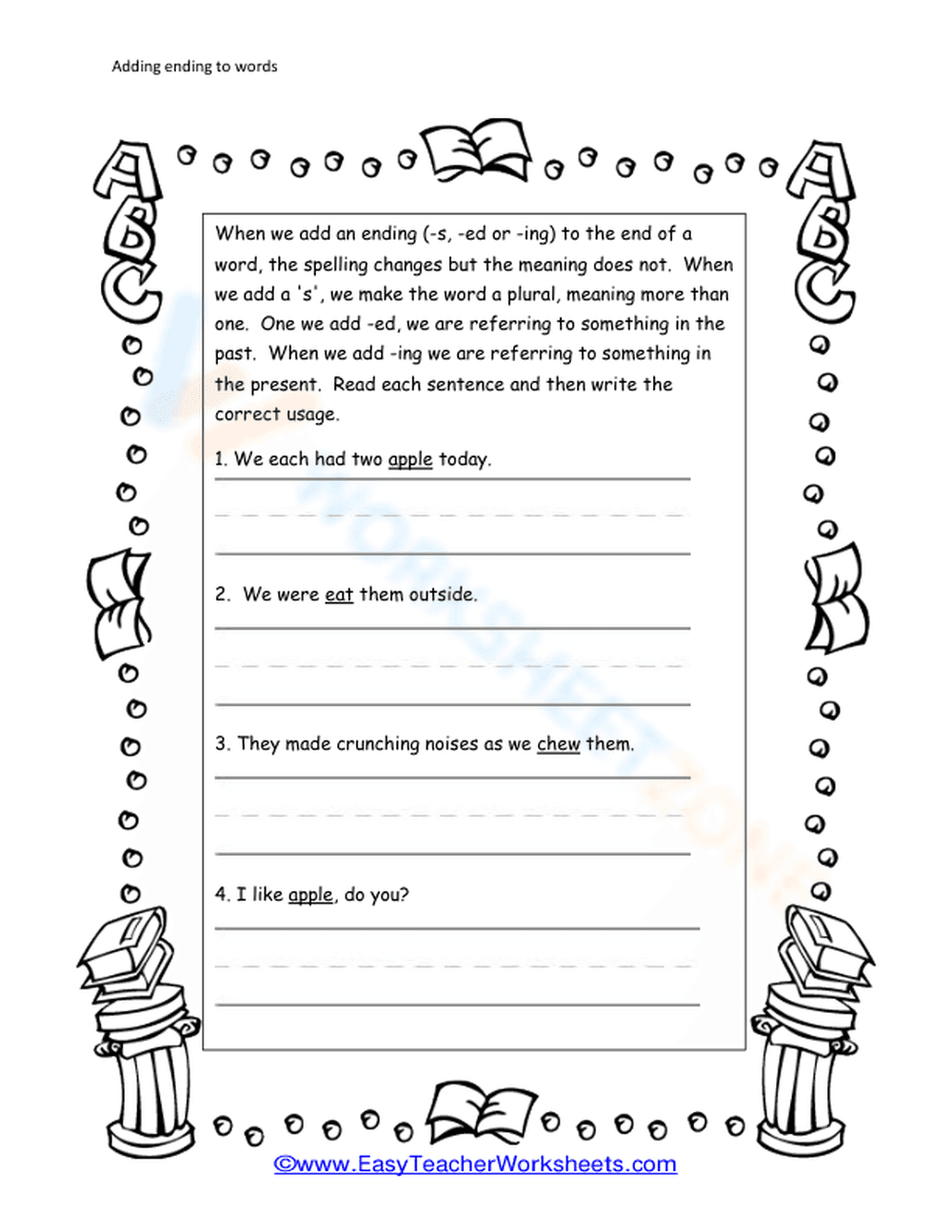
This is an English language arts worksheet focused on adding endings (-s, -ed, or -ing) to words. It includes instructions explaining how adding endings changes spelling but not meaning, and that -s makes a word plural, -ed refers to the past, and -ing refers to the present. The worksheet presents four sentences with a verb or noun highlighted, and the student must write the correct usage of the highlighted word by adding an appropriate ending on the provided lines. The words to be modified are: apple, eat, chew, and apple. The worksheet has a decorative border with ABCs, books, and decorative elements.
Grade Level Suitability:
This worksheet is suitable for 1st to 3rd grade. The content is designed to reinforce basic grammar concepts like pluralization and verb tenses in a simple, sentence-based format. The instructions are easy to understand, and the activity is straightforward.
Why Use It:
This worksheet helps students understand how to correctly use suffixes to change the tense and meaning of words. It reinforces the rules of adding -s, -ed, and -ing to verbs and nouns, improving their grammar skills and sentence construction. It also helps students understand the concept of pluralization.
How to Use It:
Begin by reading the instructions at the top of the worksheet with the student. Explain the rules for adding -s, -ed, and -ing. Then, have the student read each sentence carefully and determine which ending is needed for the highlighted word to make the sentence grammatically correct. The student then writes the correct form of the word on the line provided.
Target Users:
This worksheet is designed for elementary school students in grades 1-3 who are learning about grammar and word endings. It is particularly useful for students who need extra practice with verb tenses and pluralization. It can also be used for ESL students learning basic English grammar.
This is an English language arts worksheet focused on adding endings (-s, -ed, or -ing) to words. It includes instructions explaining how adding endings changes spelling but not meaning, and that -s makes a word plural, -ed refers to the past, and -ing refers to the present. The worksheet presents four sentences with a verb or noun highlighted, and the student must write the correct usage of the highlighted word by adding an appropriate ending on the provided lines. The words to be modified are: apple, eat, chew, and apple. The worksheet has a decorative border with ABCs, books, and decorative elements.
Grade Level Suitability:
This worksheet is suitable for 1st to 3rd grade. The content is designed to reinforce basic grammar concepts like pluralization and verb tenses in a simple, sentence-based format. The instructions are easy to understand, and the activity is straightforward.
Why Use It:
This worksheet helps students understand how to correctly use suffixes to change the tense and meaning of words. It reinforces the rules of adding -s, -ed, and -ing to verbs and nouns, improving their grammar skills and sentence construction. It also helps students understand the concept of pluralization.
How to Use It:
Begin by reading the instructions at the top of the worksheet with the student. Explain the rules for adding -s, -ed, and -ing. Then, have the student read each sentence carefully and determine which ending is needed for the highlighted word to make the sentence grammatically correct. The student then writes the correct form of the word on the line provided.
Target Users:
This worksheet is designed for elementary school students in grades 1-3 who are learning about grammar and word endings. It is particularly useful for students who need extra practice with verb tenses and pluralization. It can also be used for ESL students learning basic English grammar.


