


























1 / 2
0
Views
0
Downloads

0.0
0
0 Likes
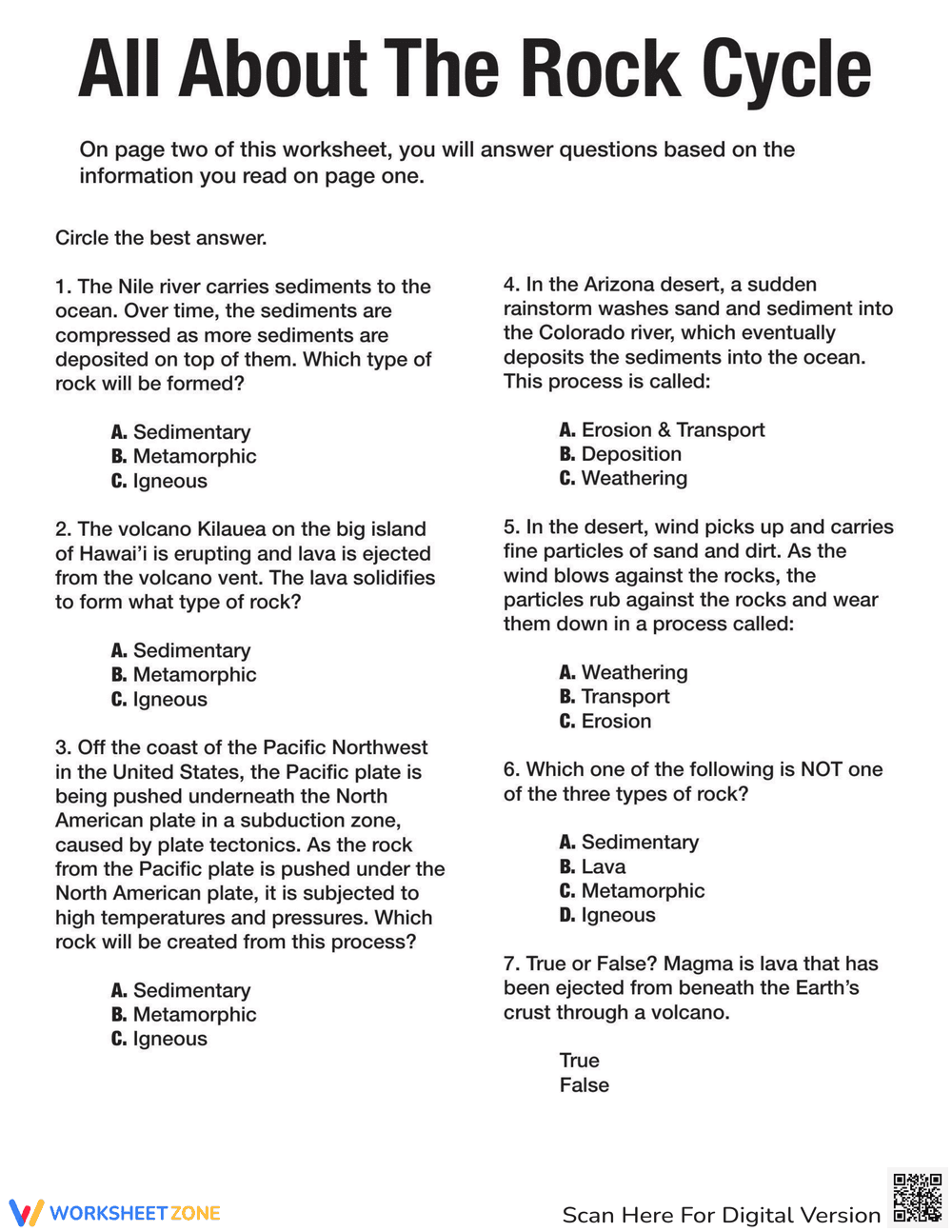
Test Your Knowledge: Rock Cycle Quiz
0 Views
0 Downloads
Paste this activity's link or code into your existing LMS (Google Classroom, Canvas, Teams, Schoology, Moodle, etc.).
Students can open and work on the activity right away, with no student login required.
You'll still be able to track student progress and results from your teacher account.
Information
Description
What It Is:
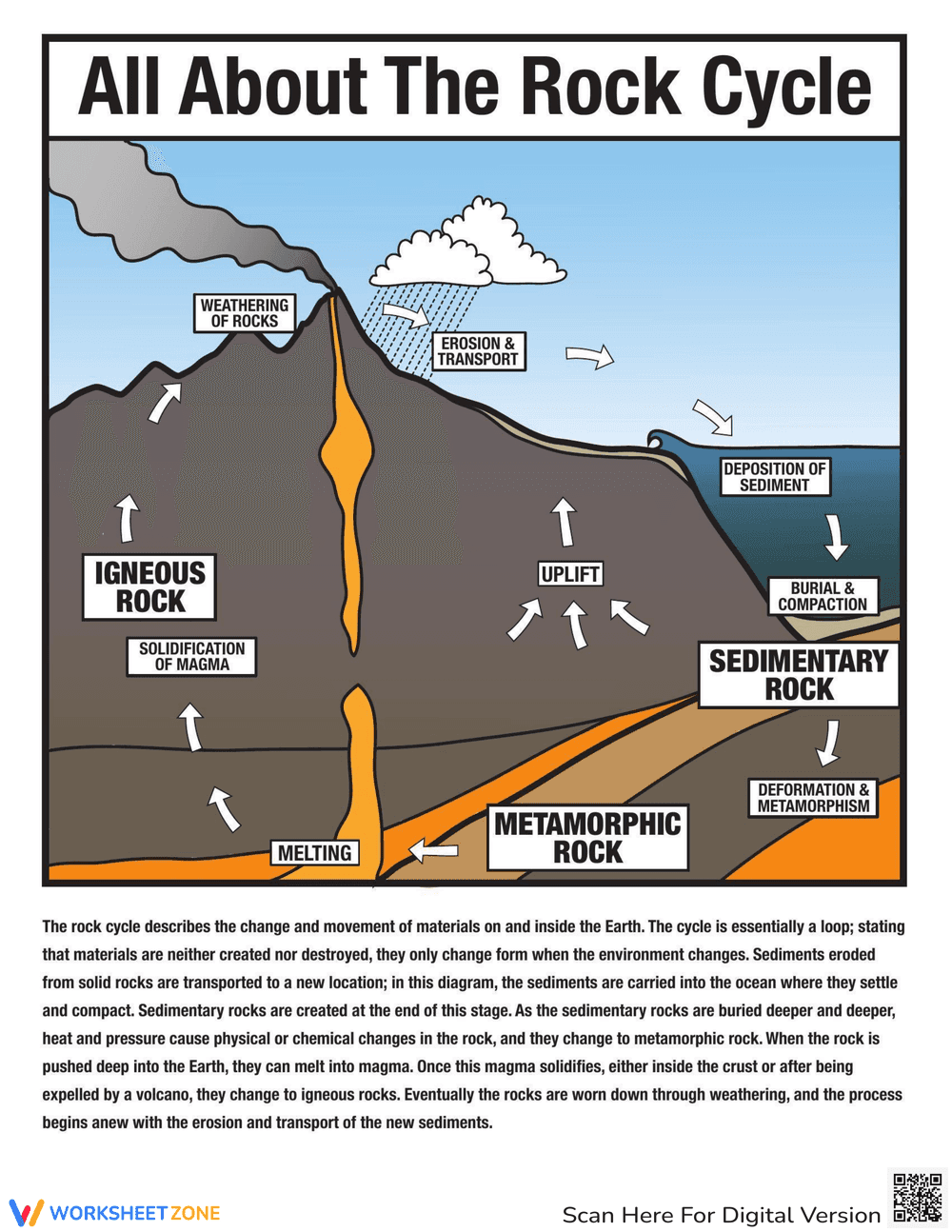
This is an educational worksheet depicting the rock cycle. It includes a labeled diagram showing the different types of rocks (igneous, sedimentary, and metamorphic) and the processes that transform them, such as weathering, erosion, transport, deposition, burial, compaction, deformation, metamorphism, melting, and solidification of magma. The worksheet also includes a short text explaining the rock cycle.
Grade Level Suitability:
This worksheet is suitable for grades 4-7. The diagram and text are simple enough for upper elementary students to understand the basic concepts, while still providing enough detail for middle school students to learn about the different processes involved in the rock cycle.
Why Use It:
This worksheet helps students visualize and understand the rock cycle, including the processes that create and transform different types of rocks. It reinforces key vocabulary and provides a clear, concise explanation of a complex geological process. It is also a good visual aid.
How to Use It:
Use this worksheet as an introduction to the rock cycle, as a review activity, or as a visual aid during a lesson. Students can use the diagram to label the different types of rocks and processes. The accompanying text can be used for reading comprehension and vocabulary building.
Target Users:
This worksheet is ideal for elementary and middle school science teachers, homeschool parents, and students learning about geology and the Earth's processes. It can also be used as a supplemental resource for earth science units.
This is an educational worksheet depicting the rock cycle. It includes a labeled diagram showing the different types of rocks (igneous, sedimentary, and metamorphic) and the processes that transform them, such as weathering, erosion, transport, deposition, burial, compaction, deformation, metamorphism, melting, and solidification of magma. The worksheet also includes a short text explaining the rock cycle.
Grade Level Suitability:
This worksheet is suitable for grades 4-7. The diagram and text are simple enough for upper elementary students to understand the basic concepts, while still providing enough detail for middle school students to learn about the different processes involved in the rock cycle.
Why Use It:
This worksheet helps students visualize and understand the rock cycle, including the processes that create and transform different types of rocks. It reinforces key vocabulary and provides a clear, concise explanation of a complex geological process. It is also a good visual aid.
How to Use It:
Use this worksheet as an introduction to the rock cycle, as a review activity, or as a visual aid during a lesson. Students can use the diagram to label the different types of rocks and processes. The accompanying text can be used for reading comprehension and vocabulary building.
Target Users:
This worksheet is ideal for elementary and middle school science teachers, homeschool parents, and students learning about geology and the Earth's processes. It can also be used as a supplemental resource for earth science units.


