


























1 / 4
0
Views
0
Downloads



0.0
0
0 Likes
Determine the Area of Shaded Region: Geometry
0 Views
0 Downloads
Paste this activity's link or code into your existing LMS (Google Classroom, Canvas, Teams, Schoology, Moodle, etc.).
Students can open and work on the activity right away, with no student login required.
You'll still be able to track student progress and results from your teacher account.
Information
Description
What It Is:
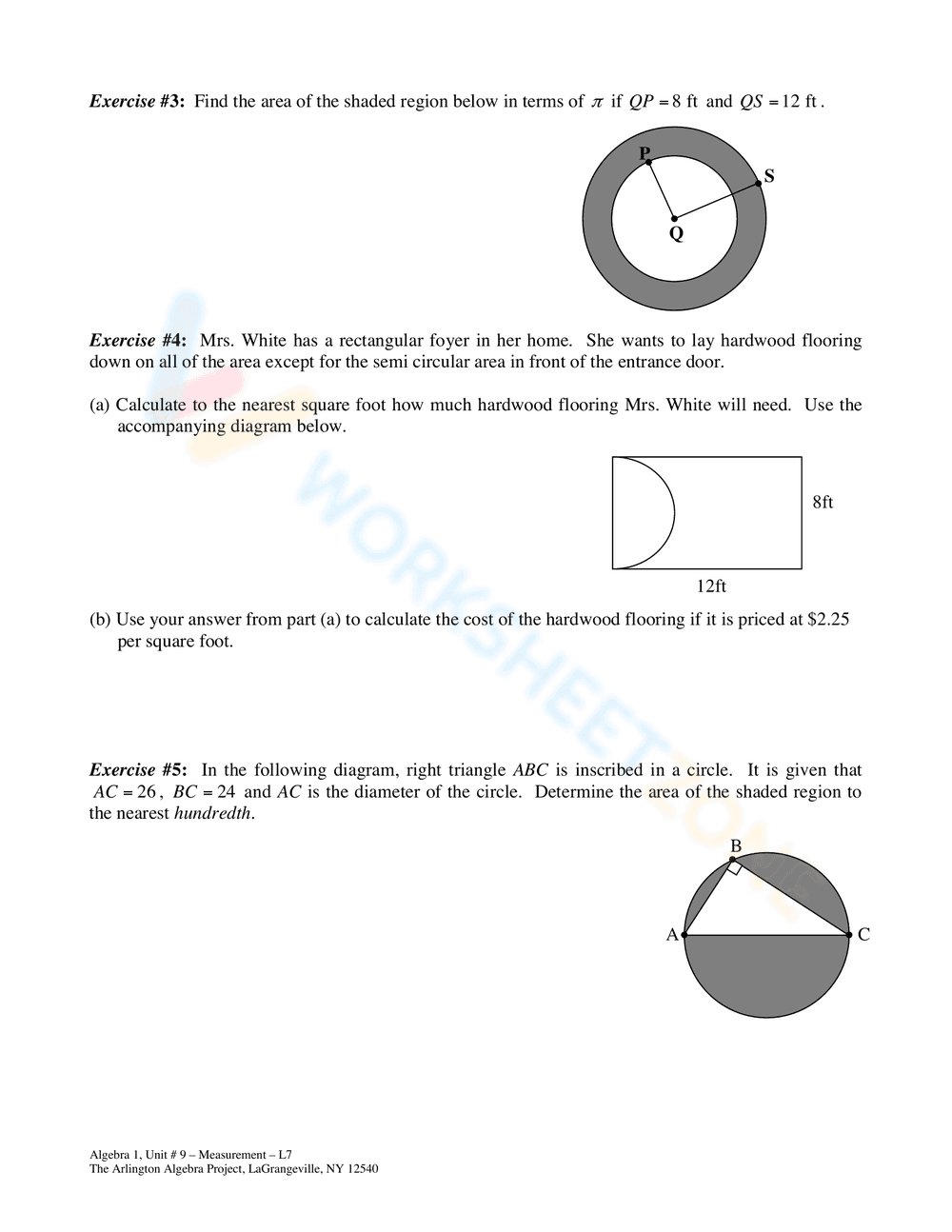
This is an Algebra 1 worksheet focused on calculating the area of shaded regions. It begins with a review of area formulas for basic shapes: triangles (A = 1/2 b h), parallelograms (A = b h), trapezoids (A = 1/2 (b1 + b2) * h), and circles (A = πr²). The worksheet presents two exercises. Exercise #1 involves a circle inscribed in a square, requiring students to find the area of the square, the exact area of the circle, express the shaded area in terms of π, and express the area of the shaded region to the nearest hundredth. Exercise #2 features a rectangle with an inscribed circle, prompting students to find the exact area of the shaded region and the area of the shaded region to the nearest tenth.
Grade Level Suitability:
This worksheet is most suitable for Algebra 1 students, typically in grades 8-9. It assumes prior knowledge of basic geometric shapes and their area formulas, and requires algebraic manipulation to solve for the shaded areas.
Why Use It:
This worksheet helps students reinforce their understanding of area formulas and apply them in problem-solving contexts. It develops critical thinking skills by requiring students to visualize geometric relationships and calculate areas of composite shapes. It also provides practice in expressing answers in terms of π and rounding to specified decimal places.
How to Use It:
Students should first review the area formulas provided for triangles, parallelograms, trapezoids, and circles. Then, they should carefully read each exercise and identify the relevant dimensions of the shapes. Students need to calculate the areas of the individual shapes and then subtract the area of the inscribed shape from the area of the outer shape to find the shaded area. Finally, they should express the answers as indicated in the problem statements.
Target Users:
The target users are Algebra 1 students who need practice in applying area formulas and solving problems involving shaded regions. This worksheet is also beneficial for teachers looking for supplementary materials to reinforce these concepts.
This is an Algebra 1 worksheet focused on calculating the area of shaded regions. It begins with a review of area formulas for basic shapes: triangles (A = 1/2 b h), parallelograms (A = b h), trapezoids (A = 1/2 (b1 + b2) * h), and circles (A = πr²). The worksheet presents two exercises. Exercise #1 involves a circle inscribed in a square, requiring students to find the area of the square, the exact area of the circle, express the shaded area in terms of π, and express the area of the shaded region to the nearest hundredth. Exercise #2 features a rectangle with an inscribed circle, prompting students to find the exact area of the shaded region and the area of the shaded region to the nearest tenth.
Grade Level Suitability:
This worksheet is most suitable for Algebra 1 students, typically in grades 8-9. It assumes prior knowledge of basic geometric shapes and their area formulas, and requires algebraic manipulation to solve for the shaded areas.
Why Use It:
This worksheet helps students reinforce their understanding of area formulas and apply them in problem-solving contexts. It develops critical thinking skills by requiring students to visualize geometric relationships and calculate areas of composite shapes. It also provides practice in expressing answers in terms of π and rounding to specified decimal places.
How to Use It:
Students should first review the area formulas provided for triangles, parallelograms, trapezoids, and circles. Then, they should carefully read each exercise and identify the relevant dimensions of the shapes. Students need to calculate the areas of the individual shapes and then subtract the area of the inscribed shape from the area of the outer shape to find the shaded area. Finally, they should express the answers as indicated in the problem statements.
Target Users:
The target users are Algebra 1 students who need practice in applying area formulas and solving problems involving shaded regions. This worksheet is also beneficial for teachers looking for supplementary materials to reinforce these concepts.


