


























0
Views
0
Downloads

0.0
0
0 Likes
Exploring the Atom: A Detailed Worksheet
0 Views
0 Downloads
Paste this activity's link or code into your existing LMS (Google Classroom, Canvas, Teams, Schoology, Moodle, etc.).
Students can open and work on the activity right away, with no student login required.
You'll still be able to track student progress and results from your teacher account.
Information
Description
What It Is:
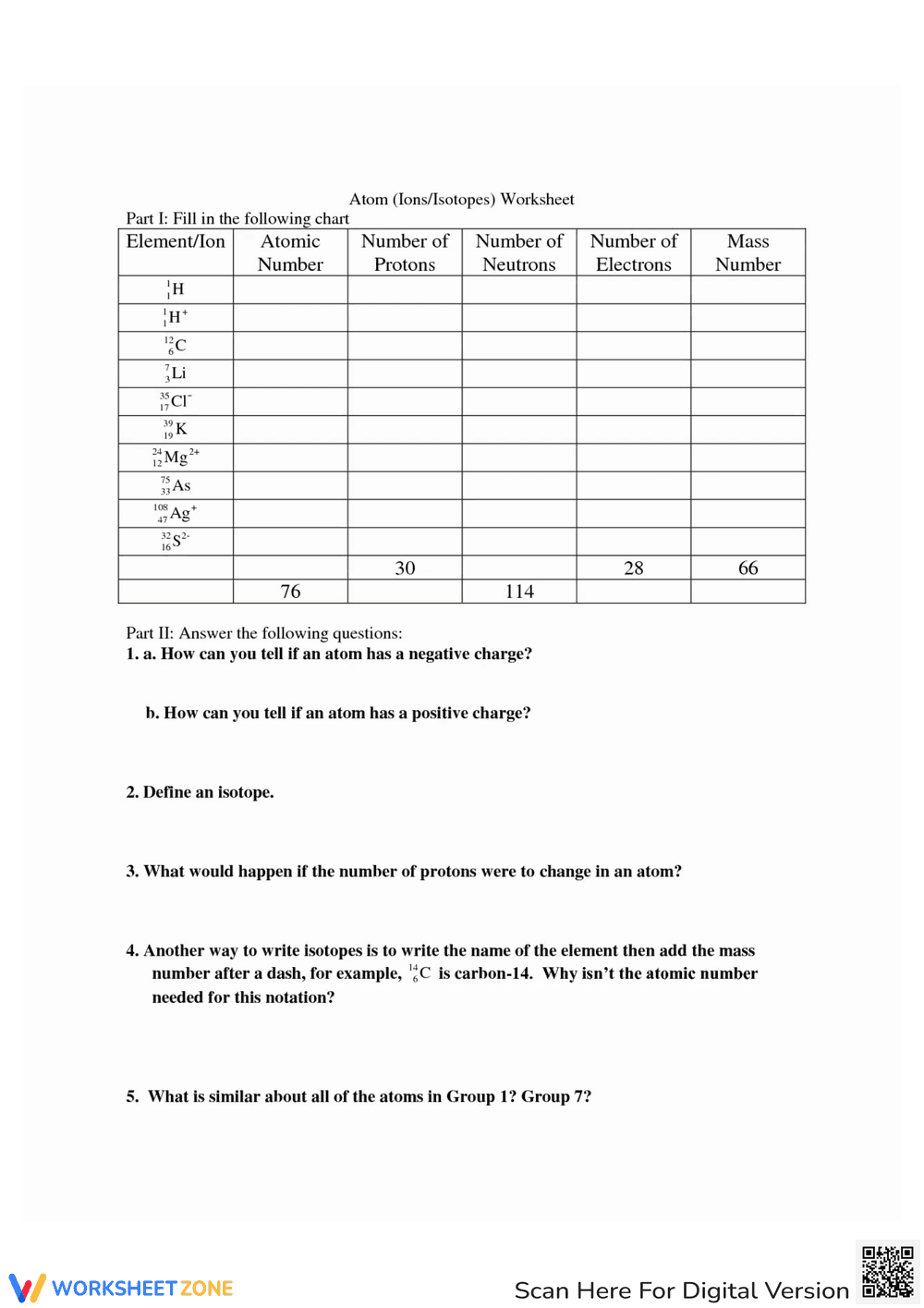
This is a chemistry worksheet focusing on atoms, ions, and isotopes. The worksheet is divided into two parts. Part I requires students to fill in a chart with information about different elements/ions, including atomic number, number of protons, neutrons, electrons, and mass number. Elements listed include Hydrogen, Carbon, Lithium, Chlorine, Potassium, Magnesium, Arsenic, Silver, and Sulfur. Some rows already have partial information filled in. Part II consists of five open-ended questions related to ions, isotopes, and atomic structure, such as how to determine if an atom has a positive or negative charge, defining an isotope, and the effect of changing the number of protons in an atom.
Grade Level Suitability:
This worksheet is suitable for grades 9-12, specifically high school chemistry or introductory college chemistry courses. The concepts covered, such as atomic structure, isotopes, and ions, are typically introduced at this level. The questions require a deeper understanding of the relationships between subatomic particles and their impact on atomic properties.
Why Use It:
This worksheet helps students reinforce their understanding of atomic structure, ions, and isotopes. It provides practice in calculating the number of protons, neutrons, and electrons in different atoms and ions. The open-ended questions encourage critical thinking and application of knowledge to explain chemical concepts. It reinforces vocabulary and problem-solving skills.
How to Use It:
Students should first review the definitions of atomic number, mass number, protons, neutrons, electrons, ions, and isotopes. Then, they can use the periodic table to find the atomic numbers of the elements listed in the chart. Using this information, and any information already provided in the table, they can calculate the remaining values. Finally, they should answer the open-ended questions in Part II, providing clear and concise explanations.
Target Users:
The target users are high school or college students taking chemistry courses. It is also suitable for teachers to use as a practice assignment, homework, or review activity. The worksheet can be used for students who are learning about atomic structure and isotopes for the first time, or as a review for more advanced topics.
This is a chemistry worksheet focusing on atoms, ions, and isotopes. The worksheet is divided into two parts. Part I requires students to fill in a chart with information about different elements/ions, including atomic number, number of protons, neutrons, electrons, and mass number. Elements listed include Hydrogen, Carbon, Lithium, Chlorine, Potassium, Magnesium, Arsenic, Silver, and Sulfur. Some rows already have partial information filled in. Part II consists of five open-ended questions related to ions, isotopes, and atomic structure, such as how to determine if an atom has a positive or negative charge, defining an isotope, and the effect of changing the number of protons in an atom.
Grade Level Suitability:
This worksheet is suitable for grades 9-12, specifically high school chemistry or introductory college chemistry courses. The concepts covered, such as atomic structure, isotopes, and ions, are typically introduced at this level. The questions require a deeper understanding of the relationships between subatomic particles and their impact on atomic properties.
Why Use It:
This worksheet helps students reinforce their understanding of atomic structure, ions, and isotopes. It provides practice in calculating the number of protons, neutrons, and electrons in different atoms and ions. The open-ended questions encourage critical thinking and application of knowledge to explain chemical concepts. It reinforces vocabulary and problem-solving skills.
How to Use It:
Students should first review the definitions of atomic number, mass number, protons, neutrons, electrons, ions, and isotopes. Then, they can use the periodic table to find the atomic numbers of the elements listed in the chart. Using this information, and any information already provided in the table, they can calculate the remaining values. Finally, they should answer the open-ended questions in Part II, providing clear and concise explanations.
Target Users:
The target users are high school or college students taking chemistry courses. It is also suitable for teachers to use as a practice assignment, homework, or review activity. The worksheet can be used for students who are learning about atomic structure and isotopes for the first time, or as a review for more advanced topics.


