


























1 / 3
0
Views
0
Downloads


0.0
0
0 Likes
Atomic Structure: Exploring Atoms Worksheet
0 Views
0 Downloads
Paste this activity's link or code into your existing LMS (Google Classroom, Canvas, Teams, Schoology, Moodle, etc.).
Students can open and work on the activity right away, with no student login required.
You'll still be able to track student progress and results from your teacher account.
Information
Description
What It Is:
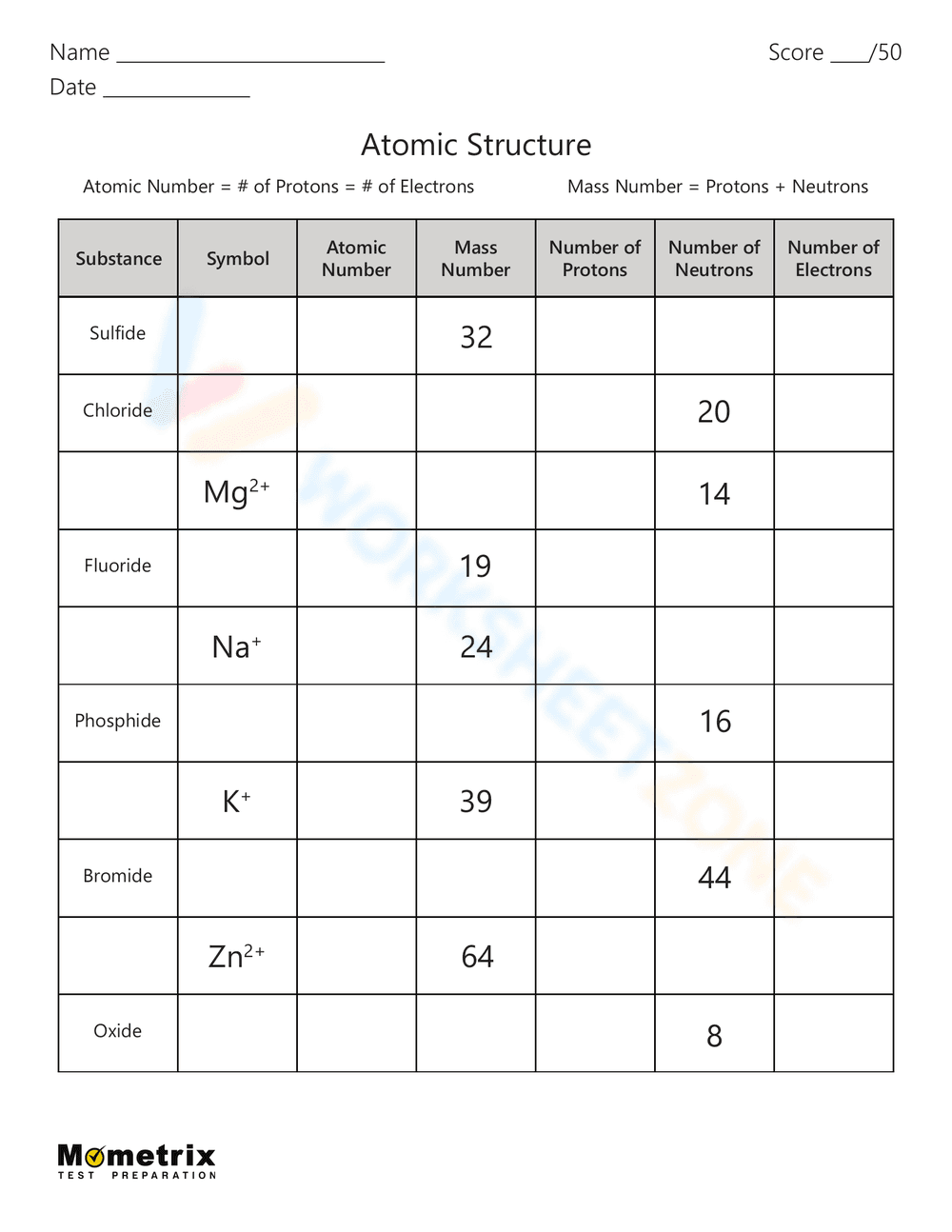
This is an atomic structure worksheet. It presents a table with the following columns: Substance, Symbol, Atomic Number, Mass Number, Number of Protons, Number of Neutrons, and Number of Electrons. Some rows are pre-filled with the substance name, symbol, or either the mass number or the number of neutrons. Students are expected to complete the table by filling in the missing information. The substances listed include Sulfide, Chloride, Magnesium ion (Mg2+), Fluoride, Sodium ion (Na+), Phosphide, Potassium ion (K+), Bromide, Zinc ion (Zn2+), and Oxide. The worksheet includes formulas at the top, stating that Atomic Number = # of Protons = # of Electrons and Mass Number = Protons + Neutrons.
Grade Level Suitability:
This worksheet is suitable for grades 9-12, particularly for high school chemistry students. It requires an understanding of atomic structure, ions, atomic number, mass number, protons, neutrons, and electrons, which are typically covered in high school chemistry courses.
Why Use It:
This worksheet reinforces understanding of atomic structure concepts. It helps students practice calculating the number of protons, neutrons, and electrons in different atoms and ions, given their atomic number and mass number. It also familiarizes them with chemical symbols and the names of common substances.
How to Use It:
Students should use their knowledge of atomic structure, the periodic table, and the given formulas to complete the table. They should first identify the atomic number of each element based on its symbol. Then, using the mass number or number of neutrons provided, they can calculate the remaining values. Remember to account for the charge of ions when determining the number of electrons.
Target Users:
This worksheet is designed for high school chemistry students, science teachers, and anyone learning about atomic structure and the periodic table. It can be used as a homework assignment, in-class activity, or review exercise.
This is an atomic structure worksheet. It presents a table with the following columns: Substance, Symbol, Atomic Number, Mass Number, Number of Protons, Number of Neutrons, and Number of Electrons. Some rows are pre-filled with the substance name, symbol, or either the mass number or the number of neutrons. Students are expected to complete the table by filling in the missing information. The substances listed include Sulfide, Chloride, Magnesium ion (Mg2+), Fluoride, Sodium ion (Na+), Phosphide, Potassium ion (K+), Bromide, Zinc ion (Zn2+), and Oxide. The worksheet includes formulas at the top, stating that Atomic Number = # of Protons = # of Electrons and Mass Number = Protons + Neutrons.
Grade Level Suitability:
This worksheet is suitable for grades 9-12, particularly for high school chemistry students. It requires an understanding of atomic structure, ions, atomic number, mass number, protons, neutrons, and electrons, which are typically covered in high school chemistry courses.
Why Use It:
This worksheet reinforces understanding of atomic structure concepts. It helps students practice calculating the number of protons, neutrons, and electrons in different atoms and ions, given their atomic number and mass number. It also familiarizes them with chemical symbols and the names of common substances.
How to Use It:
Students should use their knowledge of atomic structure, the periodic table, and the given formulas to complete the table. They should first identify the atomic number of each element based on its symbol. Then, using the mass number or number of neutrons provided, they can calculate the remaining values. Remember to account for the charge of ions when determining the number of electrons.
Target Users:
This worksheet is designed for high school chemistry students, science teachers, and anyone learning about atomic structure and the periodic table. It can be used as a homework assignment, in-class activity, or review exercise.


