


























0
Views
0
Downloads

0 Likes
Analyzing Balanced & Unbalanced Forces
0 Views
0 Downloads
Paste this activity's link or code into your existing LMS (Google Classroom, Canvas, Teams, Schoology, Moodle, etc.).
Students can open and work on the activity right away, with no student login required.
You'll still be able to track student progress and results from your teacher account.
Information
Description
What It Is:
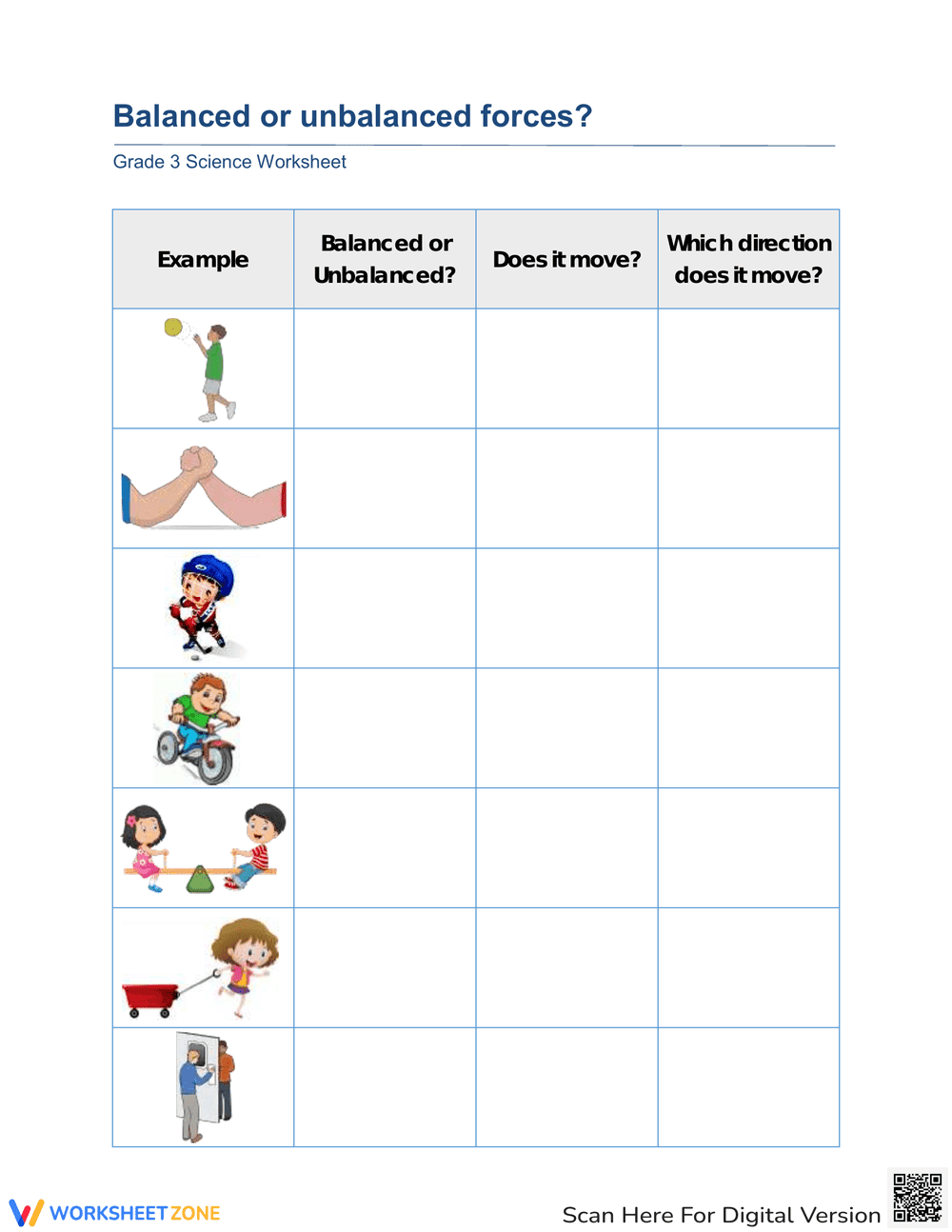
This is a science worksheet titled 'Balanced or Unbalanced Forces?'. It presents a series of illustrated examples, such as a person throwing a ball, two people arm wrestling, a person roller skating, a child riding a tricycle, children on a seesaw, a girl pulling a wagon, and people pushing a wall. Students are asked to determine if the forces in each example are balanced or unbalanced, whether the object moves, and, if it does, which direction it moves.
Grade Level Suitability:
This worksheet is suitable for Grade 3. The concepts of balanced and unbalanced forces are typically introduced at this level, and the examples provided are relatable and easy to understand for this age group.
Why Use It:
This worksheet helps students understand the difference between balanced and unbalanced forces through visual examples. It encourages critical thinking and problem-solving skills as students analyze each scenario and determine the effect of the forces involved. It reinforces the relationship between force, motion, and direction.
How to Use It:
Students should examine each picture and determine whether the forces acting on the object are balanced or unbalanced. If the forces are unbalanced, they should indicate whether the object moves and, if so, the direction of movement. The worksheet provides a table format to record answers for each example.
Target Users:
This worksheet is ideal for elementary school students, specifically those in Grade 3, who are learning about forces and motion in science. It can be used as a classroom activity, homework assignment, or review tool.
This is a science worksheet titled 'Balanced or Unbalanced Forces?'. It presents a series of illustrated examples, such as a person throwing a ball, two people arm wrestling, a person roller skating, a child riding a tricycle, children on a seesaw, a girl pulling a wagon, and people pushing a wall. Students are asked to determine if the forces in each example are balanced or unbalanced, whether the object moves, and, if it does, which direction it moves.
Grade Level Suitability:
This worksheet is suitable for Grade 3. The concepts of balanced and unbalanced forces are typically introduced at this level, and the examples provided are relatable and easy to understand for this age group.
Why Use It:
This worksheet helps students understand the difference between balanced and unbalanced forces through visual examples. It encourages critical thinking and problem-solving skills as students analyze each scenario and determine the effect of the forces involved. It reinforces the relationship between force, motion, and direction.
How to Use It:
Students should examine each picture and determine whether the forces acting on the object are balanced or unbalanced. If the forces are unbalanced, they should indicate whether the object moves and, if so, the direction of movement. The worksheet provides a table format to record answers for each example.
Target Users:
This worksheet is ideal for elementary school students, specifically those in Grade 3, who are learning about forces and motion in science. It can be used as a classroom activity, homework assignment, or review tool.


