


























1 / 5
0
Views
0
Downloads




0 Likes
Balancing Act: Chemical Equations Worksheet
0 Views
0 Downloads
Paste this activity's link or code into your existing LMS (Google Classroom, Canvas, Teams, Schoology, Moodle, etc.).
Students can open and work on the activity right away, with no student login required.
You'll still be able to track student progress and results from your teacher account.
Information
Description
What It Is:
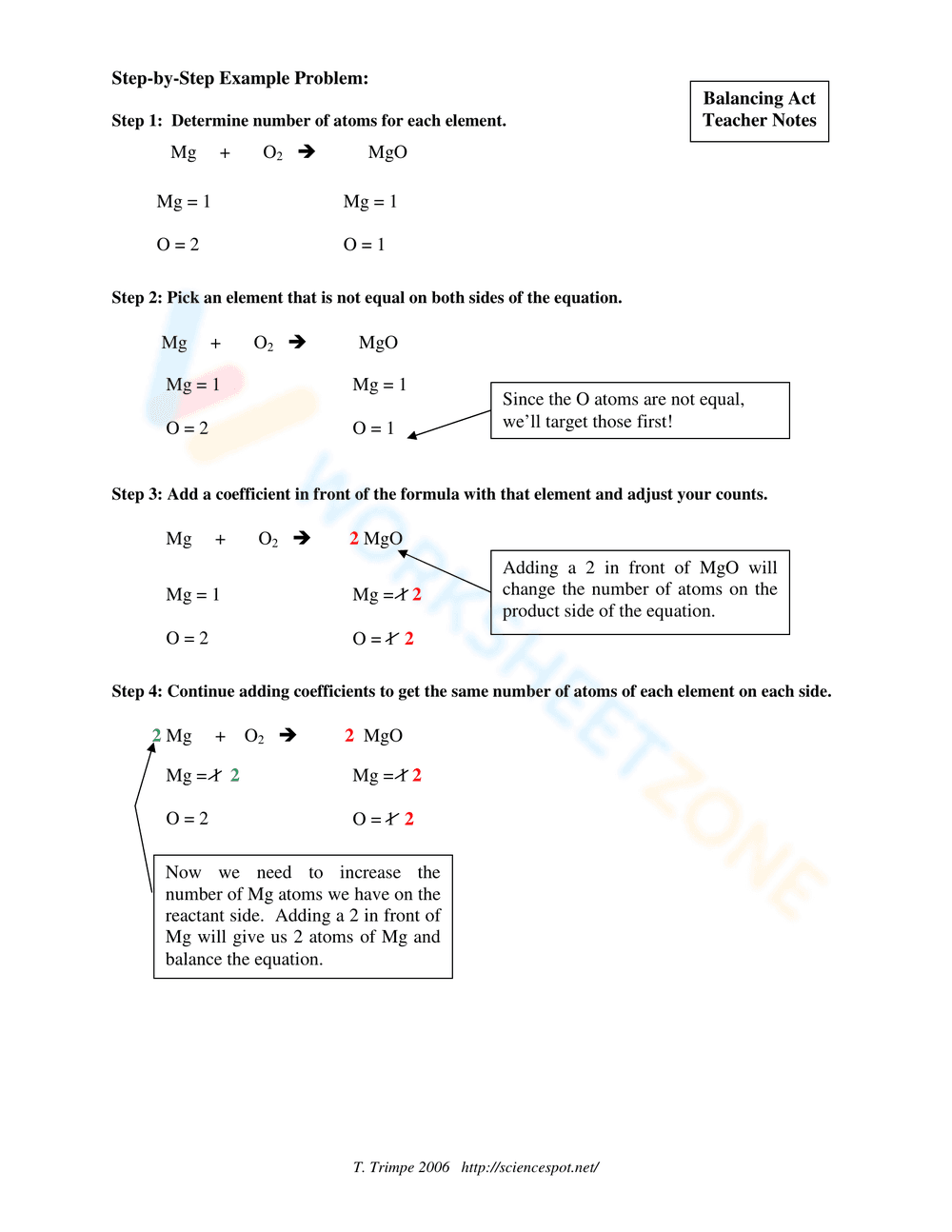
This is a chemistry worksheet titled 'Balancing Act' focused on balancing chemical equations. It starts with fill-in-the-blank questions about atoms in chemical reactions. Then, it provides a step-by-step guide on how to balance equations, including determining the number of atoms for each element, picking an unbalanced element, adding a coefficient, and continuing until all elements are balanced. Finally, it provides practice problems where students balance equations like Ca + O2 → CaO, N2 + H2 → NH3, Cu2O + C → Cu + CO2, and H2O2 → H2O + O2. Students are asked to write the number of atoms of each element on both sides of the equation.
Grade Level Suitability:
This worksheet is suitable for grades 9-12, specifically for high school chemistry students. The concepts of balancing chemical equations and understanding stoichiometry are typically taught at the high school level.
Why Use It:
This worksheet helps students understand the fundamental principle of conservation of mass in chemical reactions. It reinforces the skill of balancing chemical equations, which is essential for stoichiometry and predicting the amounts of reactants and products in a chemical reaction. It provides a structured approach with step-by-step instructions to guide students through the process.
How to Use It:
First, students should read the introductory fill-in-the-blank questions and complete them using their knowledge of chemical reactions. Then, they should follow the four-step guide to balancing equations. For each practice problem, students should count the number of atoms of each element on both sides of the equation and write them down. Then, they should add coefficients in front of the chemical formulas to balance the number of atoms of each element. Finally, they should rewrite the balanced equation.
Target Users:
The target users are high school chemistry students who are learning how to balance chemical equations. It can also be used as a review for students who need to reinforce their understanding of balancing equations. Chemistry teachers can use this as a classroom activity, homework assignment, or quiz.
This is a chemistry worksheet titled 'Balancing Act' focused on balancing chemical equations. It starts with fill-in-the-blank questions about atoms in chemical reactions. Then, it provides a step-by-step guide on how to balance equations, including determining the number of atoms for each element, picking an unbalanced element, adding a coefficient, and continuing until all elements are balanced. Finally, it provides practice problems where students balance equations like Ca + O2 → CaO, N2 + H2 → NH3, Cu2O + C → Cu + CO2, and H2O2 → H2O + O2. Students are asked to write the number of atoms of each element on both sides of the equation.
Grade Level Suitability:
This worksheet is suitable for grades 9-12, specifically for high school chemistry students. The concepts of balancing chemical equations and understanding stoichiometry are typically taught at the high school level.
Why Use It:
This worksheet helps students understand the fundamental principle of conservation of mass in chemical reactions. It reinforces the skill of balancing chemical equations, which is essential for stoichiometry and predicting the amounts of reactants and products in a chemical reaction. It provides a structured approach with step-by-step instructions to guide students through the process.
How to Use It:
First, students should read the introductory fill-in-the-blank questions and complete them using their knowledge of chemical reactions. Then, they should follow the four-step guide to balancing equations. For each practice problem, students should count the number of atoms of each element on both sides of the equation and write them down. Then, they should add coefficients in front of the chemical formulas to balance the number of atoms of each element. Finally, they should rewrite the balanced equation.
Target Users:
The target users are high school chemistry students who are learning how to balance chemical equations. It can also be used as a review for students who need to reinforce their understanding of balancing equations. Chemistry teachers can use this as a classroom activity, homework assignment, or quiz.


