


























1 / 3
0
Views
0
Plays



0.0
0
0 Likes
Renaissance History Quiz
0 Views
0 Plays
Paste this activity's link or code into your existing LMS (Google Classroom, Canvas, Teams, Schoology, Moodle, etc.).
Students can open and work on the activity right away, with no student login required.
You'll still be able to track student progress and results from your teacher account.
Information
Description
What It Is:
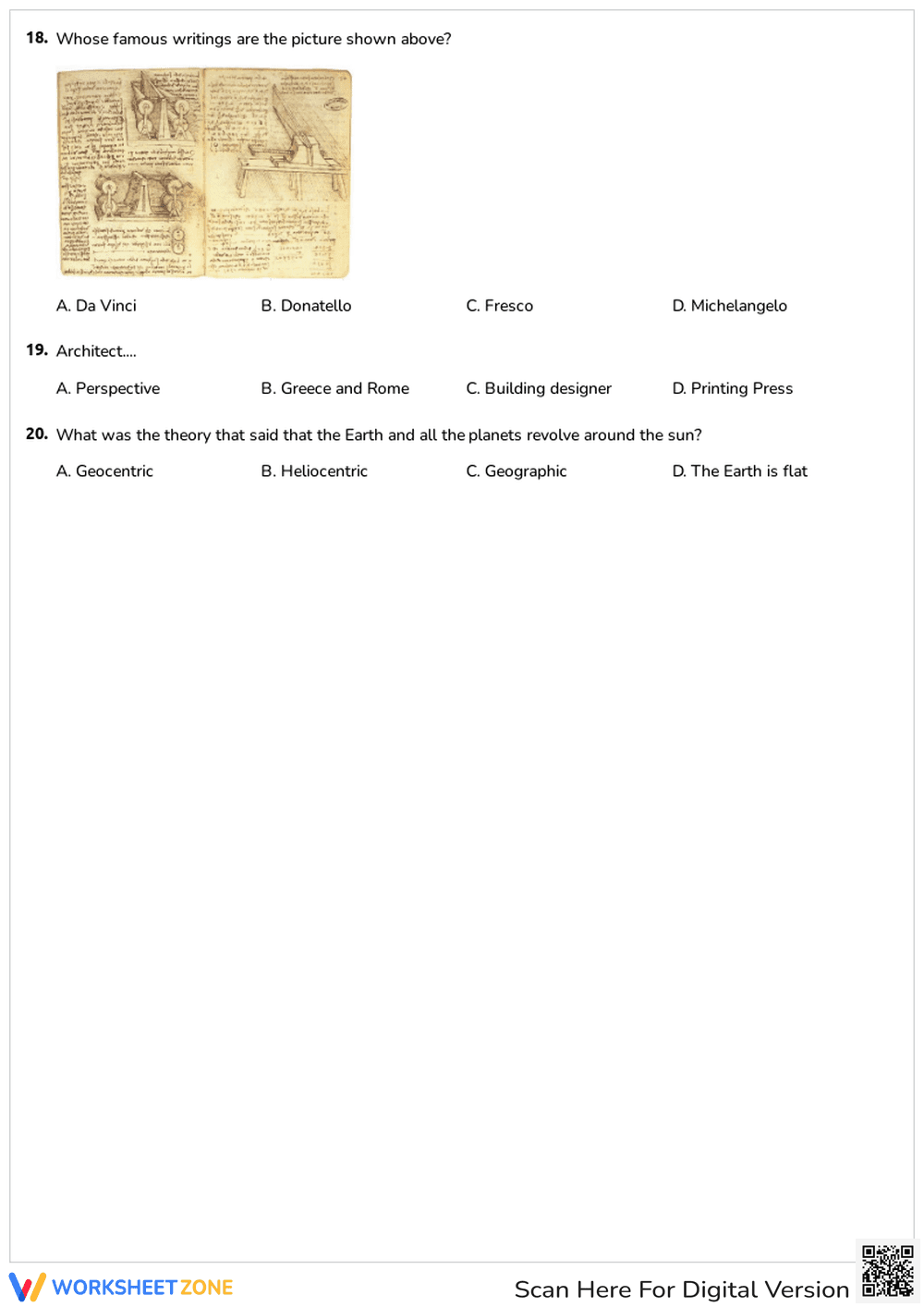
This is a worksheet featuring sketches and notes, resembling pages from a notebook. It contains technical drawings of what appears to be mechanical devices, including rollers, gears, and levers. There are handwritten notes and calculations alongside the diagrams, possibly related to the design or function of the illustrated machines.
Grade Level Suitability:
This worksheet is most suitable for high school (Grades 9-12) and college-level students. The complexity of the mechanical drawings and the presence of calculations suggest a need for advanced understanding of physics, engineering, or technical drawing principles. It would also be suitable for adults interested in history of science or Leonardo da Vinci.
Why Use It:
This worksheet can be used to explore historical engineering concepts, demonstrate the creative process of invention, and analyze mechanical systems. It helps students develop visual literacy, critical thinking, and problem-solving skills. It can also be used to inspire interest in STEM fields by showcasing the work of a renowned inventor.
How to Use It:
Students can analyze the drawings to understand how the depicted machines function. They can attempt to recreate the calculations to understand the underlying principles. The worksheet can be used as a starting point for research into the history of technology or as inspiration for designing their own mechanical devices.
Target Users:
This worksheet is targeted towards students of engineering, physics, history of science, and art. It is also suitable for hobbyists, inventors, and anyone interested in Leonardo da Vinci's notebooks and mechanical inventions.
This is a worksheet featuring sketches and notes, resembling pages from a notebook. It contains technical drawings of what appears to be mechanical devices, including rollers, gears, and levers. There are handwritten notes and calculations alongside the diagrams, possibly related to the design or function of the illustrated machines.
Grade Level Suitability:
This worksheet is most suitable for high school (Grades 9-12) and college-level students. The complexity of the mechanical drawings and the presence of calculations suggest a need for advanced understanding of physics, engineering, or technical drawing principles. It would also be suitable for adults interested in history of science or Leonardo da Vinci.
Why Use It:
This worksheet can be used to explore historical engineering concepts, demonstrate the creative process of invention, and analyze mechanical systems. It helps students develop visual literacy, critical thinking, and problem-solving skills. It can also be used to inspire interest in STEM fields by showcasing the work of a renowned inventor.
How to Use It:
Students can analyze the drawings to understand how the depicted machines function. They can attempt to recreate the calculations to understand the underlying principles. The worksheet can be used as a starting point for research into the history of technology or as inspiration for designing their own mechanical devices.
Target Users:
This worksheet is targeted towards students of engineering, physics, history of science, and art. It is also suitable for hobbyists, inventors, and anyone interested in Leonardo da Vinci's notebooks and mechanical inventions.


