


























1 / 2
0
Views
0
Downloads

0 Likes
Behavior Chain Analysis Worksheet for Problematic Behavior
0 Views
0 Downloads
Paste this activity's link or code into your existing LMS (Google Classroom, Canvas, Teams, Schoology, Moodle, etc.).
Students can open and work on the activity right away, with no student login required.
You'll still be able to track student progress and results from your teacher account.
Information
Description
What It Is:
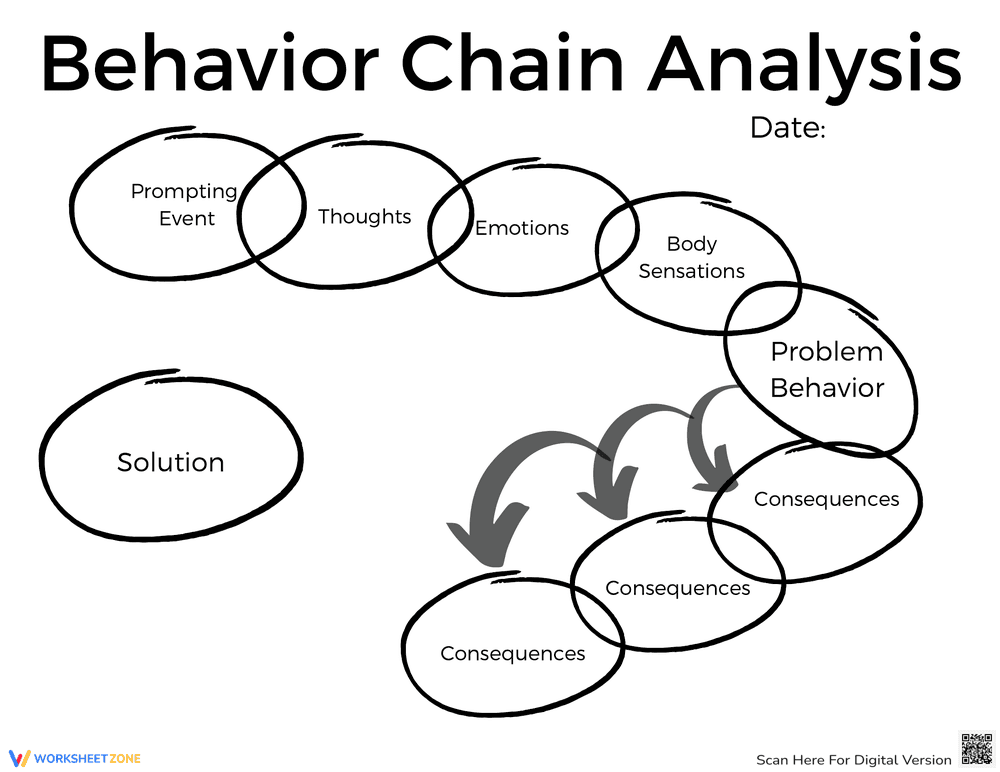
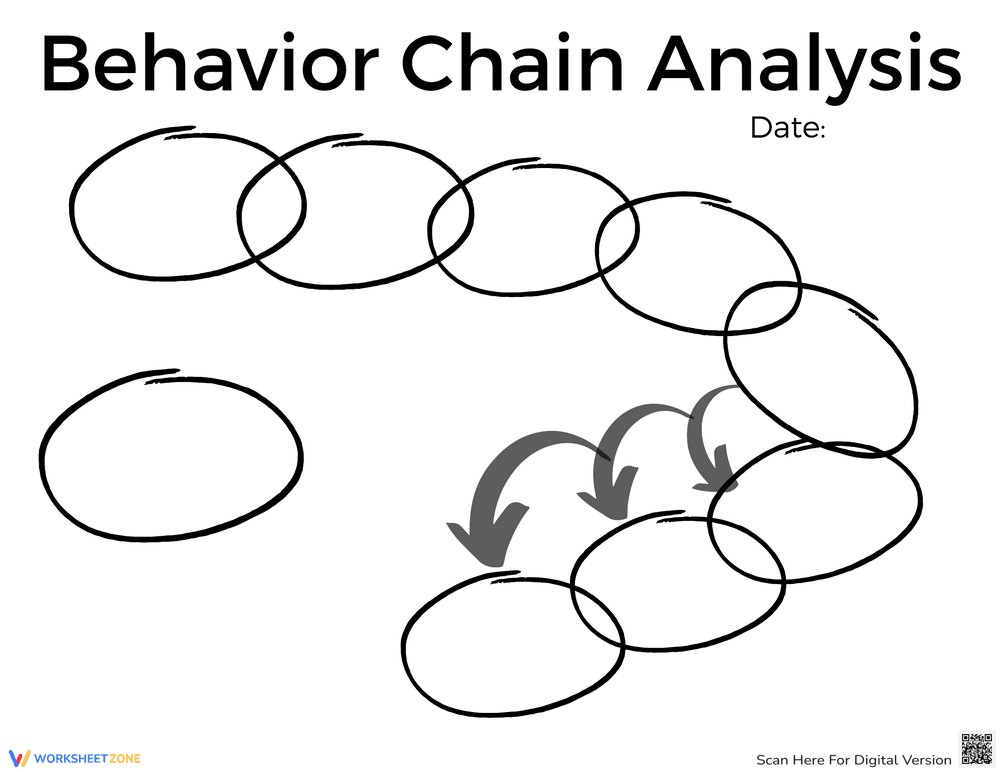
This is a Behavior Chain Analysis worksheet. It provides a template for mapping out a sequence of events leading to a problem behavior. The worksheet includes labeled circles to represent the 'Prompting Event,' 'Thoughts,' 'Emotions,' 'Body Sensations,' 'Problem Behavior,' 'Consequences,' and a 'Solution.' Arrows connect the 'Problem Behavior' to multiple 'Consequences' circles. A separate 'Solution' circle is present. There is a space for the date at the top right.
Grade Level Suitability:
This worksheet is suitable for upper elementary (grades 4-5), middle school (grades 6-8), and high school (grades 9-12), and even adult learners. The concepts are relatively straightforward, but require self-reflection and critical thinking, making it adaptable for various age groups and levels of cognitive development. It is especially useful for social-emotional learning.
Why Use It:
This worksheet helps individuals understand the chain of events that contribute to a specific behavior. It encourages self-awareness by prompting users to identify their thoughts, emotions, and physical sensations that precede a behavior. It also promotes problem-solving by encouraging the identification of potential solutions. Analyzing consequences helps in understanding the impact of the behavior.
How to Use It:
Begin by identifying the 'Problem Behavior' you want to analyze. Then, work backwards to identify the 'Prompting Event' that triggered the chain. Fill in the 'Thoughts,' 'Emotions,' and 'Body Sensations' experienced between the prompting event and the behavior. Next, list the 'Consequences' of the behavior. Finally, brainstorm and write down a 'Solution' that could break the chain in the future.
Target Users:
This worksheet is beneficial for students, individuals in therapy, or anyone seeking to understand and modify their behavior patterns. It can be used by educators, counselors, therapists, or individuals working on self-improvement. It's also useful for individuals with anger management issues, anxiety, or other emotional regulation challenges.
This is a Behavior Chain Analysis worksheet. It provides a template for mapping out a sequence of events leading to a problem behavior. The worksheet includes labeled circles to represent the 'Prompting Event,' 'Thoughts,' 'Emotions,' 'Body Sensations,' 'Problem Behavior,' 'Consequences,' and a 'Solution.' Arrows connect the 'Problem Behavior' to multiple 'Consequences' circles. A separate 'Solution' circle is present. There is a space for the date at the top right.
Grade Level Suitability:
This worksheet is suitable for upper elementary (grades 4-5), middle school (grades 6-8), and high school (grades 9-12), and even adult learners. The concepts are relatively straightforward, but require self-reflection and critical thinking, making it adaptable for various age groups and levels of cognitive development. It is especially useful for social-emotional learning.
Why Use It:
This worksheet helps individuals understand the chain of events that contribute to a specific behavior. It encourages self-awareness by prompting users to identify their thoughts, emotions, and physical sensations that precede a behavior. It also promotes problem-solving by encouraging the identification of potential solutions. Analyzing consequences helps in understanding the impact of the behavior.
How to Use It:
Begin by identifying the 'Problem Behavior' you want to analyze. Then, work backwards to identify the 'Prompting Event' that triggered the chain. Fill in the 'Thoughts,' 'Emotions,' and 'Body Sensations' experienced between the prompting event and the behavior. Next, list the 'Consequences' of the behavior. Finally, brainstorm and write down a 'Solution' that could break the chain in the future.
Target Users:
This worksheet is beneficial for students, individuals in therapy, or anyone seeking to understand and modify their behavior patterns. It can be used by educators, counselors, therapists, or individuals working on self-improvement. It's also useful for individuals with anger management issues, anxiety, or other emotional regulation challenges.


