


























0
Views
0
Downloads

0.0
0
0 Likes
Behavior Chain Analysis Worksheet
0 Views
0 Downloads
Paste this activity's link or code into your existing LMS (Google Classroom, Canvas, Teams, Schoology, Moodle, etc.).
Students can open and work on the activity right away, with no student login required.
You'll still be able to track student progress and results from your teacher account.
Information
Description
What It Is:
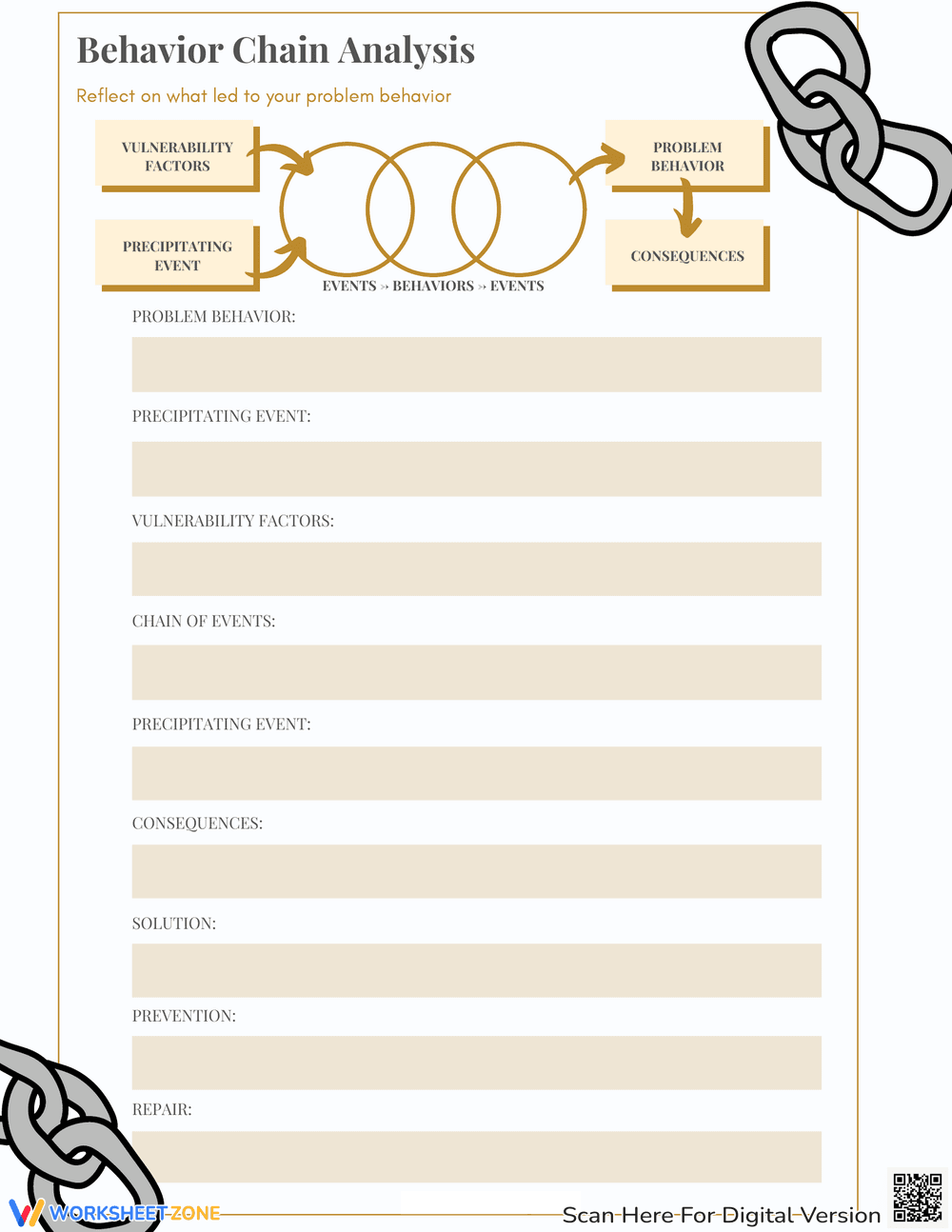
This is a Behavior Chain Analysis worksheet designed to help individuals reflect on the factors that contribute to problem behaviors. It includes a diagram illustrating the sequence of events leading to a problem behavior, starting with vulnerability factors and precipitating events, followed by a chain of events (events, behaviors, events), and culminating in the problem behavior and its consequences. The worksheet provides fill-in-the-blank sections to record the problem behavior, precipitating event, vulnerability factors, chain of events, consequences, potential solutions, prevention strategies, and repair actions.
Grade Level Suitability:
This worksheet is suitable for high school students and adults. The concepts involved require a level of self-awareness and critical thinking typically developed in older adolescents and adults. It's appropriate for social-emotional learning and therapeutic settings.
Why Use It:
This worksheet helps users to understand the root causes and triggers of problem behaviors. By identifying the chain of events, vulnerability factors, and consequences, individuals can develop strategies for preventing or modifying these behaviors. It promotes self-reflection, problem-solving, and the development of coping mechanisms.
How to Use It:
Begin by identifying the problem behavior. Then, work backward to identify the precipitating event and any vulnerability factors that made the individual more susceptible to the behavior. Next, map out the chain of events that led to the problem behavior, focusing on specific events and behaviors. Finally, consider the consequences of the behavior and brainstorm potential solutions, prevention strategies, and actions to repair any damage caused.
Target Users:
This worksheet is ideal for therapists, counselors, social workers, educators, and individuals seeking to understand and manage their own behavior. It can be used in individual therapy, group therapy, or as a self-help tool.
This is a Behavior Chain Analysis worksheet designed to help individuals reflect on the factors that contribute to problem behaviors. It includes a diagram illustrating the sequence of events leading to a problem behavior, starting with vulnerability factors and precipitating events, followed by a chain of events (events, behaviors, events), and culminating in the problem behavior and its consequences. The worksheet provides fill-in-the-blank sections to record the problem behavior, precipitating event, vulnerability factors, chain of events, consequences, potential solutions, prevention strategies, and repair actions.
Grade Level Suitability:
This worksheet is suitable for high school students and adults. The concepts involved require a level of self-awareness and critical thinking typically developed in older adolescents and adults. It's appropriate for social-emotional learning and therapeutic settings.
Why Use It:
This worksheet helps users to understand the root causes and triggers of problem behaviors. By identifying the chain of events, vulnerability factors, and consequences, individuals can develop strategies for preventing or modifying these behaviors. It promotes self-reflection, problem-solving, and the development of coping mechanisms.
How to Use It:
Begin by identifying the problem behavior. Then, work backward to identify the precipitating event and any vulnerability factors that made the individual more susceptible to the behavior. Next, map out the chain of events that led to the problem behavior, focusing on specific events and behaviors. Finally, consider the consequences of the behavior and brainstorm potential solutions, prevention strategies, and actions to repair any damage caused.
Target Users:
This worksheet is ideal for therapists, counselors, social workers, educators, and individuals seeking to understand and manage their own behavior. It can be used in individual therapy, group therapy, or as a self-help tool.


