


























0
Views
0
Downloads

0.0
0
0 Likes
Bohr Model Worksheet
0 Views
0 Downloads
Paste this activity's link or code into your existing LMS (Google Classroom, Canvas, Teams, Schoology, Moodle, etc.).
Students can open and work on the activity right away, with no student login required.
You'll still be able to track student progress and results from your teacher account.
Information
Description
What It Is:
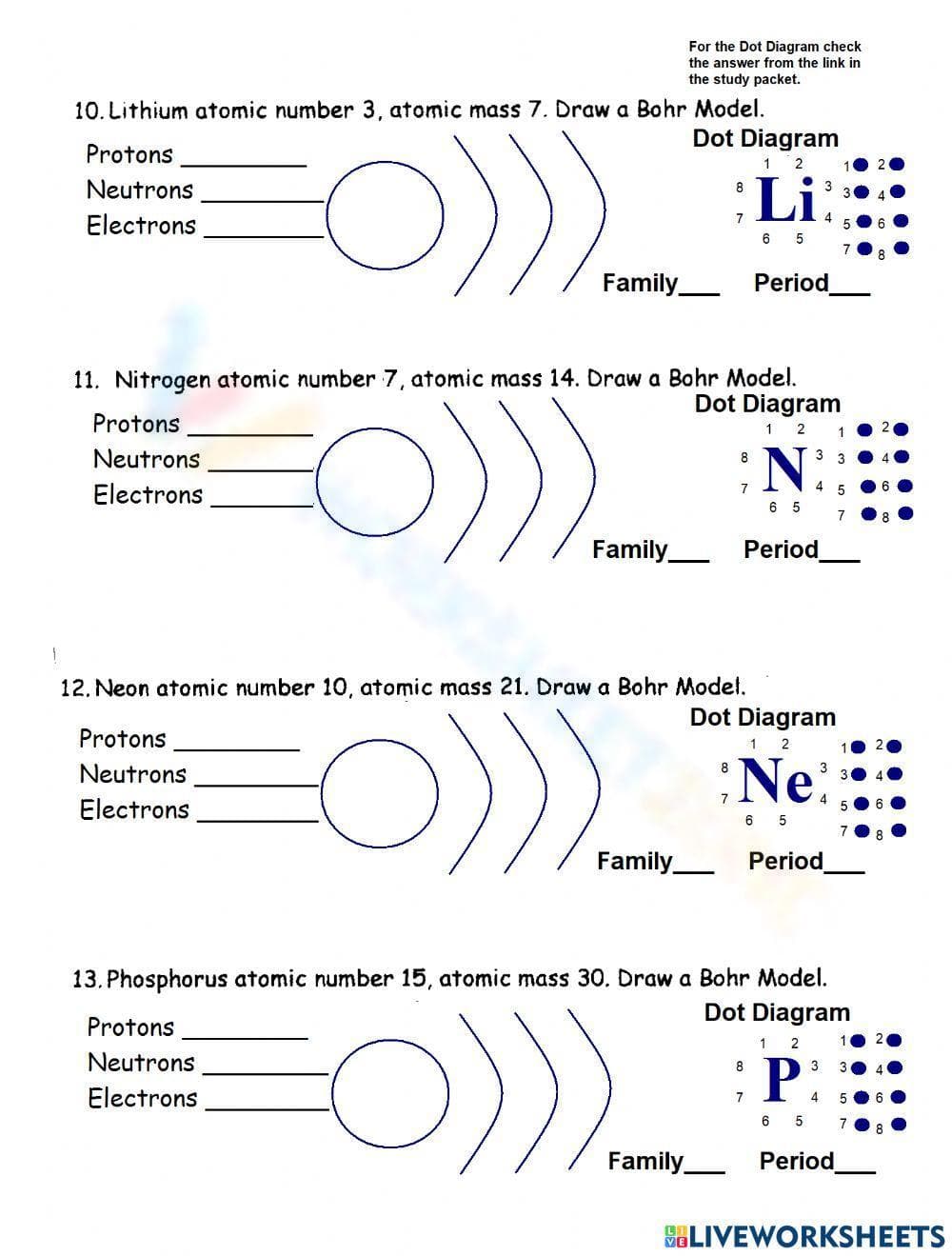
This is a chemistry worksheet focused on atomic structure. Students are asked to determine the number of protons, neutrons, and electrons for the elements Lithium, Nitrogen, Neon, and Phosphorus based on their atomic number and atomic mass. They are then instructed to draw a Bohr model of the atom and fill in a dot diagram. Finally, they must identify the family and period of each element.
Grade Level Suitability:
This worksheet is most suitable for grades 8-10. It requires an understanding of atomic structure, including protons, neutrons, electrons, atomic number, and atomic mass, which are typically covered in middle school and early high school science courses. The Bohr model and dot diagram concepts are also typically introduced at this level.
Why Use It:
This worksheet reinforces understanding of atomic structure by requiring students to apply their knowledge to specific elements. It provides practice in calculating the number of subatomic particles, visualizing the Bohr model, and relating atomic structure to the periodic table. The dot diagram exercise helps visualize valence electrons.
How to Use It:
Students should first calculate the number of protons, neutrons, and electrons for each element using the provided atomic number and atomic mass. Next, they should draw the Bohr model, placing the correct number of electrons in the appropriate energy levels. Then, they should complete the dot diagram to show valence electrons. Finally, they should use a periodic table to determine the family and period of each element and fill in the blanks.
Target Users:
The target users are middle school and high school students learning about atomic structure and the periodic table in a science or chemistry class. This worksheet is also useful for students reviewing these concepts.
This is a chemistry worksheet focused on atomic structure. Students are asked to determine the number of protons, neutrons, and electrons for the elements Lithium, Nitrogen, Neon, and Phosphorus based on their atomic number and atomic mass. They are then instructed to draw a Bohr model of the atom and fill in a dot diagram. Finally, they must identify the family and period of each element.
Grade Level Suitability:
This worksheet is most suitable for grades 8-10. It requires an understanding of atomic structure, including protons, neutrons, electrons, atomic number, and atomic mass, which are typically covered in middle school and early high school science courses. The Bohr model and dot diagram concepts are also typically introduced at this level.
Why Use It:
This worksheet reinforces understanding of atomic structure by requiring students to apply their knowledge to specific elements. It provides practice in calculating the number of subatomic particles, visualizing the Bohr model, and relating atomic structure to the periodic table. The dot diagram exercise helps visualize valence electrons.
How to Use It:
Students should first calculate the number of protons, neutrons, and electrons for each element using the provided atomic number and atomic mass. Next, they should draw the Bohr model, placing the correct number of electrons in the appropriate energy levels. Then, they should complete the dot diagram to show valence electrons. Finally, they should use a periodic table to determine the family and period of each element and fill in the blanks.
Target Users:
The target users are middle school and high school students learning about atomic structure and the periodic table in a science or chemistry class. This worksheet is also useful for students reviewing these concepts.


