


























0
Views
0
Downloads

0.0
0
0 Likes
Explore Boyle's Law with This Worksheet
0 Views
0 Downloads
Paste this activity's link or code into your existing LMS (Google Classroom, Canvas, Teams, Schoology, Moodle, etc.).
Students can open and work on the activity right away, with no student login required.
You'll still be able to track student progress and results from your teacher account.
Information
Description
What It Is:
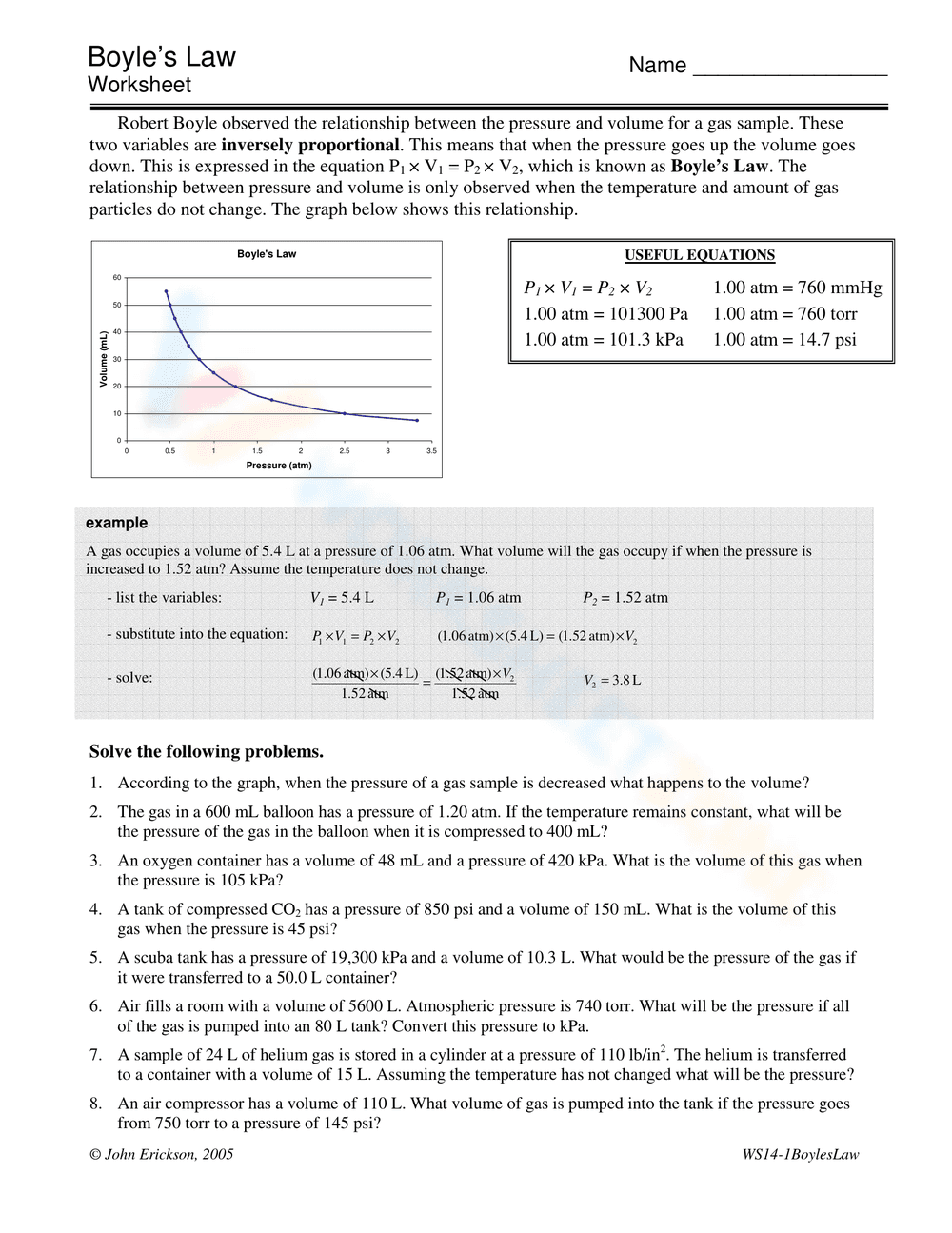
This is a Boyle's Law worksheet. It includes a brief explanation of Boyle's Law and the inverse relationship between pressure and volume of a gas. It shows the formula P1V1 = P2V2 and provides some useful equations converting between atmospheres, mmHg, torr, and kPa. An example problem is worked out, demonstrating how to solve for an unknown volume. Finally, there are eight word problems requiring the student to apply Boyle's Law to calculate either pressure or volume. A graph showing the inverse relationship between pressure and volume is also included.
Grade Level Suitability:
This worksheet is most suitable for high school students, specifically grades 9-12, taking chemistry or physics. It requires an understanding of algebraic equations and gas laws, which are typically covered in these grades.
Why Use It:
This worksheet helps students understand and apply Boyle's Law. It provides a clear explanation of the concept, a worked example, and practice problems to reinforce learning. It allows students to develop problem-solving skills and understand the relationship between pressure and volume of gases.
How to Use It:
Begin by reading the explanation of Boyle's Law and reviewing the formula. Study the worked example to understand the problem-solving process. Then, attempt to solve the eight problems provided, showing your work. Use the provided conversion equations as needed. Check your answers with an answer key or teacher.
Target Users:
This worksheet is designed for high school students learning about gas laws in chemistry or physics. It is also suitable for teachers looking for practice problems to assign to their students. Homeschooling parents can also use it as part of their science curriculum.
This is a Boyle's Law worksheet. It includes a brief explanation of Boyle's Law and the inverse relationship between pressure and volume of a gas. It shows the formula P1V1 = P2V2 and provides some useful equations converting between atmospheres, mmHg, torr, and kPa. An example problem is worked out, demonstrating how to solve for an unknown volume. Finally, there are eight word problems requiring the student to apply Boyle's Law to calculate either pressure or volume. A graph showing the inverse relationship between pressure and volume is also included.
Grade Level Suitability:
This worksheet is most suitable for high school students, specifically grades 9-12, taking chemistry or physics. It requires an understanding of algebraic equations and gas laws, which are typically covered in these grades.
Why Use It:
This worksheet helps students understand and apply Boyle's Law. It provides a clear explanation of the concept, a worked example, and practice problems to reinforce learning. It allows students to develop problem-solving skills and understand the relationship between pressure and volume of gases.
How to Use It:
Begin by reading the explanation of Boyle's Law and reviewing the formula. Study the worked example to understand the problem-solving process. Then, attempt to solve the eight problems provided, showing your work. Use the provided conversion equations as needed. Check your answers with an answer key or teacher.
Target Users:
This worksheet is designed for high school students learning about gas laws in chemistry or physics. It is also suitable for teachers looking for practice problems to assign to their students. Homeschooling parents can also use it as part of their science curriculum.


