


























0
Views
0
Downloads

0.0
0
0 Likes
Capitalize with Kit the Cat: Part 1 Worksheet
0 Views
0 Downloads
Paste this activity's link or code into your existing LMS (Google Classroom, Canvas, Teams, Schoology, Moodle, etc.).
Students can open and work on the activity right away, with no student login required.
You'll still be able to track student progress and results from your teacher account.
Information
Description
What It Is:
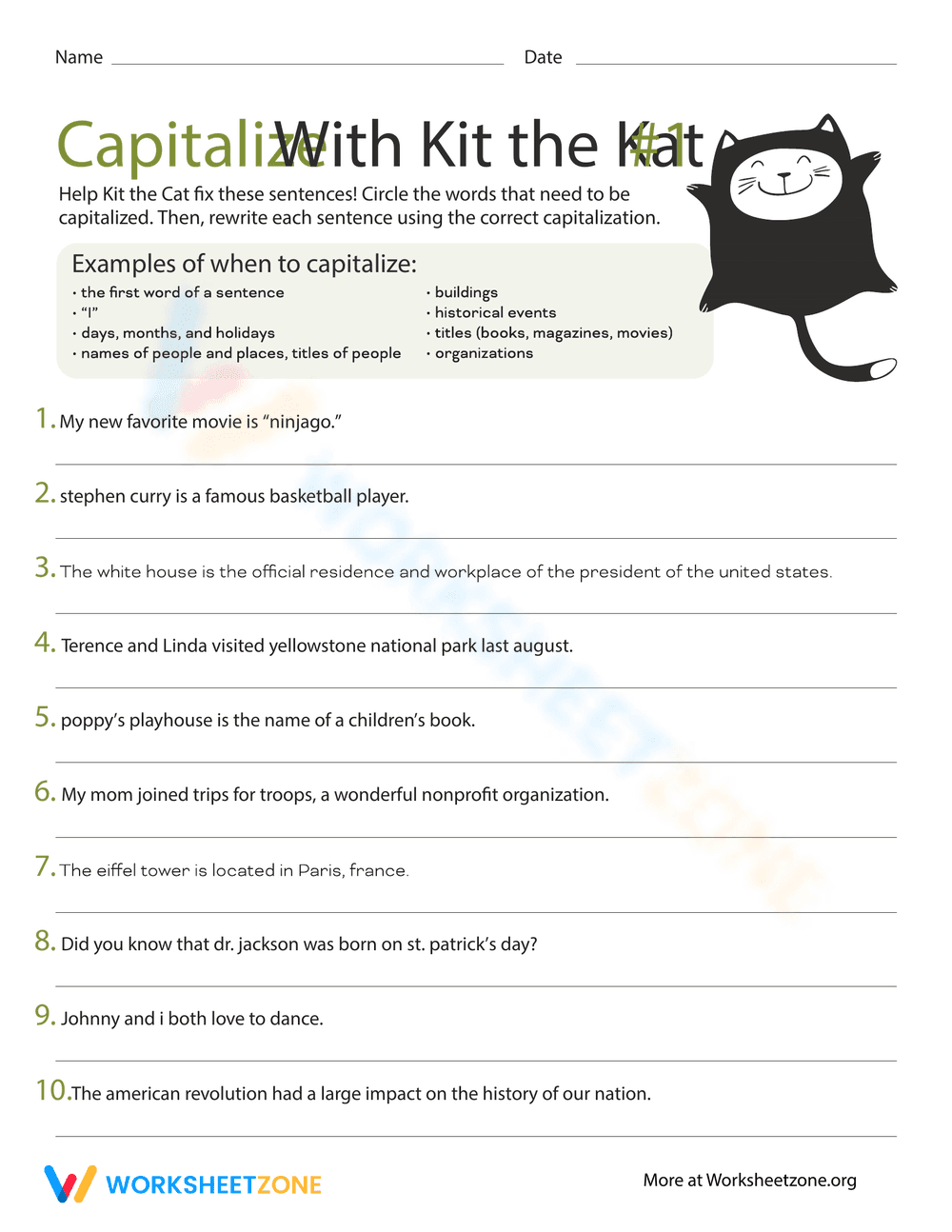
This is a capitalization worksheet featuring 'Kit the Kat.' The worksheet provides examples of when to capitalize words, including the first word of a sentence, days/months/holidays, names of people/places/titles, buildings, historical events, titles (books, magazines, movies), and organizations. Students are instructed to circle the words needing capitalization in ten sentences and then rewrite the sentences with correct capitalization.
Grade Level Suitability:
This worksheet is suitable for 2nd grade, 3rd grade, and 4th grade students. It reinforces basic capitalization rules and provides practice in identifying and correcting capitalization errors within sentences. The sentences are relatively simple, making it accessible to younger learners while still offering a challenge.
Why Use It:
This worksheet helps students master capitalization rules, improve their writing skills, and enhance their attention to detail. It provides a structured approach to learning capitalization, with clear examples and practice exercises. It also reinforces vocabulary and sentence structure.
How to Use It:
First, review the 'Examples of when to capitalize' section with the student. Then, have the student read each sentence carefully and circle the words that need to be capitalized. Finally, have the student rewrite each sentence on a separate sheet of paper, ensuring that all necessary words are capitalized correctly.
Target Users:
This worksheet is ideal for elementary school students learning or reviewing capitalization rules. It can be used by teachers in the classroom, tutors providing individualized instruction, or parents supporting their child's learning at home. It is also beneficial for students who need extra practice with grammar and writing conventions.
This is a capitalization worksheet featuring 'Kit the Kat.' The worksheet provides examples of when to capitalize words, including the first word of a sentence, days/months/holidays, names of people/places/titles, buildings, historical events, titles (books, magazines, movies), and organizations. Students are instructed to circle the words needing capitalization in ten sentences and then rewrite the sentences with correct capitalization.
Grade Level Suitability:
This worksheet is suitable for 2nd grade, 3rd grade, and 4th grade students. It reinforces basic capitalization rules and provides practice in identifying and correcting capitalization errors within sentences. The sentences are relatively simple, making it accessible to younger learners while still offering a challenge.
Why Use It:
This worksheet helps students master capitalization rules, improve their writing skills, and enhance their attention to detail. It provides a structured approach to learning capitalization, with clear examples and practice exercises. It also reinforces vocabulary and sentence structure.
How to Use It:
First, review the 'Examples of when to capitalize' section with the student. Then, have the student read each sentence carefully and circle the words that need to be capitalized. Finally, have the student rewrite each sentence on a separate sheet of paper, ensuring that all necessary words are capitalized correctly.
Target Users:
This worksheet is ideal for elementary school students learning or reviewing capitalization rules. It can be used by teachers in the classroom, tutors providing individualized instruction, or parents supporting their child's learning at home. It is also beneficial for students who need extra practice with grammar and writing conventions.


