


























1 / 2
0
Views
0
Downloads

0.0
0
0 Likes
Understanding Challenging Behavior: Meaning Making Machine
0 Views
0 Downloads
Paste this activity's link or code into your existing LMS (Google Classroom, Canvas, Teams, Schoology, Moodle, etc.).
Students can open and work on the activity right away, with no student login required.
You'll still be able to track student progress and results from your teacher account.
Information
Description
What It Is:
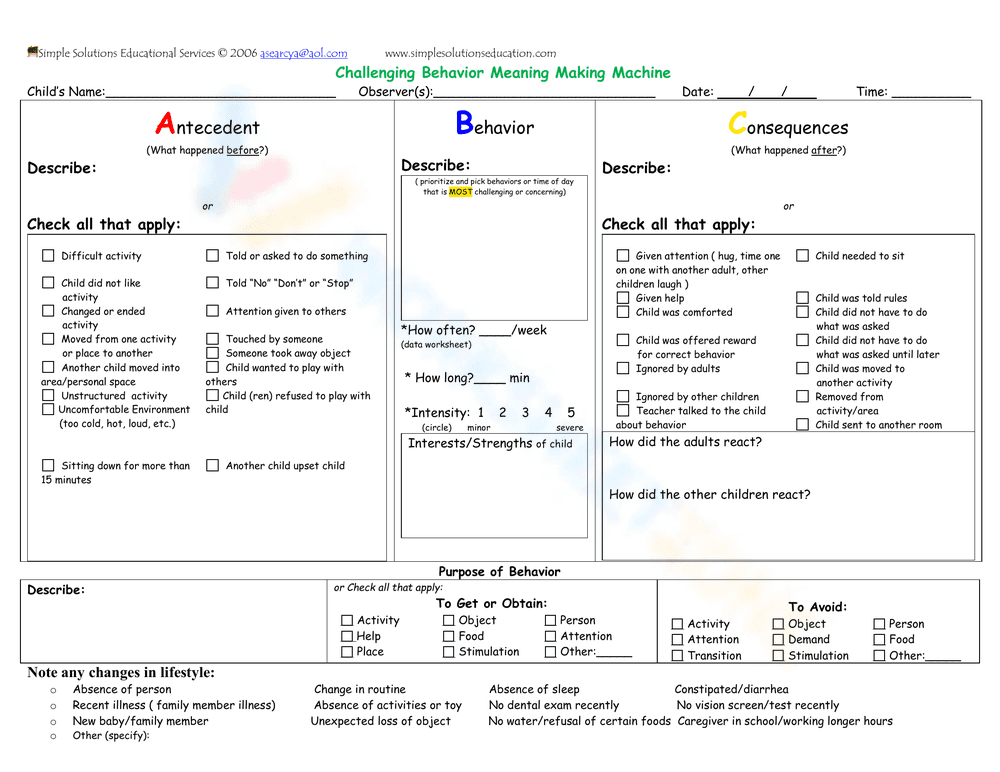
The image shows a worksheet titled 'Challenging Behavior Meaning Making Machine.' It is organized into three main sections labeled 'Antecedent (What happened before?)', 'Behavior (Describe the challenging or concerning behavior)', and 'Consequences (What happened after?)'. Each section includes a 'Describe' area for written observations and a checklist of common factors. The 'Antecedent' section has checkboxes related to activity, environment, and interactions. The 'Behavior' section includes prompts for frequency, duration, and intensity of the behavior. The 'Consequences' section has checkboxes related to adult and peer reactions, rewards, and punishments. At the bottom, there's a section to identify the 'Purpose of Behavior' (to get/obtain or to avoid) and a 'Note any changes in lifestyle' section.
Grade Level Suitability:
This worksheet is not grade-level specific in the traditional sense. It's designed for educators, therapists, or parents working with children exhibiting challenging behaviors, primarily in early childhood or elementary grades. The focus is on observation and data collection rather than academic skills.
Why Use It:
This worksheet helps to systematically analyze challenging behaviors by identifying patterns and triggers. It allows for a structured approach to understanding the function of a behavior (what the child is trying to gain or avoid), which is crucial for developing effective intervention strategies. It also encourages observation of environmental and lifestyle factors that may contribute to the behavior.
How to Use It:
Observe the child's behavior and complete the worksheet as soon as possible after an incident. In the 'Antecedent' section, describe the events that occurred immediately before the behavior. In the 'Behavior' section, describe the behavior itself and note its frequency, duration, and intensity. In the 'Consequences' section, describe what happened immediately after the behavior, including reactions from adults and peers. Check the boxes that apply in each section. Analyze the completed worksheet to identify potential patterns and the purpose of the behavior.
Target Users:
This worksheet is primarily intended for use by educators, special education teachers, therapists, psychologists, counselors, and parents who are working with children exhibiting challenging behaviors. It is suitable for those who need a structured method for observing, recording, and analyzing behavioral data.
The image shows a worksheet titled 'Challenging Behavior Meaning Making Machine.' It is organized into three main sections labeled 'Antecedent (What happened before?)', 'Behavior (Describe the challenging or concerning behavior)', and 'Consequences (What happened after?)'. Each section includes a 'Describe' area for written observations and a checklist of common factors. The 'Antecedent' section has checkboxes related to activity, environment, and interactions. The 'Behavior' section includes prompts for frequency, duration, and intensity of the behavior. The 'Consequences' section has checkboxes related to adult and peer reactions, rewards, and punishments. At the bottom, there's a section to identify the 'Purpose of Behavior' (to get/obtain or to avoid) and a 'Note any changes in lifestyle' section.
Grade Level Suitability:
This worksheet is not grade-level specific in the traditional sense. It's designed for educators, therapists, or parents working with children exhibiting challenging behaviors, primarily in early childhood or elementary grades. The focus is on observation and data collection rather than academic skills.
Why Use It:
This worksheet helps to systematically analyze challenging behaviors by identifying patterns and triggers. It allows for a structured approach to understanding the function of a behavior (what the child is trying to gain or avoid), which is crucial for developing effective intervention strategies. It also encourages observation of environmental and lifestyle factors that may contribute to the behavior.
How to Use It:
Observe the child's behavior and complete the worksheet as soon as possible after an incident. In the 'Antecedent' section, describe the events that occurred immediately before the behavior. In the 'Behavior' section, describe the behavior itself and note its frequency, duration, and intensity. In the 'Consequences' section, describe what happened immediately after the behavior, including reactions from adults and peers. Check the boxes that apply in each section. Analyze the completed worksheet to identify potential patterns and the purpose of the behavior.
Target Users:
This worksheet is primarily intended for use by educators, special education teachers, therapists, psychologists, counselors, and parents who are working with children exhibiting challenging behaviors. It is suitable for those who need a structured method for observing, recording, and analyzing behavioral data.


