


























1 / 2
0
Views
0
Downloads

0 Likes
Charles's Law Activity
0 Views
0 Downloads
Paste this activity's link or code into your existing LMS (Google Classroom, Canvas, Teams, Schoology, Moodle, etc.).
Students can open and work on the activity right away, with no student login required.
You'll still be able to track student progress and results from your teacher account.
Information
Description
What It Is:
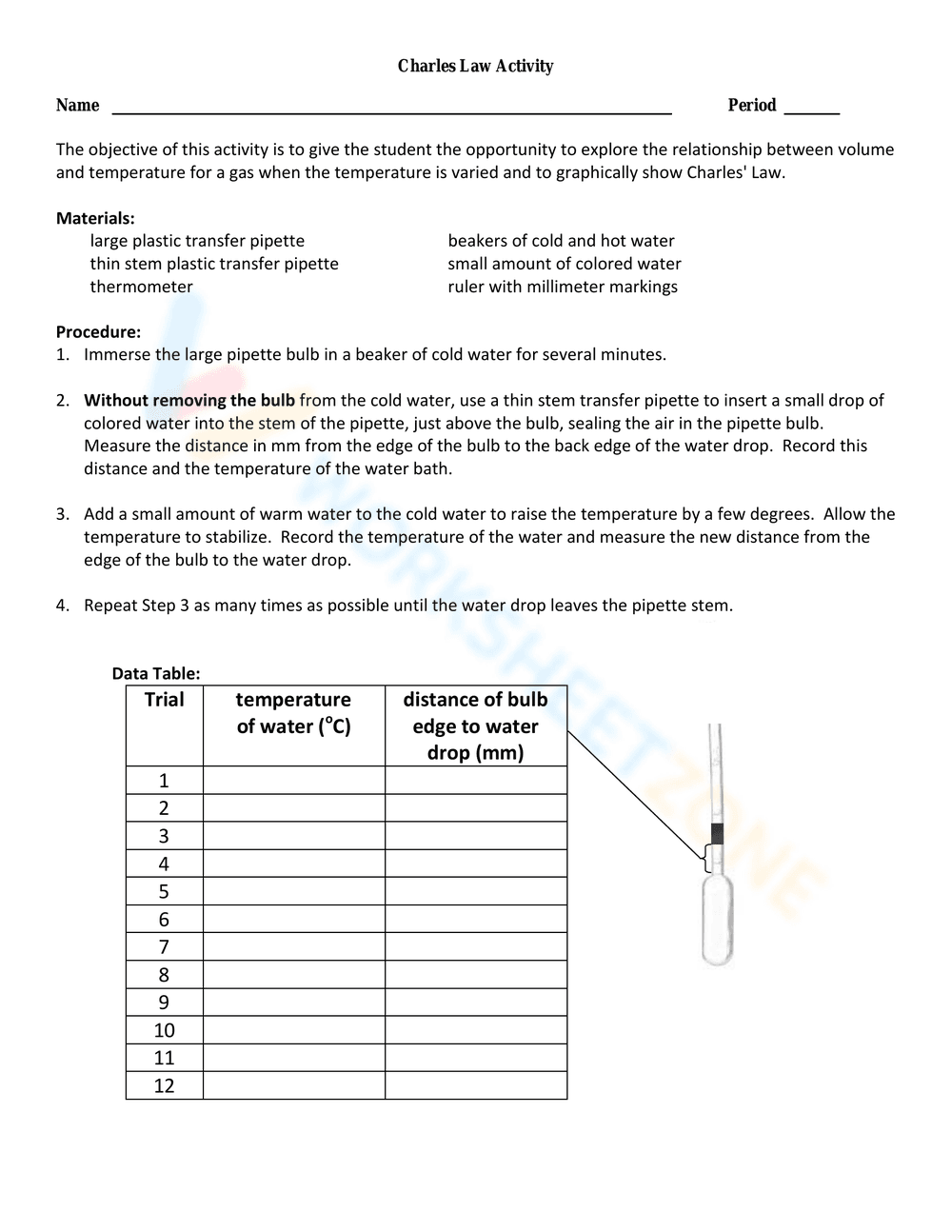
This is a science worksheet for a Charles' Law activity. It includes sections for the student's name and period, a statement of the activity's objective, a list of materials (large plastic transfer pipette, thin stem plastic transfer pipette, thermometer, beakers of cold and hot water, small amount of colored water, ruler with millimeter markings), a step-by-step procedure, and a data table to record the temperature of water in Celsius and the distance of the bulb edge to the water drop in millimeters for 12 trials.
Grade Level Suitability:
This worksheet is suitable for grades 9-12 (high school) physics or chemistry students. The experiment requires careful measurements, data recording, and an understanding of temperature scales and gas laws, making it appropriate for high school level science courses.
Why Use It:
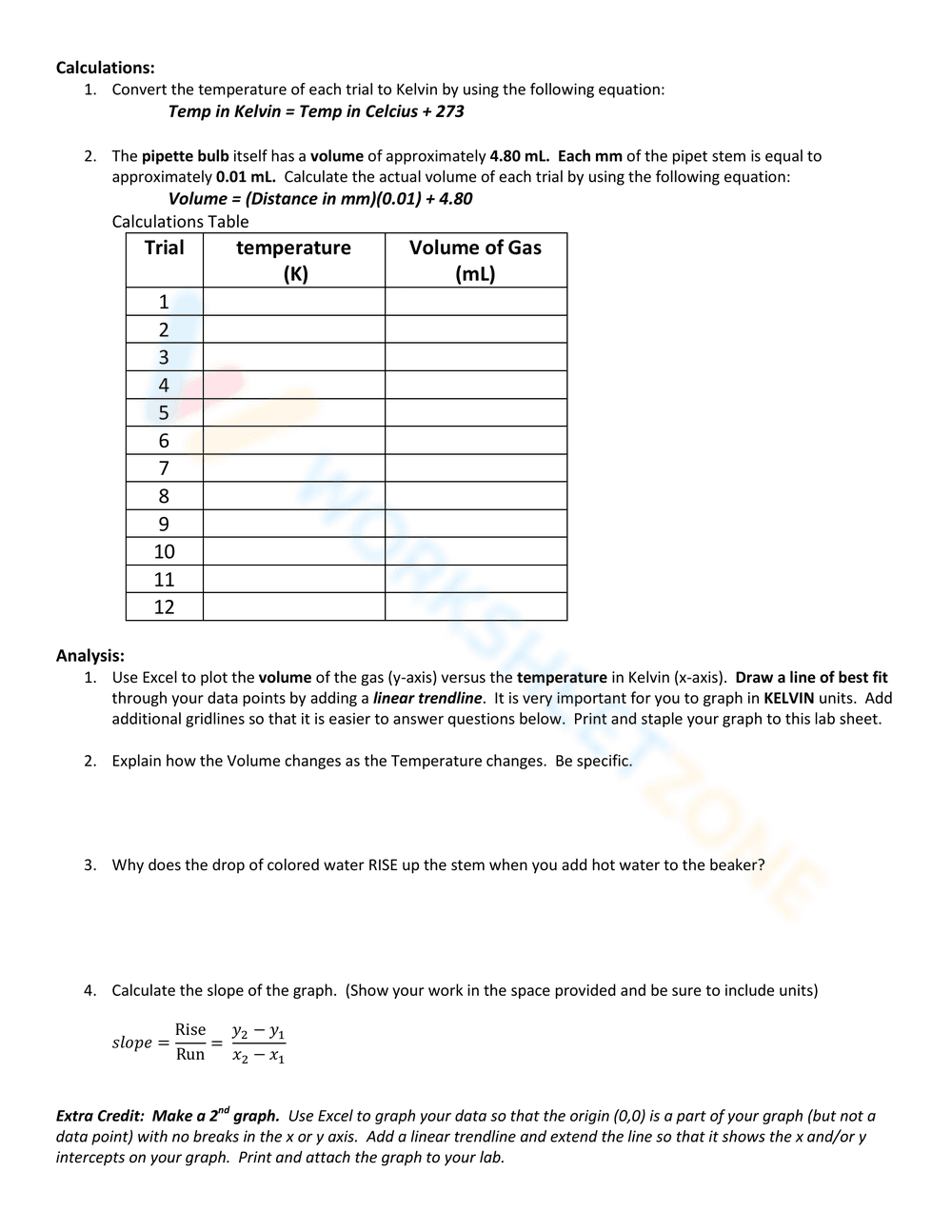
This worksheet helps students explore the relationship between volume and temperature for a gas according to Charles' Law. It allows them to conduct a hands-on experiment, collect data, and graphically represent the relationship, improving their understanding of gas laws and scientific methodology.
How to Use It:
Students should follow the procedure outlined on the worksheet, starting by immersing the large pipette bulb in cold water. They then add a small drop of colored water, measure the initial temperature and distance, and gradually add warm water to raise the temperature, recording the temperature and distance for each trial in the provided data table.
Target Users:
The target users are high school students in physics or chemistry classes who are learning about gas laws and conducting experiments to understand scientific principles. It's also suitable for science teachers looking for a lab activity to illustrate Charles' Law.
This is a science worksheet for a Charles' Law activity. It includes sections for the student's name and period, a statement of the activity's objective, a list of materials (large plastic transfer pipette, thin stem plastic transfer pipette, thermometer, beakers of cold and hot water, small amount of colored water, ruler with millimeter markings), a step-by-step procedure, and a data table to record the temperature of water in Celsius and the distance of the bulb edge to the water drop in millimeters for 12 trials.
Grade Level Suitability:
This worksheet is suitable for grades 9-12 (high school) physics or chemistry students. The experiment requires careful measurements, data recording, and an understanding of temperature scales and gas laws, making it appropriate for high school level science courses.
Why Use It:
This worksheet helps students explore the relationship between volume and temperature for a gas according to Charles' Law. It allows them to conduct a hands-on experiment, collect data, and graphically represent the relationship, improving their understanding of gas laws and scientific methodology.
How to Use It:
Students should follow the procedure outlined on the worksheet, starting by immersing the large pipette bulb in cold water. They then add a small drop of colored water, measure the initial temperature and distance, and gradually add warm water to raise the temperature, recording the temperature and distance for each trial in the provided data table.
Target Users:
The target users are high school students in physics or chemistry classes who are learning about gas laws and conducting experiments to understand scientific principles. It's also suitable for science teachers looking for a lab activity to illustrate Charles' Law.


