


























1 / 2
0
Views
0
Downloads

0.0
0
0 Likes
Charles' Law Worksheet
0 Views
0 Downloads
Paste this activity's link or code into your existing LMS (Google Classroom, Canvas, Teams, Schoology, Moodle, etc.).
Students can open and work on the activity right away, with no student login required.
You'll still be able to track student progress and results from your teacher account.
Information
Description
What It Is:
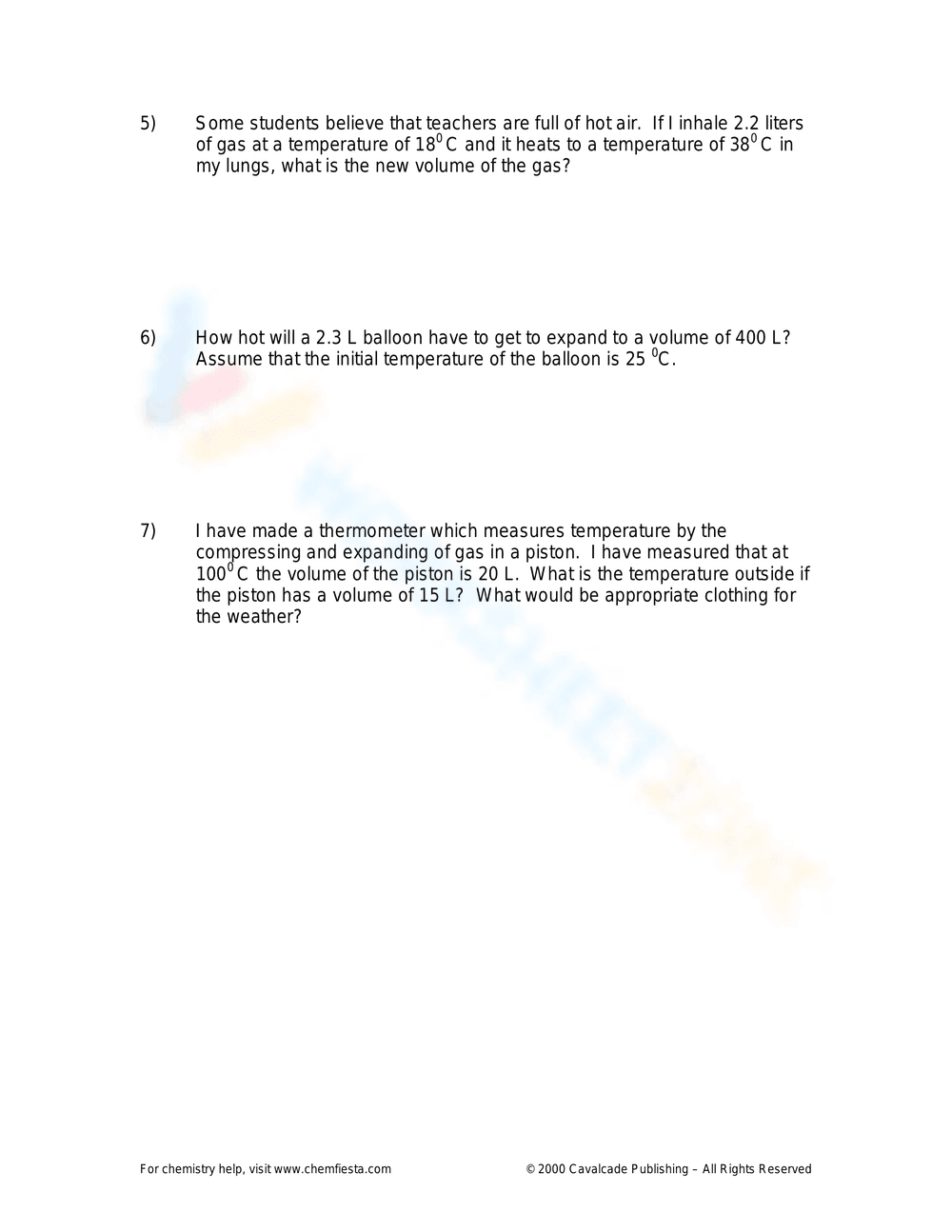
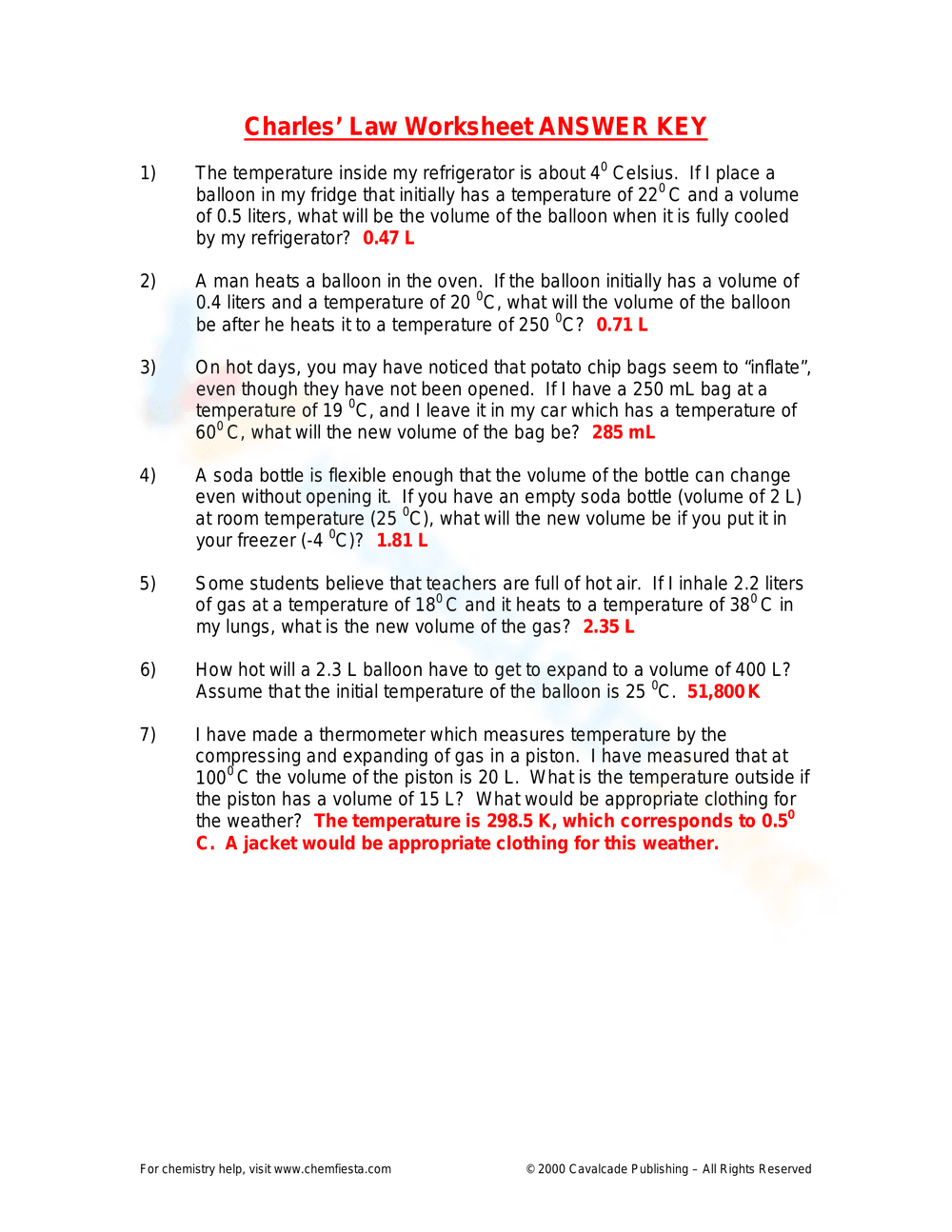
This is a worksheet focusing on Charles' Law in chemistry. It presents four word problems that require students to calculate the change in volume of a gas when the temperature changes, given initial volume and temperature values. The problems involve real-world scenarios like balloons in refrigerators and ovens, potato chip bags in cars, and soda bottles in freezers.
Grade Level Suitability:
This worksheet is suitable for grades 9-12, particularly for students studying chemistry or physics. It requires understanding of scientific concepts like temperature, volume, and Charles' Law, as well as the ability to apply mathematical formulas to solve problems.
Why Use It:
This worksheet helps students understand and apply Charles' Law in practical contexts. It reinforces problem-solving skills and strengthens their understanding of the relationship between temperature and volume of gases. It also helps them visualize the scientific concepts through everyday examples.
How to Use It:
Students should read each problem carefully and identify the initial and final volumes and temperatures. They should then apply Charles' Law (V1/T1 = V2/T2) to calculate the unknown volume. Ensure students convert temperatures to Kelvin before applying the formula.
Target Users:
The target users are high school students in chemistry or physics classes, as well as teachers looking for supplemental material to teach and reinforce Charles' Law. It's also suitable for students preparing for science exams or standardized tests.
This is a worksheet focusing on Charles' Law in chemistry. It presents four word problems that require students to calculate the change in volume of a gas when the temperature changes, given initial volume and temperature values. The problems involve real-world scenarios like balloons in refrigerators and ovens, potato chip bags in cars, and soda bottles in freezers.
Grade Level Suitability:
This worksheet is suitable for grades 9-12, particularly for students studying chemistry or physics. It requires understanding of scientific concepts like temperature, volume, and Charles' Law, as well as the ability to apply mathematical formulas to solve problems.
Why Use It:
This worksheet helps students understand and apply Charles' Law in practical contexts. It reinforces problem-solving skills and strengthens their understanding of the relationship between temperature and volume of gases. It also helps them visualize the scientific concepts through everyday examples.
How to Use It:
Students should read each problem carefully and identify the initial and final volumes and temperatures. They should then apply Charles' Law (V1/T1 = V2/T2) to calculate the unknown volume. Ensure students convert temperatures to Kelvin before applying the formula.
Target Users:
The target users are high school students in chemistry or physics classes, as well as teachers looking for supplemental material to teach and reinforce Charles' Law. It's also suitable for students preparing for science exams or standardized tests.


