


























0
Views
0
Downloads

0.0
0
0 Likes
Chicken Checkers: Learning Consonant Digraphs
0 Views
0 Downloads
Paste this activity's link or code into your existing LMS (Google Classroom, Canvas, Teams, Schoology, Moodle, etc.).
Students can open and work on the activity right away, with no student login required.
You'll still be able to track student progress and results from your teacher account.
Information
Description
What It Is:
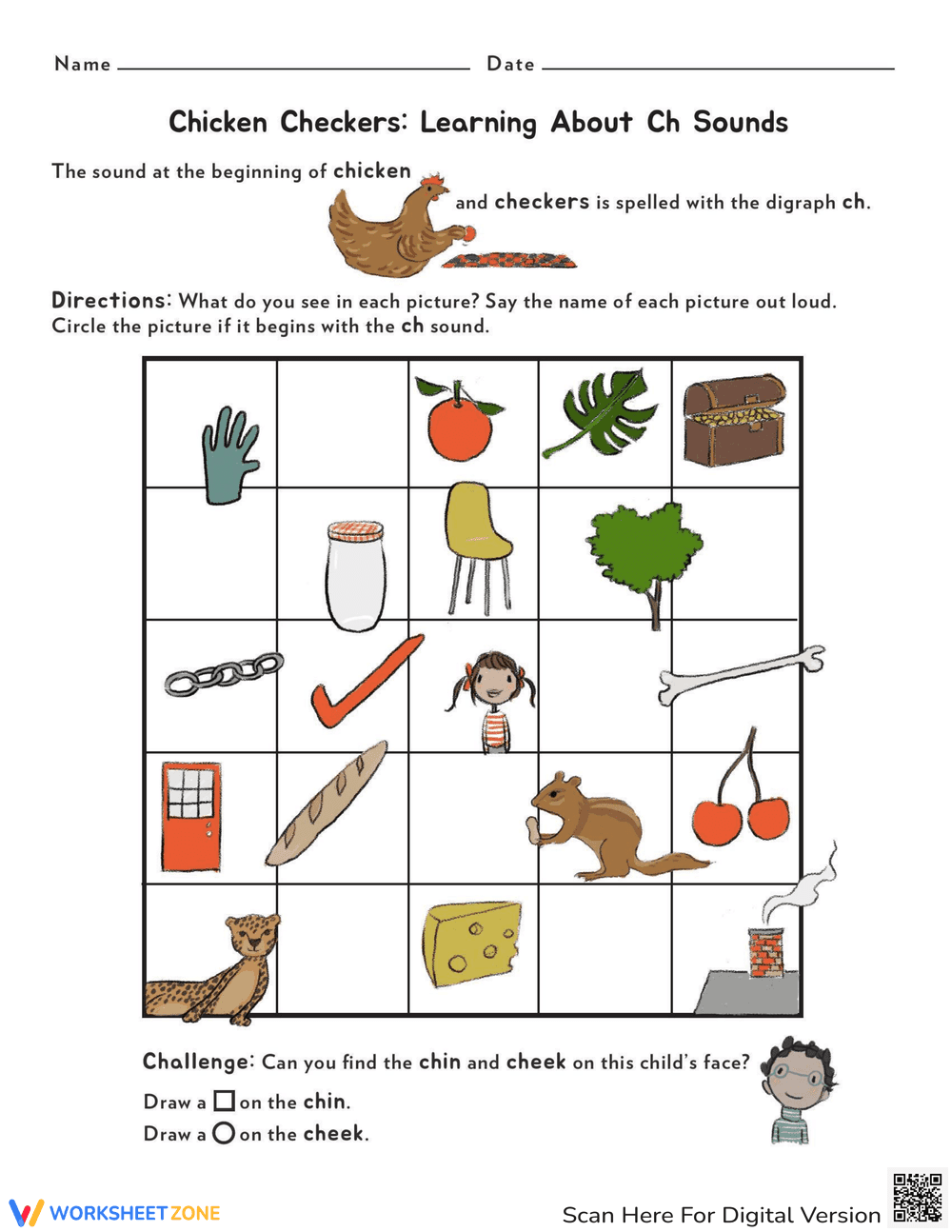
This is a phonics worksheet titled 'Chicken Checkers: Learning About Ch Sounds'. It features a grid of pictures including a glove, tomato, leaf, chest, jar, chair, tree, chain, checkmark, child, bone, door, bread, chipmunk, cherries, cheetah, cheese, and chili. The directions instruct students to say the name of each picture aloud and circle the pictures that begin with the 'ch' sound. A challenge section asks students to identify the chin and cheek on a child's face and draw a square on the chin and a circle on the cheek.
Grade Level Suitability:
Suitable for Kindergarten and 1st Grade. It focuses on identifying the 'ch' sound in words, a foundational phonics skill typically taught in these grades. The challenge activity involving identifying facial features is also appropriate for this age range.
Why Use It:
This worksheet helps students practice phonemic awareness and phonics skills by identifying the 'ch' sound at the beginning of words. It improves vocabulary, auditory discrimination, and fine motor skills (circling and drawing). The 'chin and cheek' challenge promotes body awareness and observation skills.
How to Use It:
First, instruct the student to say the name of each picture out loud. Then, guide them to circle only the pictures that begin with the 'ch' sound. Finally, have them draw a square on the chin and a circle on the cheek of the child in the challenge section.
Target Users:
This worksheet is designed for kindergarten and first-grade students learning about phonics and the 'ch' sound. It can be used by teachers in the classroom or by parents for at-home learning and reinforcement. It is also suitable for ESL/ELL students who are learning to pronounce English sounds.
This is a phonics worksheet titled 'Chicken Checkers: Learning About Ch Sounds'. It features a grid of pictures including a glove, tomato, leaf, chest, jar, chair, tree, chain, checkmark, child, bone, door, bread, chipmunk, cherries, cheetah, cheese, and chili. The directions instruct students to say the name of each picture aloud and circle the pictures that begin with the 'ch' sound. A challenge section asks students to identify the chin and cheek on a child's face and draw a square on the chin and a circle on the cheek.
Grade Level Suitability:
Suitable for Kindergarten and 1st Grade. It focuses on identifying the 'ch' sound in words, a foundational phonics skill typically taught in these grades. The challenge activity involving identifying facial features is also appropriate for this age range.
Why Use It:
This worksheet helps students practice phonemic awareness and phonics skills by identifying the 'ch' sound at the beginning of words. It improves vocabulary, auditory discrimination, and fine motor skills (circling and drawing). The 'chin and cheek' challenge promotes body awareness and observation skills.
How to Use It:
First, instruct the student to say the name of each picture out loud. Then, guide them to circle only the pictures that begin with the 'ch' sound. Finally, have them draw a square on the chin and a circle on the cheek of the child in the challenge section.
Target Users:
This worksheet is designed for kindergarten and first-grade students learning about phonics and the 'ch' sound. It can be used by teachers in the classroom or by parents for at-home learning and reinforcement. It is also suitable for ESL/ELL students who are learning to pronounce English sounds.


