


























1 / 2
0
Views
0
Downloads


0.0
0
0 Likes
Genetics: Chromosome Worksheet for In-Depth Study
0 Views
0 Downloads
Paste this activity's link or code into your existing LMS (Google Classroom, Canvas, Teams, Schoology, Moodle, etc.).
Students can open and work on the activity right away, with no student login required.
You'll still be able to track student progress and results from your teacher account.
Information
Description
What It Is:
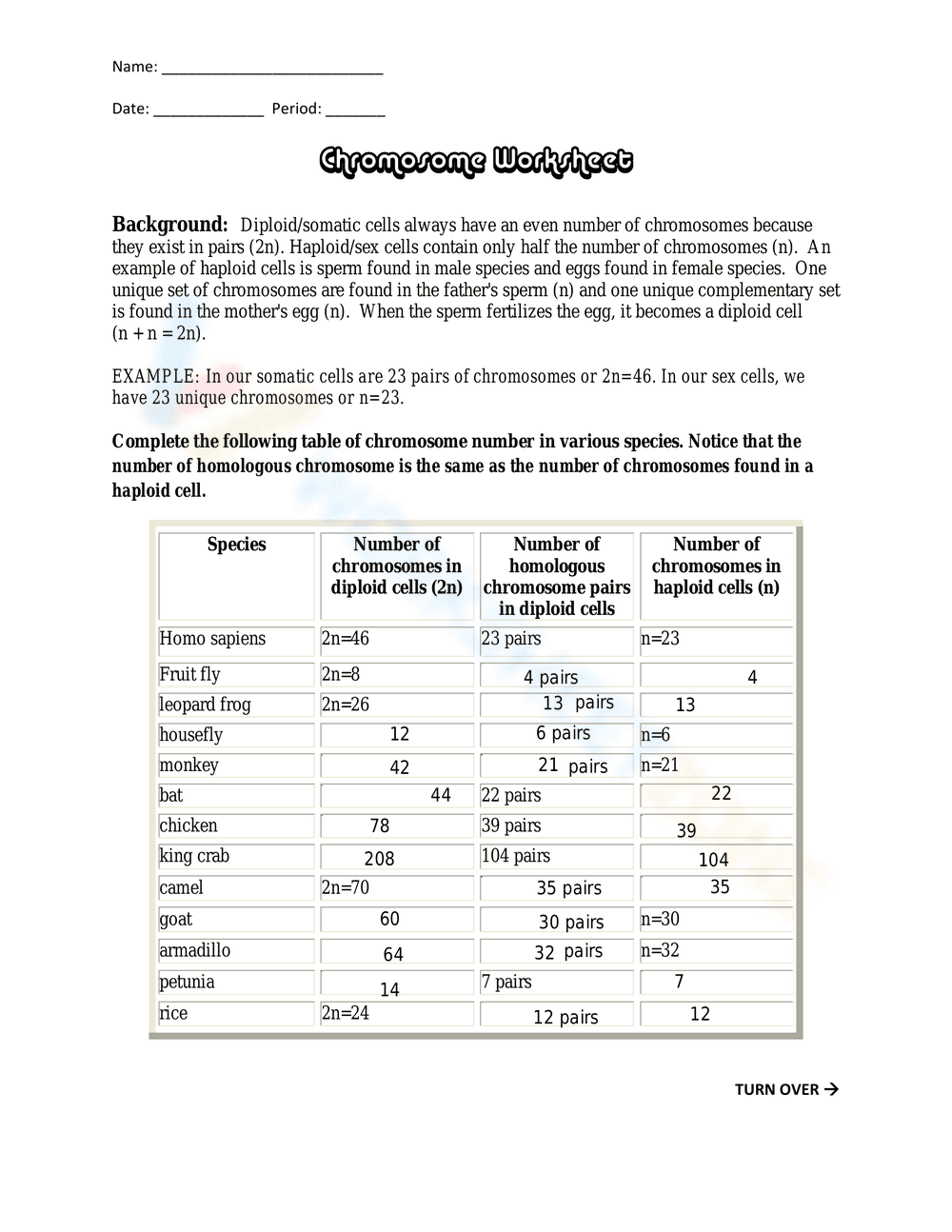
This is a chromosome worksheet that focuses on understanding the relationship between diploid (2n) and haploid (n) chromosome numbers in various species. The worksheet provides background information about diploid and haploid cells and includes a table for students to complete. The table lists different species (Homo sapiens, Fruit fly, leopard frog, housefly, monkey, bat, chicken, king crab, camel, goat, armadillo, petunia, rice) and requires students to fill in the number of chromosomes in diploid cells (2n), the number of homologous chromosome pairs in diploid cells, and the number of chromosomes in haploid cells (n). Some of the table entries are pre-filled, requiring students to calculate the missing values.
Grade Level Suitability:
This worksheet is suitable for high school Biology (Grades 9-12). The concepts of diploid and haploid cells, along with chromosome numbers, are typically introduced in high school biology courses. The worksheet requires students to apply their understanding of these concepts to solve problems and complete the table, indicating a higher-level understanding appropriate for high school.
Why Use It:
This worksheet reinforces understanding of chromosome number, diploid/haploid relationships, and homologous pairs. It helps students develop critical thinking skills by requiring them to analyze data and apply their knowledge to different species. It provides a structured way to learn about chromosome numbers in different organisms and reinforces the link between diploid and haploid chromosome numbers.
How to Use It:
Students should first read the background information provided on the worksheet. Then, they should use their understanding of diploid and haploid chromosome numbers to complete the table. For each species, they will need to determine the missing values based on the given information. For example, if the diploid number (2n) is given, they can calculate the haploid number (n) by dividing by 2. They should also understand that homologous pairs are half the total diploid number.
Target Users:
The target users are high school biology students learning about genetics, chromosomes, and cell division (meiosis). It is also suitable for teachers looking for supplemental materials to reinforce these concepts.
This is a chromosome worksheet that focuses on understanding the relationship between diploid (2n) and haploid (n) chromosome numbers in various species. The worksheet provides background information about diploid and haploid cells and includes a table for students to complete. The table lists different species (Homo sapiens, Fruit fly, leopard frog, housefly, monkey, bat, chicken, king crab, camel, goat, armadillo, petunia, rice) and requires students to fill in the number of chromosomes in diploid cells (2n), the number of homologous chromosome pairs in diploid cells, and the number of chromosomes in haploid cells (n). Some of the table entries are pre-filled, requiring students to calculate the missing values.
Grade Level Suitability:
This worksheet is suitable for high school Biology (Grades 9-12). The concepts of diploid and haploid cells, along with chromosome numbers, are typically introduced in high school biology courses. The worksheet requires students to apply their understanding of these concepts to solve problems and complete the table, indicating a higher-level understanding appropriate for high school.
Why Use It:
This worksheet reinforces understanding of chromosome number, diploid/haploid relationships, and homologous pairs. It helps students develop critical thinking skills by requiring them to analyze data and apply their knowledge to different species. It provides a structured way to learn about chromosome numbers in different organisms and reinforces the link between diploid and haploid chromosome numbers.
How to Use It:
Students should first read the background information provided on the worksheet. Then, they should use their understanding of diploid and haploid chromosome numbers to complete the table. For each species, they will need to determine the missing values based on the given information. For example, if the diploid number (2n) is given, they can calculate the haploid number (n) by dividing by 2. They should also understand that homologous pairs are half the total diploid number.
Target Users:
The target users are high school biology students learning about genetics, chromosomes, and cell division (meiosis). It is also suitable for teachers looking for supplemental materials to reinforce these concepts.


