


























0
Views
0
Downloads

0.0
0
0 Likes
Claim Evidence Linking Worksheet
0 Views
0 Downloads
Paste this activity's link or code into your existing LMS (Google Classroom, Canvas, Teams, Schoology, Moodle, etc.).
Students can open and work on the activity right away, with no student login required.
You'll still be able to track student progress and results from your teacher account.
Information
Description
What It Is:
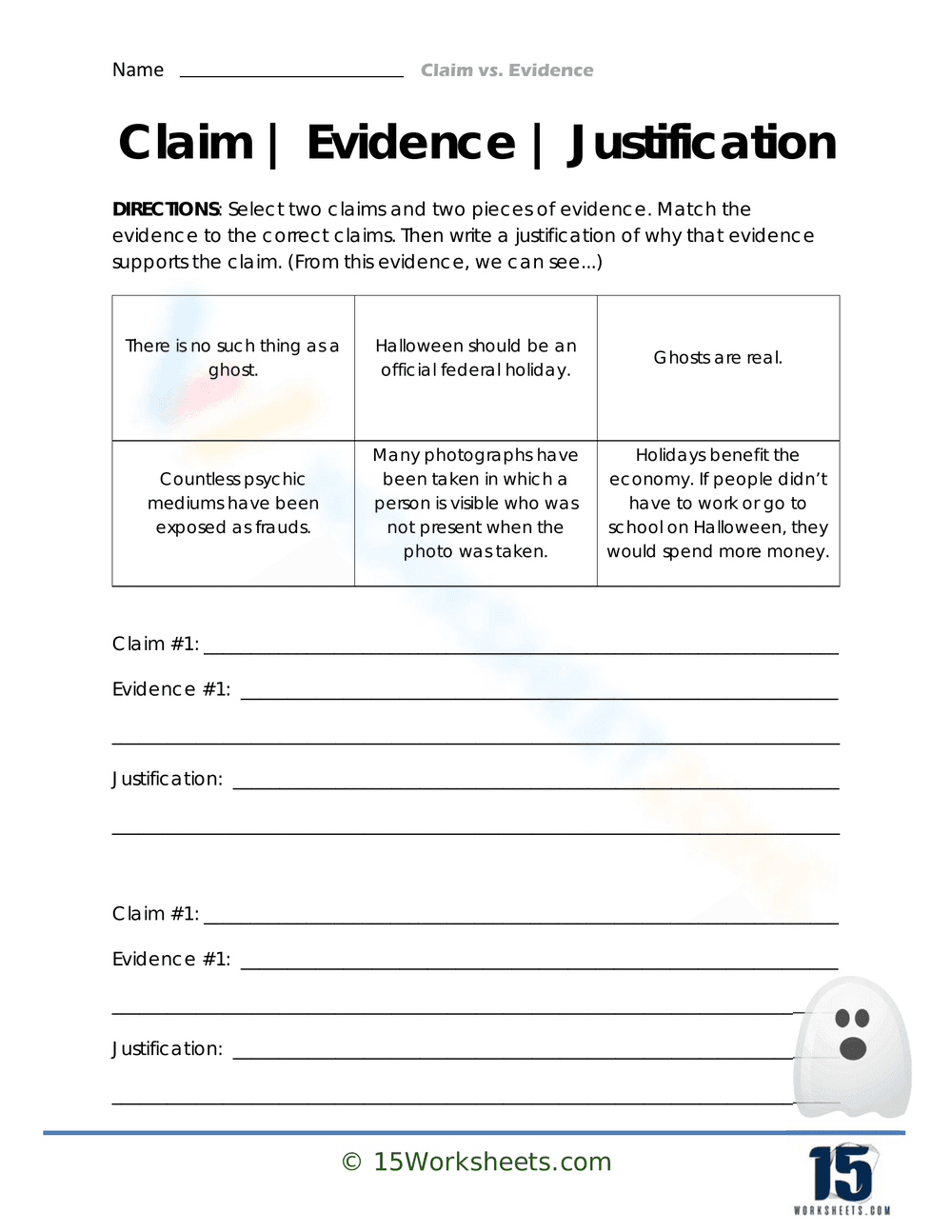
This is a worksheet focused on identifying and connecting claims with supporting evidence and providing a justification. It presents three claims: 'There is no such thing as a ghost,' 'Halloween should be an official federal holiday,' and 'Ghosts are real.' It also provides supporting evidence such as 'Countless psychic mediums have been exposed as frauds,' 'Many photographs have been taken in which a person is visible who was not present when the photo was taken,' and 'Holidays benefit the economy. If people didn't have to work or go to school on Halloween, they would spend more money.' Students must match claims with evidence and justify the connection.
Grade Level Suitability:
This worksheet is suitable for grades 6-8. The task of identifying claims and evidence, and providing a written justification, requires critical thinking and writing skills typically developed in middle school. The subject matter, while somewhat fantastical, is presented in a way that encourages analytical reasoning.
Why Use It:
This worksheet helps students develop critical thinking skills by analyzing claims and evidence. It reinforces the ability to distinguish between claims and supporting facts, and it encourages students to articulate the reasoning behind their connections. This strengthens their ability to form well-supported arguments.
How to Use It:
Students should first read each claim and piece of evidence. Then, they should match the evidence that best supports each claim. Finally, in the 'Justification' section, students should write a short paragraph explaining why the chosen evidence supports the claim. Two claim/evidence/justification pairings are to be completed.
Target Users:
This worksheet is ideal for middle school students learning about argumentative writing, critical thinking, and the relationship between claims and evidence. It can be used in language arts or debate classes to reinforce these concepts.
This is a worksheet focused on identifying and connecting claims with supporting evidence and providing a justification. It presents three claims: 'There is no such thing as a ghost,' 'Halloween should be an official federal holiday,' and 'Ghosts are real.' It also provides supporting evidence such as 'Countless psychic mediums have been exposed as frauds,' 'Many photographs have been taken in which a person is visible who was not present when the photo was taken,' and 'Holidays benefit the economy. If people didn't have to work or go to school on Halloween, they would spend more money.' Students must match claims with evidence and justify the connection.
Grade Level Suitability:
This worksheet is suitable for grades 6-8. The task of identifying claims and evidence, and providing a written justification, requires critical thinking and writing skills typically developed in middle school. The subject matter, while somewhat fantastical, is presented in a way that encourages analytical reasoning.
Why Use It:
This worksheet helps students develop critical thinking skills by analyzing claims and evidence. It reinforces the ability to distinguish between claims and supporting facts, and it encourages students to articulate the reasoning behind their connections. This strengthens their ability to form well-supported arguments.
How to Use It:
Students should first read each claim and piece of evidence. Then, they should match the evidence that best supports each claim. Finally, in the 'Justification' section, students should write a short paragraph explaining why the chosen evidence supports the claim. Two claim/evidence/justification pairings are to be completed.
Target Users:
This worksheet is ideal for middle school students learning about argumentative writing, critical thinking, and the relationship between claims and evidence. It can be used in language arts or debate classes to reinforce these concepts.


