


























0
Views
0
Downloads

0.0
0
0 Likes
Science Worksheets: Classifying Matter Made Easy
0 Views
0 Downloads
Paste this activity's link or code into your existing LMS (Google Classroom, Canvas, Teams, Schoology, Moodle, etc.).
Students can open and work on the activity right away, with no student login required.
You'll still be able to track student progress and results from your teacher account.
Information
Description
What It Is:
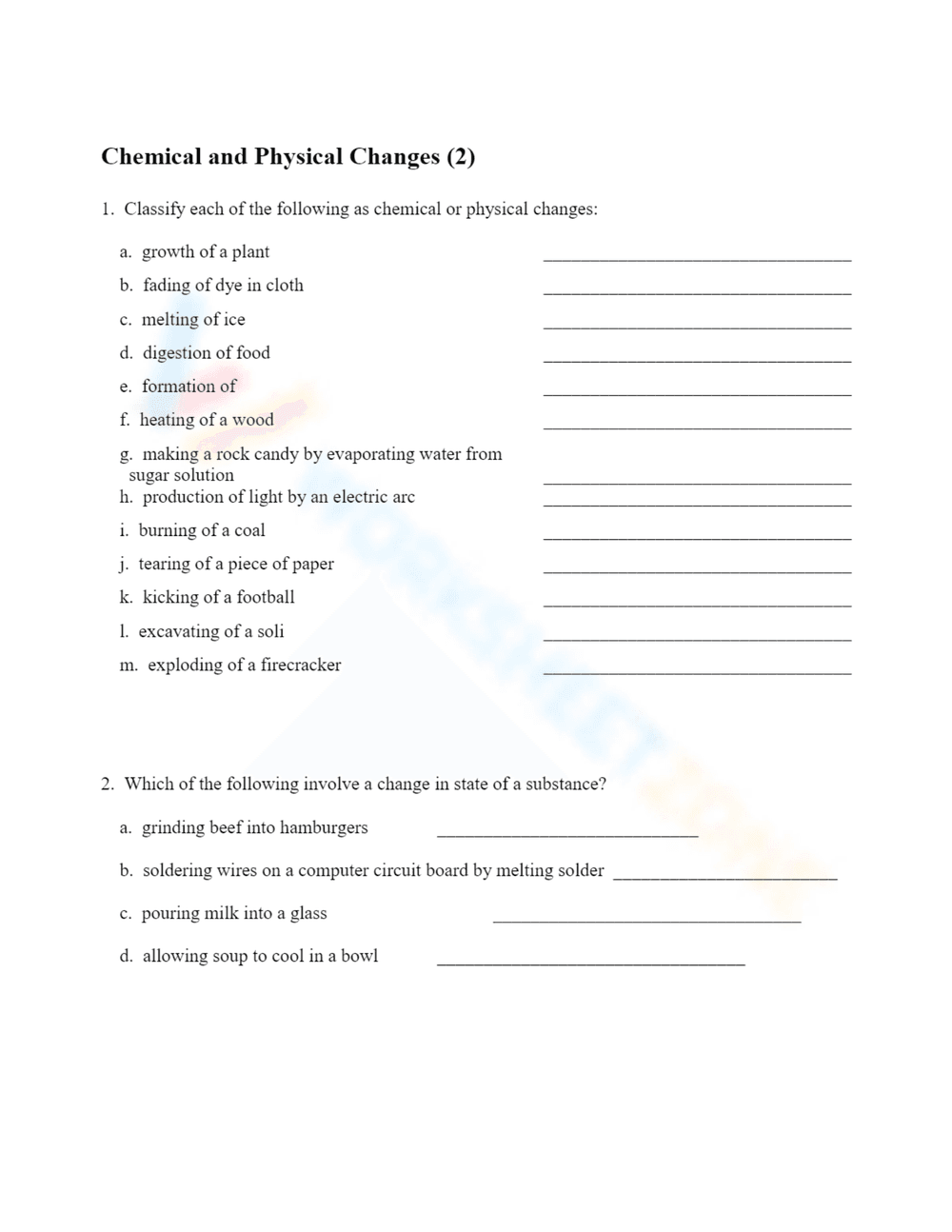
This is an educational worksheet focused on identifying and classifying chemical and physical changes. It presents a list of scenarios (e.g., 'growth of a plant,' 'melting of ice,' 'burning of a coal,' 'tearing of a piece of paper') and asks the student to classify each as either a chemical or physical change. A second section requires identifying which scenarios involve a change in the state of a substance, such as grinding beef into hamburgers or pouring milk into a glass.
Grade Level Suitability:
This worksheet is suitable for grades 6-9. It requires an understanding of basic scientific concepts related to matter and its properties, typically covered in middle school science curricula. The scenarios presented require critical thinking to distinguish between changes that alter the composition of a substance (chemical) and those that do not (physical).
Why Use It:
This worksheet reinforces the understanding of chemical and physical changes by providing real-world examples. It helps students develop critical thinking skills and apply their knowledge of scientific concepts to everyday situations. It also allows for assessment of student comprehension of the differences between chemical and physical changes.
How to Use It:
Students should read each scenario carefully and determine whether the change described is a chemical change (resulting in a new substance) or a physical change (altering the form or appearance but not the composition). They should write 'chemical' or 'physical' in the provided blank space next to each scenario. For the second section, they should identify if a change in state occurs, such as solid to liquid.
Target Users:
The target users are middle school students learning about chemistry and physical science concepts. It's beneficial for students who need practice in applying their knowledge of chemical and physical changes to real-world examples. It can also be used as a review or assessment tool.
This is an educational worksheet focused on identifying and classifying chemical and physical changes. It presents a list of scenarios (e.g., 'growth of a plant,' 'melting of ice,' 'burning of a coal,' 'tearing of a piece of paper') and asks the student to classify each as either a chemical or physical change. A second section requires identifying which scenarios involve a change in the state of a substance, such as grinding beef into hamburgers or pouring milk into a glass.
Grade Level Suitability:
This worksheet is suitable for grades 6-9. It requires an understanding of basic scientific concepts related to matter and its properties, typically covered in middle school science curricula. The scenarios presented require critical thinking to distinguish between changes that alter the composition of a substance (chemical) and those that do not (physical).
Why Use It:
This worksheet reinforces the understanding of chemical and physical changes by providing real-world examples. It helps students develop critical thinking skills and apply their knowledge of scientific concepts to everyday situations. It also allows for assessment of student comprehension of the differences between chemical and physical changes.
How to Use It:
Students should read each scenario carefully and determine whether the change described is a chemical change (resulting in a new substance) or a physical change (altering the form or appearance but not the composition). They should write 'chemical' or 'physical' in the provided blank space next to each scenario. For the second section, they should identify if a change in state occurs, such as solid to liquid.
Target Users:
The target users are middle school students learning about chemistry and physical science concepts. It's beneficial for students who need practice in applying their knowledge of chemical and physical changes to real-world examples. It can also be used as a review or assessment tool.


