


























1 / 2
0
Views
0
Downloads


0.0
0
0 Likes
Colligative Properties Worksheet
0 Views
0 Downloads
Paste this activity's link or code into your existing LMS (Google Classroom, Canvas, Teams, Schoology, Moodle, etc.).
Students can open and work on the activity right away, with no student login required.
You'll still be able to track student progress and results from your teacher account.
Information
Description
What It Is:
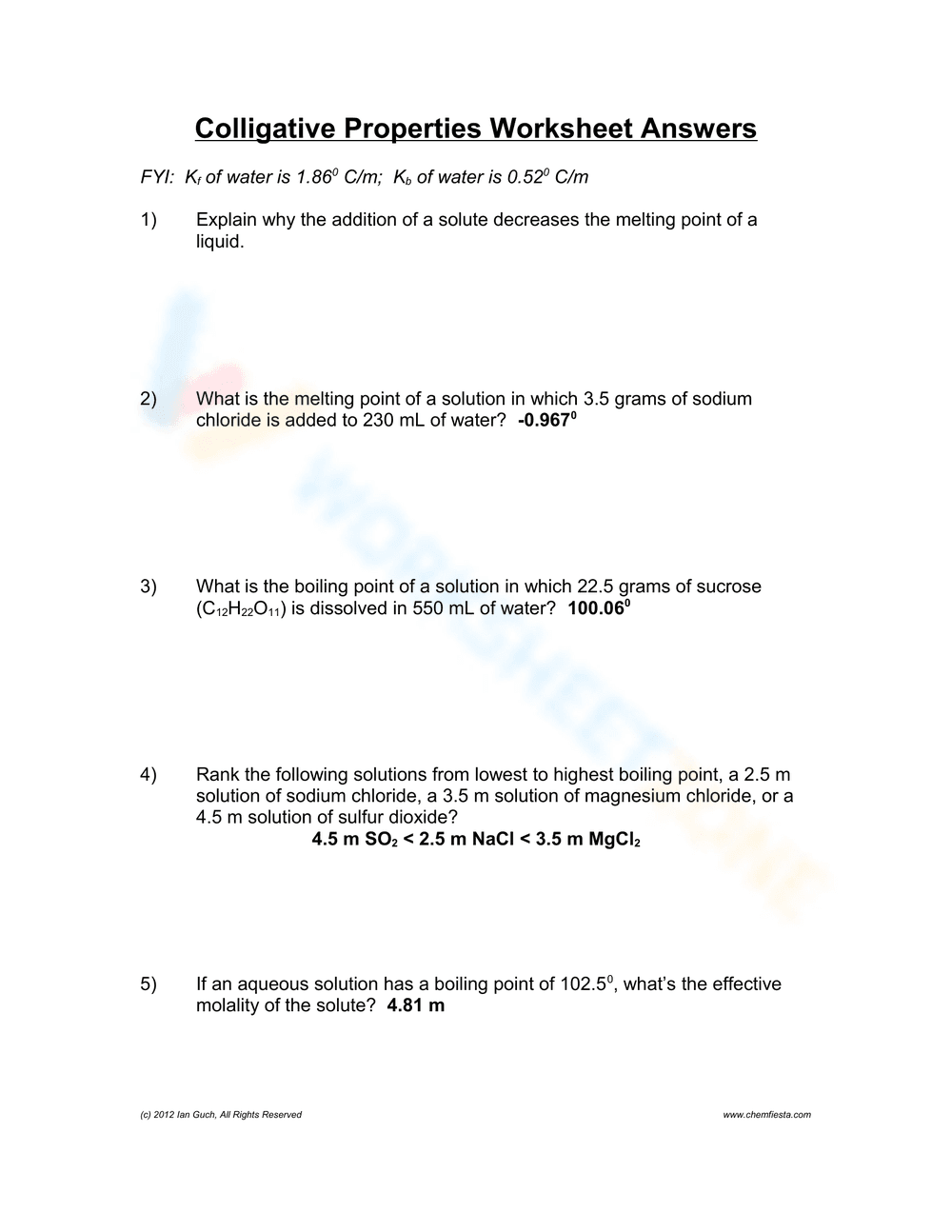
This is a chemistry worksheet focusing on colligative properties. It includes five questions: one requires an explanation of why adding a solute decreases melting point, two ask for calculations of melting and boiling points of solutions (sodium chloride and sucrose in water), one requires ranking solutions by boiling point (sodium chloride, magnesium chloride, and sulfur dioxide), and the final question asks for calculation of molality given a boiling point. The worksheet provides the cryoscopic and ebullioscopic constants for water.
Grade Level Suitability:
This worksheet is most suitable for high school chemistry students, specifically grades 11-12. It requires understanding of solution chemistry, colligative properties, and calculations involving molality, melting point depression, and boiling point elevation.
Why Use It:
This worksheet provides practice in applying the concepts of colligative properties to solve quantitative problems. It reinforces understanding of how solutes affect the physical properties of solutions and develops problem-solving skills in chemistry. It also covers the calculation of melting points, boiling points, and molality.
How to Use It:
Students should use their knowledge of colligative properties, formulas, and the provided constants to answer each question. They will need to perform calculations to determine melting points, boiling points, and molality, as well as explain the underlying principles. A calculator and periodic table would be helpful.
Target Users:
The target users are high school chemistry students learning about colligative properties. It's also suitable for teachers looking for practice problems to assign to their students or for students reviewing these concepts for exams.
This is a chemistry worksheet focusing on colligative properties. It includes five questions: one requires an explanation of why adding a solute decreases melting point, two ask for calculations of melting and boiling points of solutions (sodium chloride and sucrose in water), one requires ranking solutions by boiling point (sodium chloride, magnesium chloride, and sulfur dioxide), and the final question asks for calculation of molality given a boiling point. The worksheet provides the cryoscopic and ebullioscopic constants for water.
Grade Level Suitability:
This worksheet is most suitable for high school chemistry students, specifically grades 11-12. It requires understanding of solution chemistry, colligative properties, and calculations involving molality, melting point depression, and boiling point elevation.
Why Use It:
This worksheet provides practice in applying the concepts of colligative properties to solve quantitative problems. It reinforces understanding of how solutes affect the physical properties of solutions and develops problem-solving skills in chemistry. It also covers the calculation of melting points, boiling points, and molality.
How to Use It:
Students should use their knowledge of colligative properties, formulas, and the provided constants to answer each question. They will need to perform calculations to determine melting points, boiling points, and molality, as well as explain the underlying principles. A calculator and periodic table would be helpful.
Target Users:
The target users are high school chemistry students learning about colligative properties. It's also suitable for teachers looking for practice problems to assign to their students or for students reviewing these concepts for exams.


