


























1 / 3
0
Views
0
Downloads



0.0
0
0 Likes
Combined Gas Law Problems
0 Views
0 Downloads
Information
Description
What It Is:
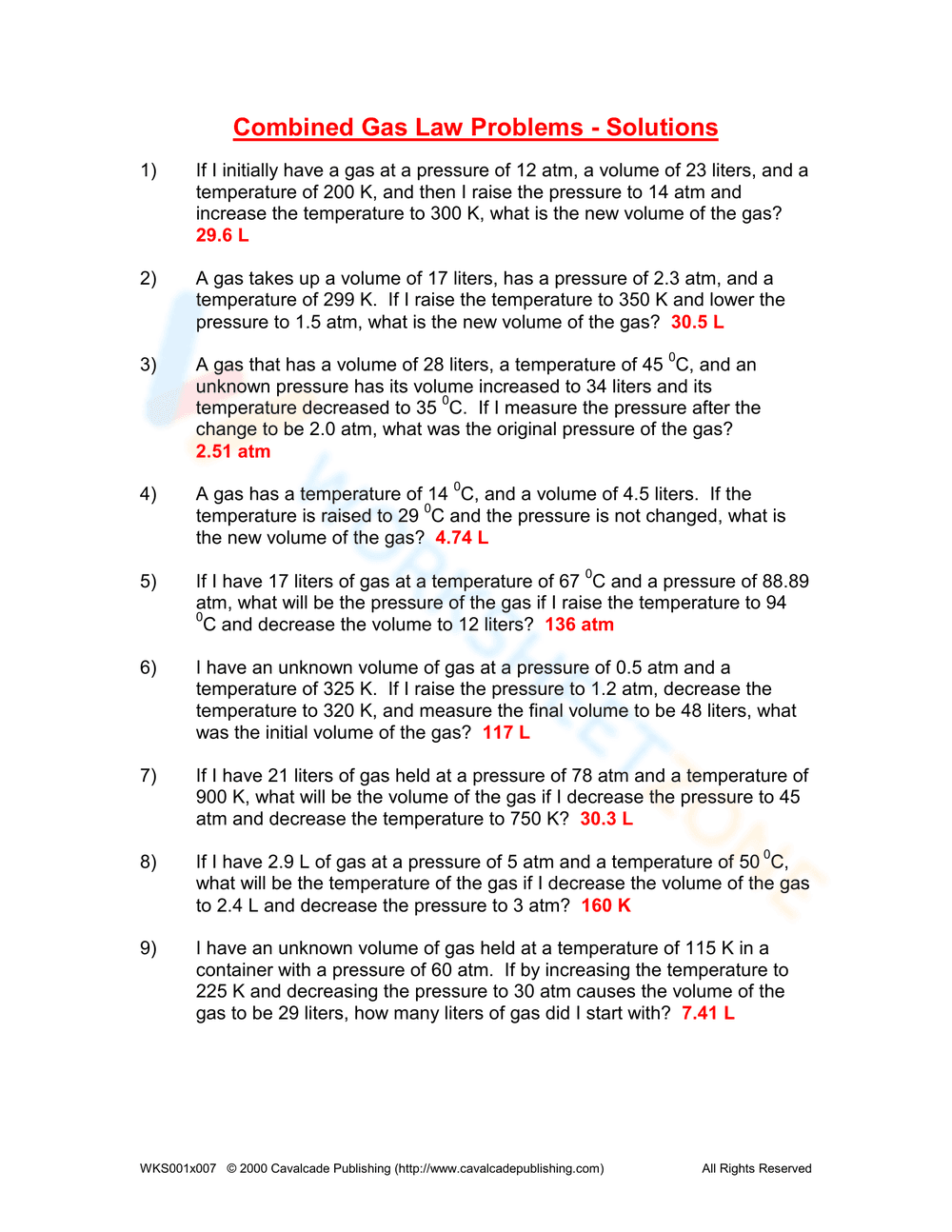
This is a worksheet containing four word problems related to the Combined Gas Law. Each problem provides initial and final conditions for a gas (pressure, volume, and temperature) and asks the student to calculate the missing variable. The problems require application of the combined gas law formula.
Grade Level Suitability:
Suitable for grades 11-12. The problems require understanding of chemistry concepts, algebraic manipulation, and unit conversions, which are typically taught in high school chemistry courses.
Why Use It:
This worksheet provides practice in applying the Combined Gas Law to solve quantitative problems. It reinforces understanding of the relationship between pressure, volume, and temperature of a gas. It helps students develop problem-solving skills and practice unit conversions.
How to Use It:
Students should read each problem carefully, identify the given variables and the unknown variable, and apply the Combined Gas Law formula (P1V1/T1 = P2V2/T2) to solve for the unknown. Ensure students pay attention to units and convert them if necessary.
Target Users:
High school students taking chemistry, particularly those learning about gas laws. It is also useful for teachers looking for practice problems to assign to their students.
This is a worksheet containing four word problems related to the Combined Gas Law. Each problem provides initial and final conditions for a gas (pressure, volume, and temperature) and asks the student to calculate the missing variable. The problems require application of the combined gas law formula.
Grade Level Suitability:
Suitable for grades 11-12. The problems require understanding of chemistry concepts, algebraic manipulation, and unit conversions, which are typically taught in high school chemistry courses.
Why Use It:
This worksheet provides practice in applying the Combined Gas Law to solve quantitative problems. It reinforces understanding of the relationship between pressure, volume, and temperature of a gas. It helps students develop problem-solving skills and practice unit conversions.
How to Use It:
Students should read each problem carefully, identify the given variables and the unknown variable, and apply the Combined Gas Law formula (P1V1/T1 = P2V2/T2) to solve for the unknown. Ensure students pay attention to units and convert them if necessary.
Target Users:
High school students taking chemistry, particularly those learning about gas laws. It is also useful for teachers looking for practice problems to assign to their students.


