


























1 / 4
0
Views
0
Downloads


0.0
0
0 Likes
Solve Problems with Combined Gas Law Worksheet
0 Views
0 Downloads
Information
Description
What It Is:
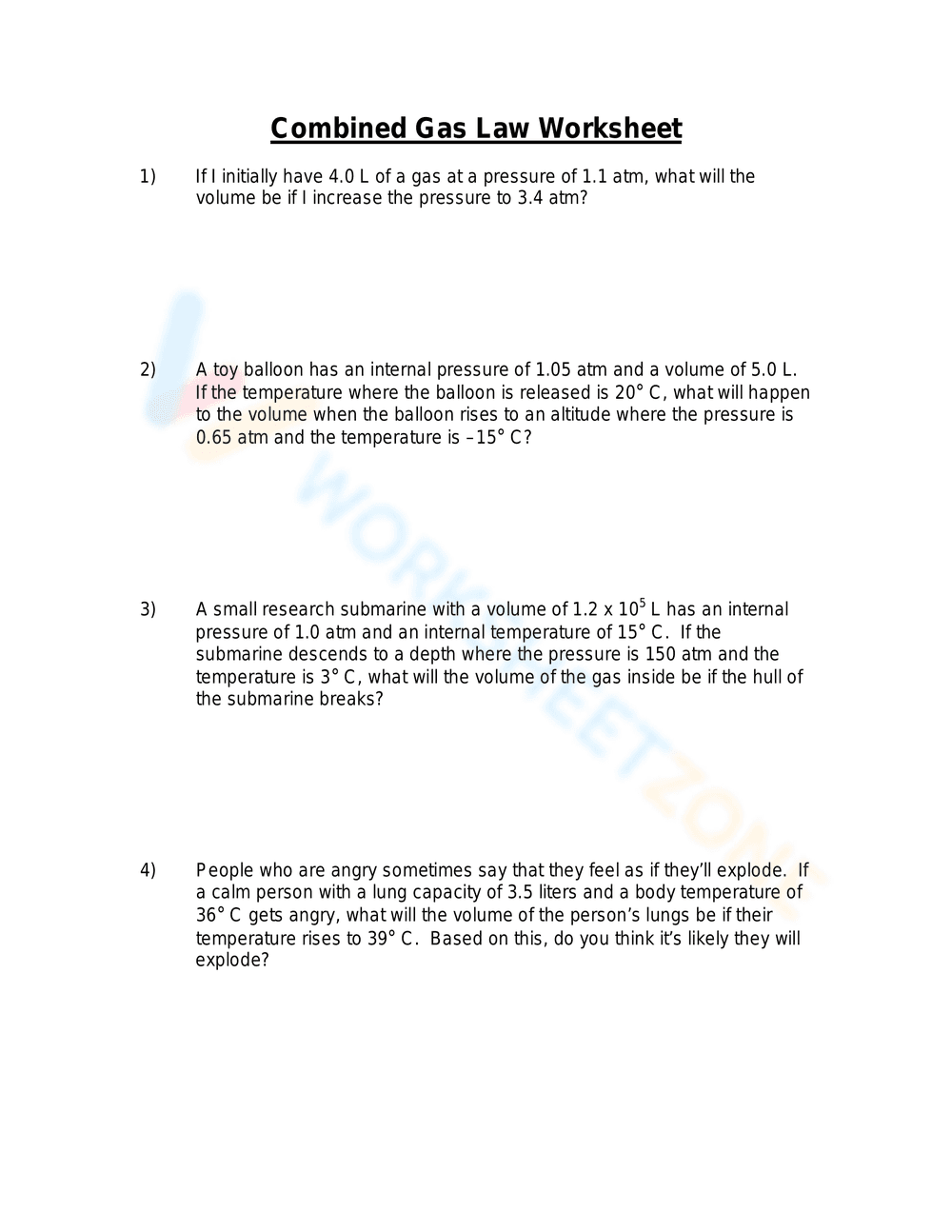
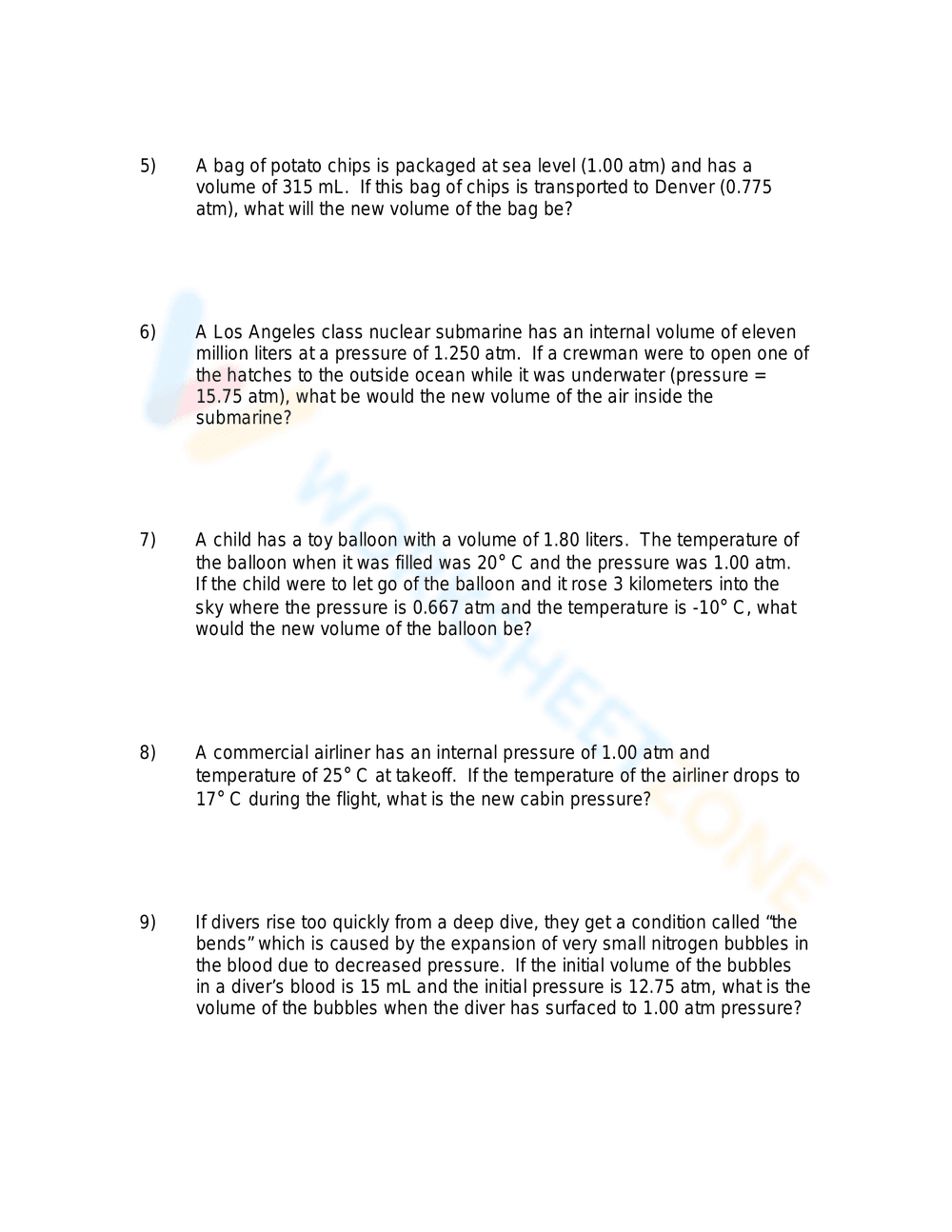
This is a 'Combined Gas Law Worksheet' featuring four word problems. Each problem provides initial and final conditions (pressure, volume, and temperature) and requires the student to calculate the unknown variable. The problems involve scenarios like gas compression, balloon behavior at different altitudes, a submarine's gas volume change at depth, and a hypothetical lung expansion during anger. The last problem also asks for a conclusion based on the calculation.
Grade Level Suitability:
This worksheet is suitable for grades 10-12, specifically for high school chemistry or physics courses. The problems require a good understanding of the combined gas law equation and the ability to manipulate variables, as well as some unit conversions. The scientific notation in problem 3 also suggests a higher grade level.
Why Use It:
This worksheet reinforces the application of the combined gas law to solve real-world problems. It helps students develop problem-solving skills, understand the relationships between pressure, volume, and temperature of gases, and improve their mathematical abilities in a scientific context. It also encourages critical thinking with the final question in problem 4.
How to Use It:
Students should use the combined gas law equation (P1V1/T1 = P2V2/T2) to solve each problem. First, identify the known and unknown variables in each scenario. Convert all values to consistent units (e.g., Kelvin for temperature). Plug the values into the equation and solve for the unknown variable. For problem 4, calculate the final volume and then provide a reasoned answer to the explosion question.
Target Users:
This worksheet is designed for high school students studying chemistry or physics, particularly those learning about gas laws. It is useful for teachers seeking practice problems for their students or for students who want to reinforce their understanding of the combined gas law.
This is a 'Combined Gas Law Worksheet' featuring four word problems. Each problem provides initial and final conditions (pressure, volume, and temperature) and requires the student to calculate the unknown variable. The problems involve scenarios like gas compression, balloon behavior at different altitudes, a submarine's gas volume change at depth, and a hypothetical lung expansion during anger. The last problem also asks for a conclusion based on the calculation.
Grade Level Suitability:
This worksheet is suitable for grades 10-12, specifically for high school chemistry or physics courses. The problems require a good understanding of the combined gas law equation and the ability to manipulate variables, as well as some unit conversions. The scientific notation in problem 3 also suggests a higher grade level.
Why Use It:
This worksheet reinforces the application of the combined gas law to solve real-world problems. It helps students develop problem-solving skills, understand the relationships between pressure, volume, and temperature of gases, and improve their mathematical abilities in a scientific context. It also encourages critical thinking with the final question in problem 4.
How to Use It:
Students should use the combined gas law equation (P1V1/T1 = P2V2/T2) to solve each problem. First, identify the known and unknown variables in each scenario. Convert all values to consistent units (e.g., Kelvin for temperature). Plug the values into the equation and solve for the unknown variable. For problem 4, calculate the final volume and then provide a reasoned answer to the explosion question.
Target Users:
This worksheet is designed for high school students studying chemistry or physics, particularly those learning about gas laws. It is useful for teachers seeking practice problems for their students or for students who want to reinforce their understanding of the combined gas law.


