


























1 / 2
0
Views
0
Downloads


0 Likes
Compare Text Forms: Written vs. Audio-Visual
0 Views
0 Downloads
Paste this activity's link or code into your existing LMS (Google Classroom, Canvas, Teams, Schoology, Moodle, etc.).
Students can open and work on the activity right away, with no student login required.
You'll still be able to track student progress and results from your teacher account.
Information
Description
What It Is:
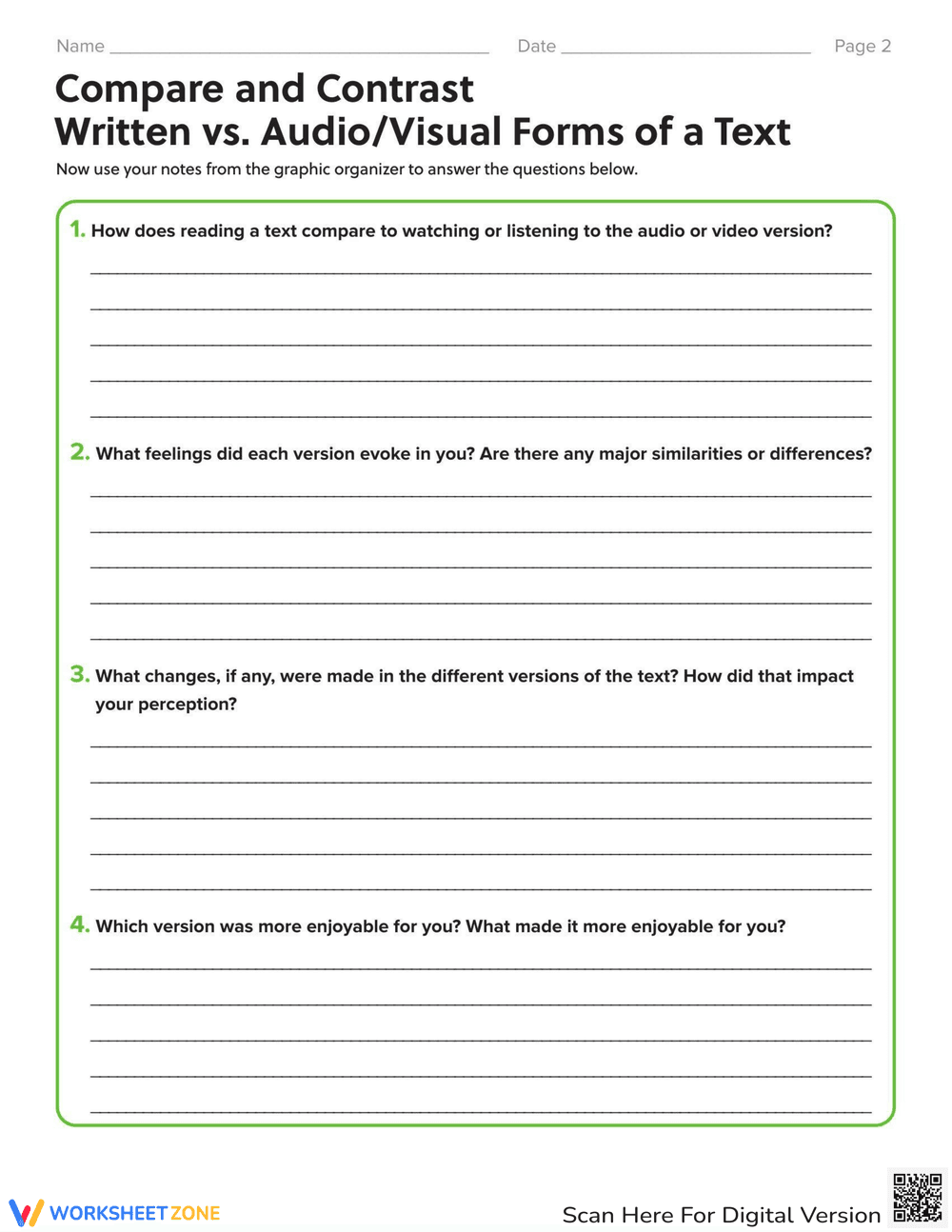
This is a compare and contrast worksheet designed to analyze a text presented in two different formats: written and audio/visual. The worksheet includes sections to record the title of the reading and listening/viewing versions, the visual experience ('What did you see?'), the auditory experience ('What did you hear?'), similarities between the two versions, and differences between the two versions. The listening/viewing version allows for selection between Audio, Video, and Live versions.
Grade Level Suitability:
This worksheet is suitable for grades 4-8. The complexity of comparing and contrasting different formats of a text requires analytical skills typically developed in these grade levels. The prompts are straightforward, but the cognitive task of identifying similarities and differences requires higher-order thinking.
Why Use It:
This worksheet helps students develop critical thinking skills by comparing and contrasting information presented in different formats. It improves comprehension by encouraging students to actively analyze visual and auditory elements. It also encourages students to consider how different media affect their understanding and experience of a text.
How to Use It:
First, choose a text that is available in both written and audio/visual formats (e.g., a book and its movie adaptation). Fill in the titles of each version. Then, read the written version and watch/listen to the audio/visual version. Next, in the 'Visual Experience' and 'Auditory Experience' sections, describe what you saw and heard in each version. Finally, compare the two versions and record the similarities and differences in the corresponding sections.
Target Users:
This worksheet is ideal for students in upper elementary and middle school grades who are learning about media literacy, text analysis, and critical thinking. It is also useful for teachers who want to incorporate different learning styles and media into their curriculum.
This is a compare and contrast worksheet designed to analyze a text presented in two different formats: written and audio/visual. The worksheet includes sections to record the title of the reading and listening/viewing versions, the visual experience ('What did you see?'), the auditory experience ('What did you hear?'), similarities between the two versions, and differences between the two versions. The listening/viewing version allows for selection between Audio, Video, and Live versions.
Grade Level Suitability:
This worksheet is suitable for grades 4-8. The complexity of comparing and contrasting different formats of a text requires analytical skills typically developed in these grade levels. The prompts are straightforward, but the cognitive task of identifying similarities and differences requires higher-order thinking.
Why Use It:
This worksheet helps students develop critical thinking skills by comparing and contrasting information presented in different formats. It improves comprehension by encouraging students to actively analyze visual and auditory elements. It also encourages students to consider how different media affect their understanding and experience of a text.
How to Use It:
First, choose a text that is available in both written and audio/visual formats (e.g., a book and its movie adaptation). Fill in the titles of each version. Then, read the written version and watch/listen to the audio/visual version. Next, in the 'Visual Experience' and 'Auditory Experience' sections, describe what you saw and heard in each version. Finally, compare the two versions and record the similarities and differences in the corresponding sections.
Target Users:
This worksheet is ideal for students in upper elementary and middle school grades who are learning about media literacy, text analysis, and critical thinking. It is also useful for teachers who want to incorporate different learning styles and media into their curriculum.


