


























0
Views
0
Downloads

0.0
0
0 Likes
Identify Complete and Incomplete Sentences
0 Views
0 Downloads
Paste this activity's link or code into your existing LMS (Google Classroom, Canvas, Teams, Schoology, Moodle, etc.).
Students can open and work on the activity right away, with no student login required.
You'll still be able to track student progress and results from your teacher account.
Information
Description
What It Is:
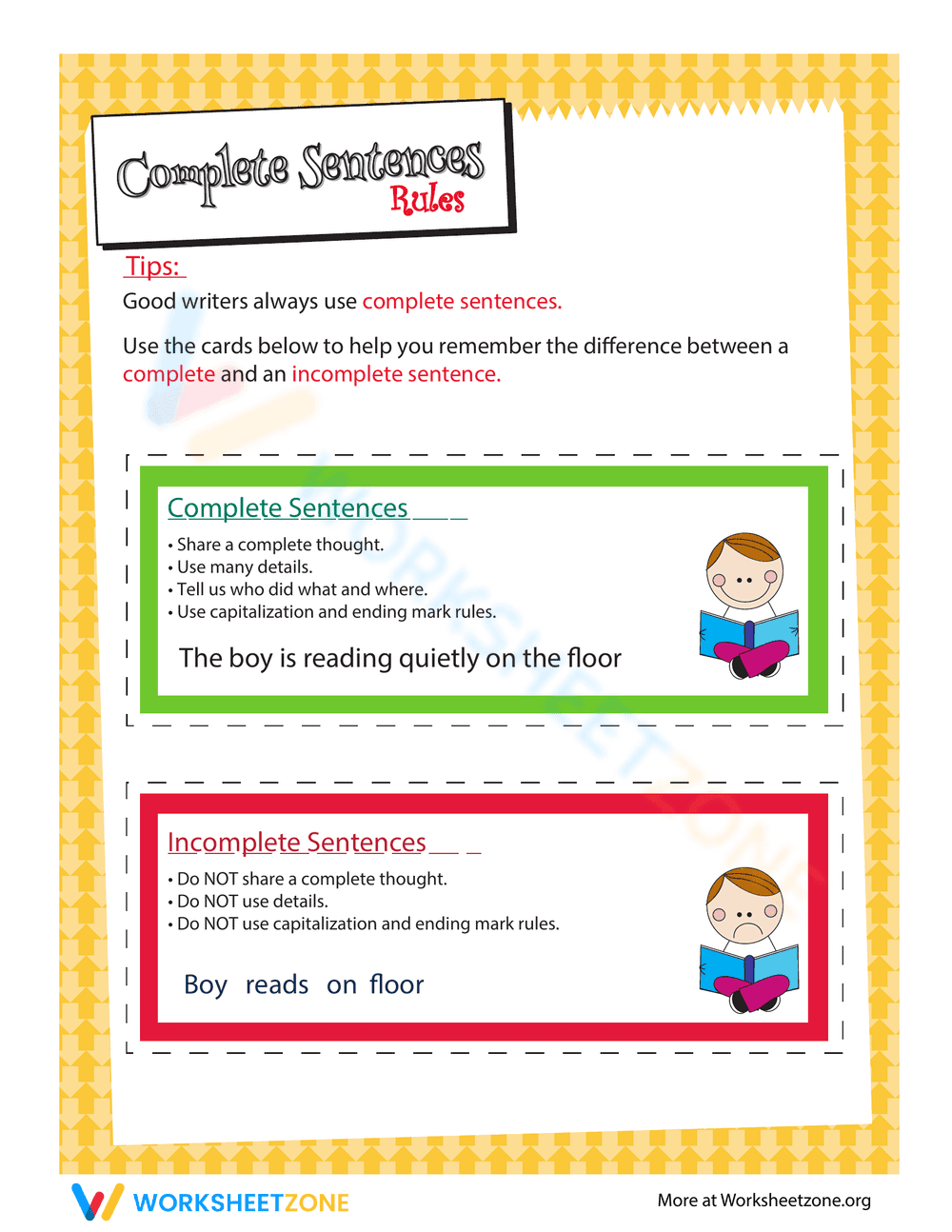
This worksheet provides a lesson on complete and incomplete sentences. It features a section explaining the rules of complete sentences, including sharing a complete thought, using details, telling who did what and where, and using capitalization and ending marks. An example of a complete sentence is given: 'The boy is reading quietly on the floor.' A second section details what incomplete sentences lack, such as a complete thought, details, and correct capitalization and ending marks. An example of an incomplete sentence is provided: 'Boy reads on floor.'
Grade Level Suitability:
This worksheet is suitable for 1st to 3rd grade students. The concepts are presented in a simple, visual manner with clear examples, making it accessible for early elementary learners who are beginning to learn about sentence structure.
Why Use It:
This worksheet helps students understand the difference between complete and incomplete sentences. It reinforces the key elements of a complete sentence, such as including a subject, verb, and complete thought. It also highlights the importance of capitalization, punctuation, and details.
How to Use It:
The worksheet can be used as an introductory lesson or a review activity. Students can read the explanations and examples, then use the information to identify complete and incomplete sentences. It can be followed up with exercises where students rewrite incomplete sentences to make them complete.
Target Users:
This worksheet is designed for elementary school students, particularly those in grades 1-3, who are learning about sentence structure and grammar. It's also helpful for students who need extra support in writing complete sentences.
This worksheet provides a lesson on complete and incomplete sentences. It features a section explaining the rules of complete sentences, including sharing a complete thought, using details, telling who did what and where, and using capitalization and ending marks. An example of a complete sentence is given: 'The boy is reading quietly on the floor.' A second section details what incomplete sentences lack, such as a complete thought, details, and correct capitalization and ending marks. An example of an incomplete sentence is provided: 'Boy reads on floor.'
Grade Level Suitability:
This worksheet is suitable for 1st to 3rd grade students. The concepts are presented in a simple, visual manner with clear examples, making it accessible for early elementary learners who are beginning to learn about sentence structure.
Why Use It:
This worksheet helps students understand the difference between complete and incomplete sentences. It reinforces the key elements of a complete sentence, such as including a subject, verb, and complete thought. It also highlights the importance of capitalization, punctuation, and details.
How to Use It:
The worksheet can be used as an introductory lesson or a review activity. Students can read the explanations and examples, then use the information to identify complete and incomplete sentences. It can be followed up with exercises where students rewrite incomplete sentences to make them complete.
Target Users:
This worksheet is designed for elementary school students, particularly those in grades 1-3, who are learning about sentence structure and grammar. It's also helpful for students who need extra support in writing complete sentences.


