


























0
Views
0
Downloads

0.0
0
0 Likes
Grip Grammar: Compound Words 4
0 Views
0 Downloads
Paste this activity's link or code into your existing LMS (Google Classroom, Canvas, Teams, Schoology, Moodle, etc.).
Students can open and work on the activity right away, with no student login required.
You'll still be able to track student progress and results from your teacher account.
Information
Description
What It Is:
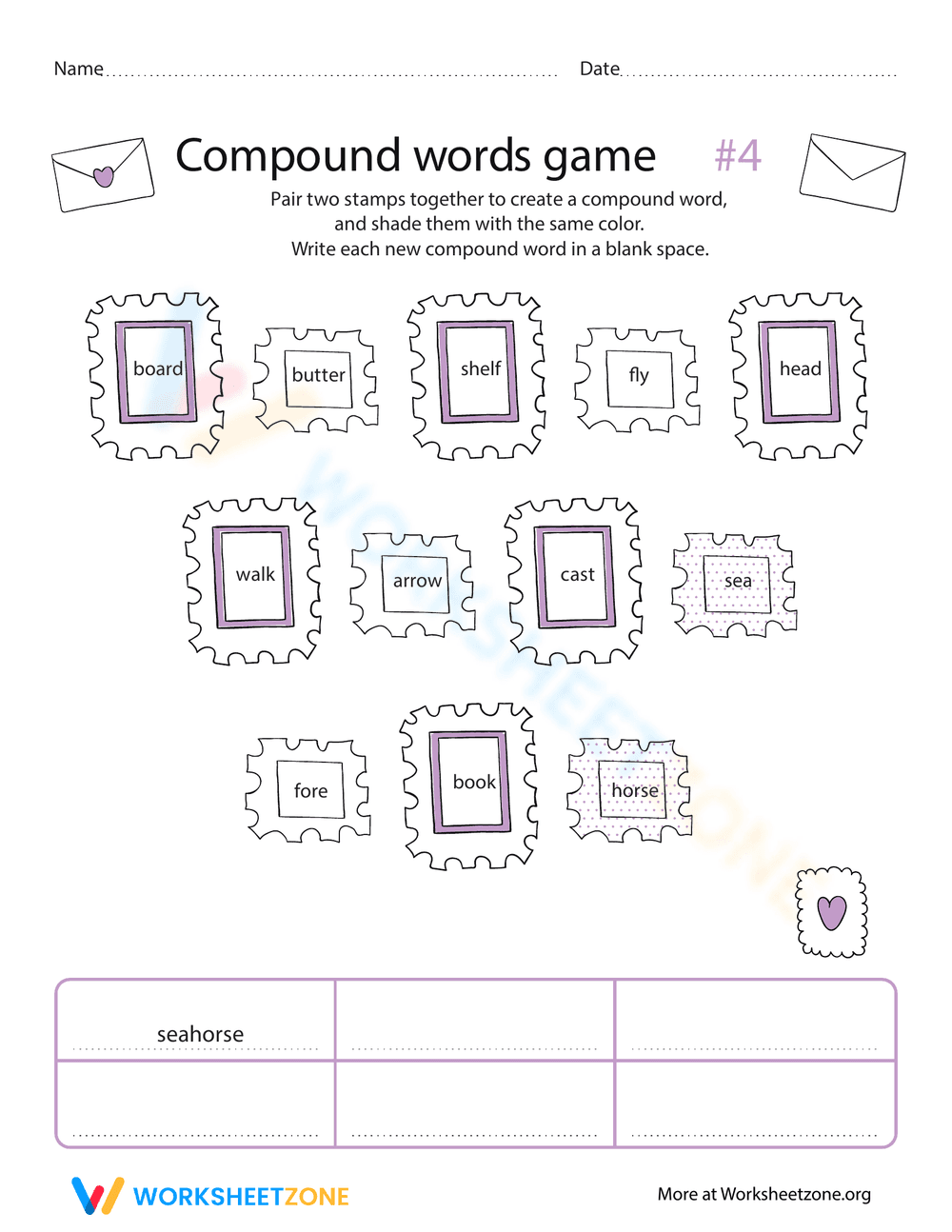
This is a worksheet designed as a 'Compound Words Game.' It features a series of stamps, each containing a single word. The activity instructs students to pair two stamps to create a compound word, shade the matching stamps with the same color, and then write the new compound word in a provided blank space. Example words include 'board,' 'butter,' 'shelf,' 'fly,' 'head,' 'walk,' 'arrow,' 'cast,' 'sea,' 'fore,' 'book,' and 'horse.' One compound word, 'seahorse' is already filled in as an example.
Grade Level Suitability:
This worksheet is suitable for grades 2-4. The concept of compound words is typically introduced in the early elementary grades. The words used in the activity are relatively simple and appropriate for this age range. The visual element of coloring the matching stamps adds an engaging and accessible dimension for younger learners.
Why Use It:
This worksheet helps students develop their vocabulary and understanding of compound words. It encourages them to think creatively about how words can be combined to form new meanings. The coloring activity adds a fun and interactive element, making the learning process more enjoyable. It also reinforces spelling and word recognition skills.
How to Use It:
Instruct students to look at the stamps and identify pairs of words that can be combined to create a compound word. Once a pair is identified, they should color the corresponding stamps with the same color. Then, they should write the new compound word in one of the provided blank spaces. For example, 'sea' and 'horse' are already colored, and 'seahorse' is written in the blank.
Target Users:
This worksheet is ideal for elementary school students in grades 2-4 who are learning about compound words. It can be used in the classroom as part of a language arts lesson or as a supplemental activity for students who need extra practice. It is also suitable for homeschooling environments.
This is a worksheet designed as a 'Compound Words Game.' It features a series of stamps, each containing a single word. The activity instructs students to pair two stamps to create a compound word, shade the matching stamps with the same color, and then write the new compound word in a provided blank space. Example words include 'board,' 'butter,' 'shelf,' 'fly,' 'head,' 'walk,' 'arrow,' 'cast,' 'sea,' 'fore,' 'book,' and 'horse.' One compound word, 'seahorse' is already filled in as an example.
Grade Level Suitability:
This worksheet is suitable for grades 2-4. The concept of compound words is typically introduced in the early elementary grades. The words used in the activity are relatively simple and appropriate for this age range. The visual element of coloring the matching stamps adds an engaging and accessible dimension for younger learners.
Why Use It:
This worksheet helps students develop their vocabulary and understanding of compound words. It encourages them to think creatively about how words can be combined to form new meanings. The coloring activity adds a fun and interactive element, making the learning process more enjoyable. It also reinforces spelling and word recognition skills.
How to Use It:
Instruct students to look at the stamps and identify pairs of words that can be combined to create a compound word. Once a pair is identified, they should color the corresponding stamps with the same color. Then, they should write the new compound word in one of the provided blank spaces. For example, 'sea' and 'horse' are already colored, and 'seahorse' is written in the blank.
Target Users:
This worksheet is ideal for elementary school students in grades 2-4 who are learning about compound words. It can be used in the classroom as part of a language arts lesson or as a supplemental activity for students who need extra practice. It is also suitable for homeschooling environments.


