


























1 / 4
0
Views
0
Downloads

0.0
0
0 Likes
Practice Proving Congruent Triangles
0 Views
0 Downloads
Paste this activity's link or code into your existing LMS (Google Classroom, Canvas, Teams, Schoology, Moodle, etc.).
Students can open and work on the activity right away, with no student login required.
You'll still be able to track student progress and results from your teacher account.
Information
Description
What It Is:
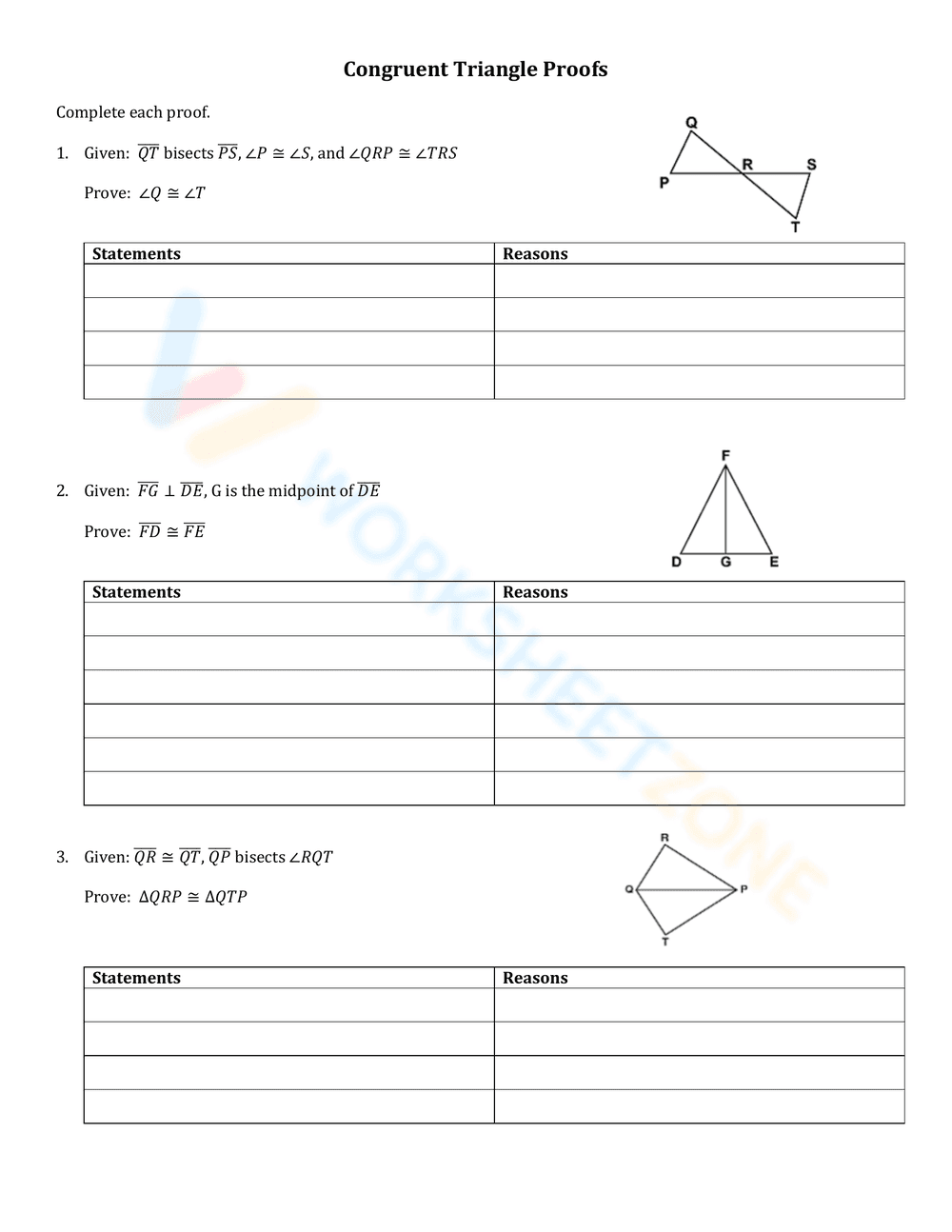
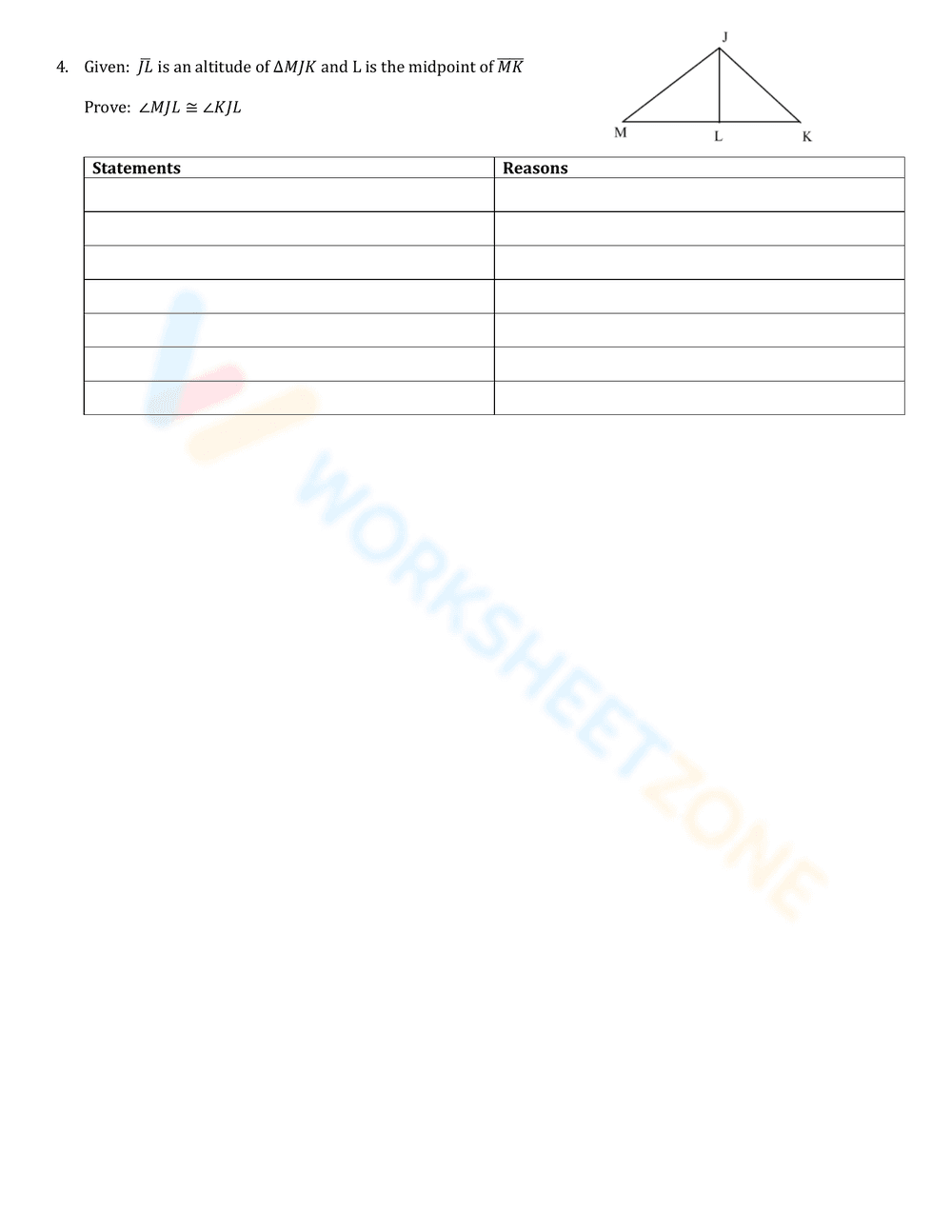
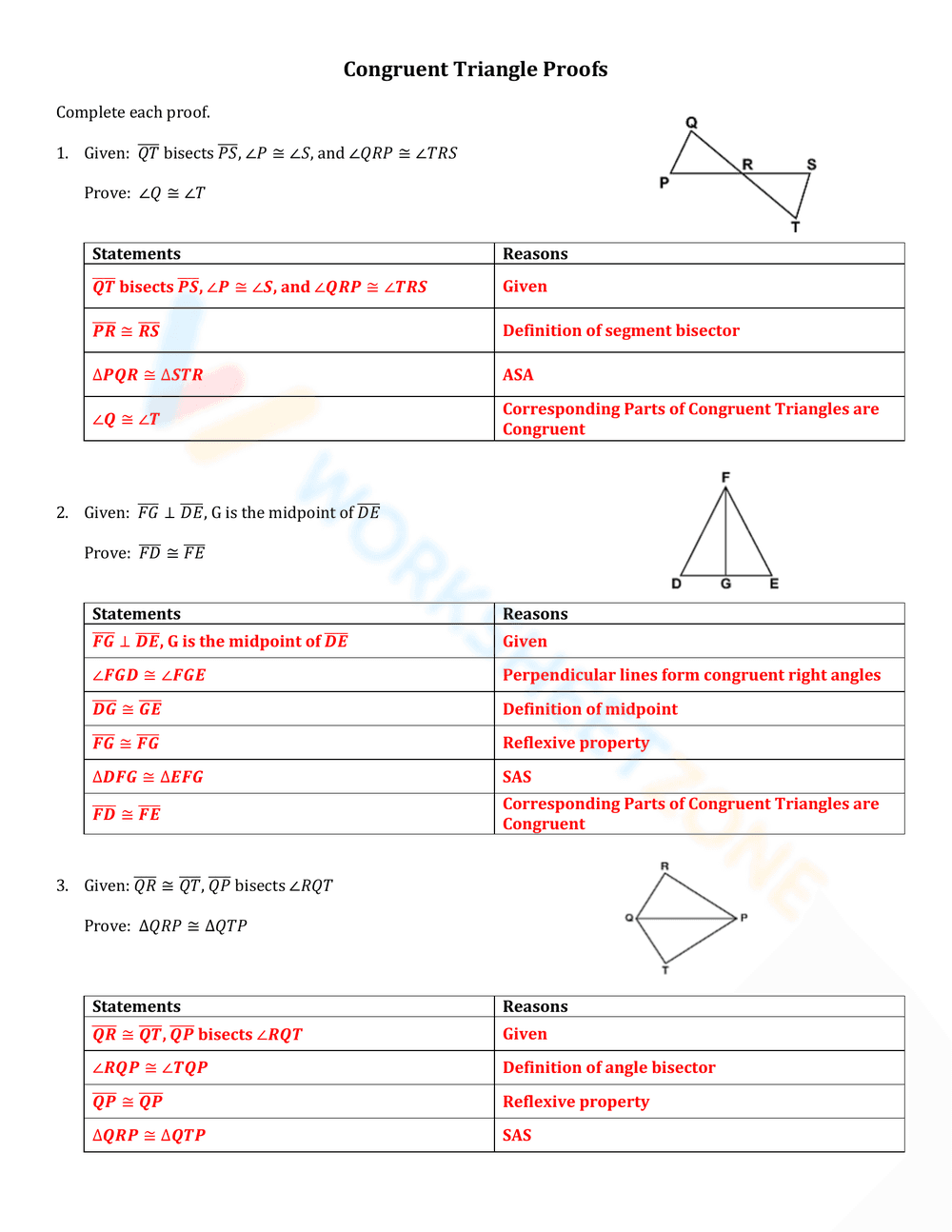
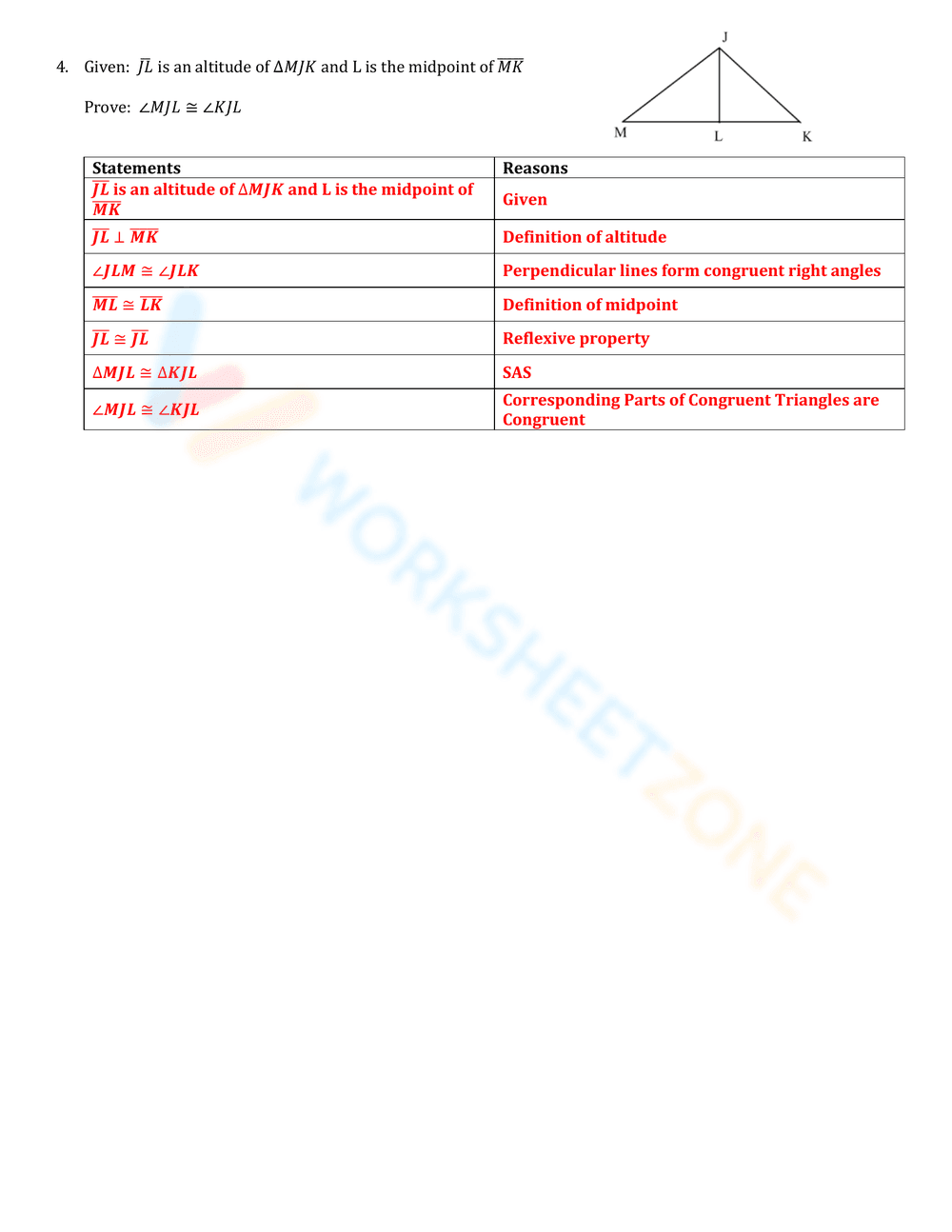
This is a geometry worksheet focusing on congruent triangle proofs. It presents three separate problems, each providing given information and a statement to prove. Each problem includes a diagram of the triangles involved. Students are expected to fill in the 'Statements' and 'Reasons' in a two-column proof format to demonstrate the congruence of the triangles. The first problem gives that QT bisects angle PQS, angle P is congruent to angle S, and angle QRP is congruent to angle TRS, and asks students to prove angle Q is congruent to angle T. The second problem states that FC is perpendicular to DE, G is the midpoint of DE, and asks to prove FD is congruent to FE. The third problem states QR is congruent to QT, QP bisects angle RQT, and asks students to prove triangle QRP is congruent to triangle QTP.
Grade Level Suitability:
This worksheet is suitable for high school geometry, specifically grades 9-10. It requires a strong understanding of geometric postulates, theorems, and definitions related to triangle congruence, angle bisectors, perpendicular lines, and midpoints.
Why Use It:
This worksheet helps students develop logical reasoning and proof-writing skills in geometry. It reinforces the application of congruence postulates (such as SAS, ASA, SSS) and theorems (like the Isosceles Triangle Theorem) to prove triangle congruence. It also helps students understand the relationship between given information and the steps required to reach a logical conclusion.
How to Use It:
Students should start by carefully analyzing the given information and the diagram for each problem. Then, they should fill in the 'Statements' column with a series of logical steps that lead to the desired conclusion. In the 'Reasons' column, they should provide justification for each statement, citing relevant postulates, theorems, definitions, or previously proven statements. Students should work through each problem step-by-step, ensuring that each statement is logically supported by a valid reason.
Target Users:
This worksheet is intended for high school students studying geometry, particularly those learning about triangle congruence and geometric proofs. It is also beneficial for teachers who need to provide practice problems for their students to reinforce these concepts.
This is a geometry worksheet focusing on congruent triangle proofs. It presents three separate problems, each providing given information and a statement to prove. Each problem includes a diagram of the triangles involved. Students are expected to fill in the 'Statements' and 'Reasons' in a two-column proof format to demonstrate the congruence of the triangles. The first problem gives that QT bisects angle PQS, angle P is congruent to angle S, and angle QRP is congruent to angle TRS, and asks students to prove angle Q is congruent to angle T. The second problem states that FC is perpendicular to DE, G is the midpoint of DE, and asks to prove FD is congruent to FE. The third problem states QR is congruent to QT, QP bisects angle RQT, and asks students to prove triangle QRP is congruent to triangle QTP.
Grade Level Suitability:
This worksheet is suitable for high school geometry, specifically grades 9-10. It requires a strong understanding of geometric postulates, theorems, and definitions related to triangle congruence, angle bisectors, perpendicular lines, and midpoints.
Why Use It:
This worksheet helps students develop logical reasoning and proof-writing skills in geometry. It reinforces the application of congruence postulates (such as SAS, ASA, SSS) and theorems (like the Isosceles Triangle Theorem) to prove triangle congruence. It also helps students understand the relationship between given information and the steps required to reach a logical conclusion.
How to Use It:
Students should start by carefully analyzing the given information and the diagram for each problem. Then, they should fill in the 'Statements' column with a series of logical steps that lead to the desired conclusion. In the 'Reasons' column, they should provide justification for each statement, citing relevant postulates, theorems, definitions, or previously proven statements. Students should work through each problem step-by-step, ensuring that each statement is logically supported by a valid reason.
Target Users:
This worksheet is intended for high school students studying geometry, particularly those learning about triangle congruence and geometric proofs. It is also beneficial for teachers who need to provide practice problems for their students to reinforce these concepts.


