


























1 / 3
0
Views
0
Downloads


0.0
0
0 Likes
Applying Conservation of Energy in Mechanics
0 Views
0 Downloads
Paste this activity's link or code into your existing LMS (Google Classroom, Canvas, Teams, Schoology, Moodle, etc.).
Students can open and work on the activity right away, with no student login required.
You'll still be able to track student progress and results from your teacher account.
Information
Description
What It Is:
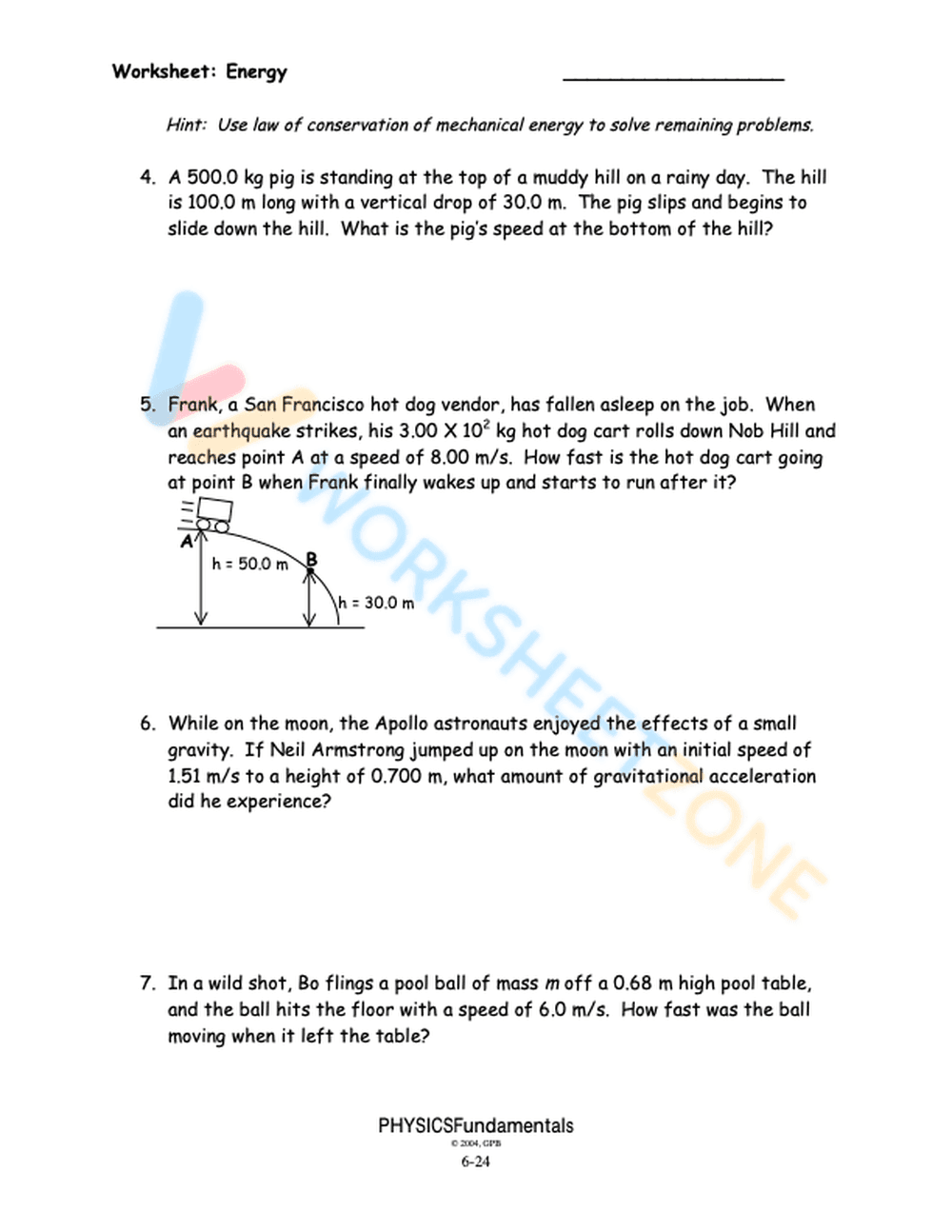
This is a physics worksheet focused on energy calculations. It includes problems related to kinetic energy (KE) and potential energy (PE). The worksheet presents word problems requiring students to calculate KE given mass and velocity, and PE given mass and height. It also asks students to calculate the work done to achieve these energy states. Specific examples include a baseball's KE and work done to it, a racecar's KE, and a package's PE on a shelf, along with the work required to place it there.
Grade Level Suitability:
This worksheet is suitable for high school physics, likely grades 9-12. The problems require an understanding of physics formulas for kinetic and potential energy, unit conversions, and basic algebra skills, which are typically covered in high school physics courses.
Why Use It:
This worksheet provides practice in applying the formulas for kinetic and potential energy to real-world scenarios. It reinforces the concepts of energy, work, mass, velocity, and height. It helps students develop problem-solving skills in physics and understand the relationship between work and energy.
How to Use It:
Students should read each problem carefully and identify the given information (mass, velocity, height). They should then select the appropriate formula (KE = 1/2 mv^2, PE = mgh) and plug in the values. Students must pay attention to units and convert them if necessary. Finally, students should calculate the answer and include the correct units (Joules).
Target Users:
The target users are high school physics students who are learning about kinetic and potential energy. It is appropriate for students who need extra practice applying the formulas and understanding the concepts. It is also useful for teachers as a homework assignment or in-class activity.
This is a physics worksheet focused on energy calculations. It includes problems related to kinetic energy (KE) and potential energy (PE). The worksheet presents word problems requiring students to calculate KE given mass and velocity, and PE given mass and height. It also asks students to calculate the work done to achieve these energy states. Specific examples include a baseball's KE and work done to it, a racecar's KE, and a package's PE on a shelf, along with the work required to place it there.
Grade Level Suitability:
This worksheet is suitable for high school physics, likely grades 9-12. The problems require an understanding of physics formulas for kinetic and potential energy, unit conversions, and basic algebra skills, which are typically covered in high school physics courses.
Why Use It:
This worksheet provides practice in applying the formulas for kinetic and potential energy to real-world scenarios. It reinforces the concepts of energy, work, mass, velocity, and height. It helps students develop problem-solving skills in physics and understand the relationship between work and energy.
How to Use It:
Students should read each problem carefully and identify the given information (mass, velocity, height). They should then select the appropriate formula (KE = 1/2 mv^2, PE = mgh) and plug in the values. Students must pay attention to units and convert them if necessary. Finally, students should calculate the answer and include the correct units (Joules).
Target Users:
The target users are high school physics students who are learning about kinetic and potential energy. It is appropriate for students who need extra practice applying the formulas and understanding the concepts. It is also useful for teachers as a homework assignment or in-class activity.


