


























Objectives
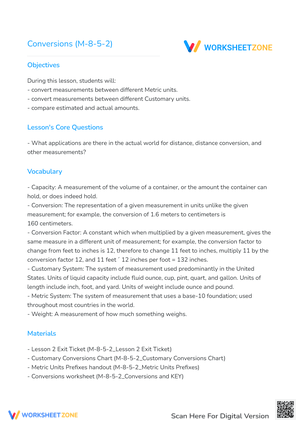
<p>During this lesson, students will:<br>- convert measurements between different Metric units.<br>- convert measurements between different Customary units.<br>- compare estimated and actual amounts.</p>
Core Questions
<p>- What applications are there in the actual world for distance, distance conversion, and other measurements? </p>
Vocabulary
<p>- Capacity: A measurement of the volume of a container, or the amount the container can hold, or does indeed hold. <br>- Conversion: The representation of a given measurement in units unlike the given measurement; for example, the conversion of 1.6 meters to centimeters is <br>160 centimeters. <br>- Conversion Factor: A constant which when multiplied by a given measurement, gives the same measure in a different unit of measurement; for example, the conversion factor to change from feet to inches is 12, therefore to change 11 feet to inches, multiply 11 by the conversion factor 12, and 11 feet ´ 12 inches per foot = 132 inches. <br>- Customary System: The system of measurement used predominantly in the United States. Units of liquid capacity include fluid ounce, cup, pint, quart, and gallon. Units of length include inch, foot, and yard. Units of weight include ounce and pound. <br>- Metric System: The system of measurement that uses a base-10 foundation; used throughout most countries in the world. <br>- Weight: A measurement of how much something weighs.</p>
Materials
<p>- Lesson 2 Exit Ticket (M-8-5-2_Lesson 2 Exit Ticket)<br>- Customary Conversions Chart (M-8-5-2_Customary Conversions Chart)<br>- Metric Units Prefixes handout (M-8-5-2_Metric Units Prefixes)<br>- Conversions worksheet (M-8-5-2_Conversions and KEY)</p>
Assignment
<p>- Assessing students' selection of operation and conversion factors is the first step in properly assessing unit conversions.<br>- Encourage students to assess their own responses and challenge the validity of their answers. Students who are unfamiliar with the various sizes of units can benefit greatly from equivalency tools. For instance, explaining to students that five miles is about equal to eight kilometers can make it easier for them to assess whether or not their answers are reasonable.</p>
Supports
<p>Explicit Instruction, Modeling, Scaffolding, Active Engagement<br>W: Students investigate how to convert between different measuring types—weight, capacity, and length—within each measurement system. Conversions are first modeled tangibly before moving on to more abstract criteria, such as the requirement to connect units during the conversion process.<br>H: Students are "hooked" into the course by being asked to look up the nations that utilize each measurement system. Students can see how measurement systems are applicable to this study approach.<br>E: Activities and instruction are scaffolded, emphasizing abstract thought. Different strategies and visual organizers are applied to promote abstract thought.<br>R: The lesson's open-ended format, especially concerning creating the instructional PowerPoint, gives students lots of chances to edit, go over again, consider, and reconsider.<br>E: As they engage in group projects, individual work, and class debates, students assess themselves.<br>T: By incorporating several representations, including measurement, counting intervals, reading dimensions, and learning modalities, an ideal learning environment is created for every student.<br>O: Throughout the course, the approach changes from being more concrete at first to being far more abstract.<br> </p>
Procedures
<p><strong>Part 1: Length, Capacity, and Weight</strong><br><br>Explain to students:<strong> "We work with two measurement systems: the </strong><i><strong>Customary System</strong></i><strong> and the </strong><i><strong>Metric System</strong></i><strong>. Do you know what a key characteristics of the Metric System is?"</strong> <i>(powers of ten)</i><br><br><strong>"The distinct characteristic of the </strong><i><strong>Metric System</strong></i><strong> is the base 10 foundation for all measurements."</strong><br><br>Students should be divided into groups of three to four. Give your students a few minutes to research the following question: <strong>"Which countries use the metric system most frequently? Which countries primarily use the Customary System?"</strong> Compare and discuss the group's answers:<br><br>Some countries that primarily use the metric system: China, Germany, Japan, India, Indonesia, France, Spain, Sweden, Russia, South Korea, Canada, Mexico, and Brazil.<br><br>Some countries that primarily use the customary system: the United States and Great Britain. Myanmar (previously known as Burma) and Liberia are among the other nations that use the Customary or SI system. The Customary System is not recognized as the official measurement system in the United Kingdom. However, such units are mandatory on distance signs. There is contradictory information about Myanmar and Liberia's official measurement systems. However, much of the literature indicates that the Customary System is the preferred measurement system for these two countries.<br><br>Because of its foundation in the base 10 system, the metric system is widely used around the world. As a result, knowledge and conversions may readily be transferred between countries. The United States has declared that it would use the metric system for all commercial and transportation purposes. However, the procedure has been extremely slow. The customary system is still given more emphasis in the elementary mathematics curriculum.<br><br><strong>Note:</strong> Almost all countries, with the exception of the United States, use the metric system. Thus, it is critical that all Americans be able to convert from the Customary System to the Metric System. However, that investigation is beyond the scope of this lesson. This lesson is only concerned with doing conversions within each system. As a result, we shall convert measures in both the metric and customary systems.<br><br><strong>"Let's start with conversions between the metric systems. We are interested in three distinct measurements—length, capacity, and weight."</strong><br><br><strong>"The following is a crucial question: What is the difference between </strong><i><strong>capacity</strong></i><strong> and </strong><i><strong>weight</strong></i><strong>?"</strong> Give the class some time to talk about the question.<i> (Capacity measures the volume of a container, amount the container can hold, or amount the container does hold. Weight is a measurement of how much something weighs.)</i><br><br><strong>"Let's look at the measurement prefixes we'll come across before we start processing conversions. Which prefixes are frequently used in the Metric system? When discussing the Metric System, the terms </strong><i><strong>milli</strong></i><strong>, </strong><i><strong>centi</strong></i><strong>, and </strong><i><strong>kilo</strong></i><strong> are frequently used. Every sort of measurement is utilized with these prefixes."</strong><br><br><strong>"Now, what do you think each prefix stands for?"</strong> <i>(kilo = thousand, centi = hundredth, milli = thousandth)</i><br><br>Please distribute the handout on Metric Units Prefixes (M-8-5-2_Metric Units Prefixes).<strong> "Perhaps we could go over these interpretations in a quick table." </strong>Go over the Metric Units Prefixes table with the students using the handout.<br><br><strong>"Starting with length, we will now convert between the three different measurement kinds. We will examine and switch between the following lengths:</strong><br><br><strong>meter</strong><br><strong>millimeter</strong><br><strong>centimeter</strong><br><strong>kilometer</strong><br><br><strong>First, let's convert one meter to its equal in the other three measurements. Spend some time discussing the conversions with your group and filling in the blanks in the table using the following knowledge:</strong><br><br><i><strong>milli</strong></i><strong> represents \(1 \over 1000\).</strong><br><br><i><strong>centi</strong></i><strong> represents \(1 \over 100\).</strong><br><br><i><strong>kilo</strong></i><strong> represents 1000” </strong><br><br><strong>"We can come up with a strategy to change meters to the other metrics. First of all, we see that a millimeter is shorter than a meter. Additionally, we observe that a centimeter is shorter than a meter. However, a kilometer is longer than a meter. How may this information help us in the process of conversion?" </strong>Extend the conversation to help students identify the conversion's most effective operation. <strong>"What happens, in other words, when we convert a larger number into a smaller one?" </strong>(<i>Dividing by a positive number greater than one produces a smaller quotient, whereas dividing by a positive number less than one results in a larger quotient. Similarly, multiplying by a positive number greater than one results in a larger product, and multiplying by a positive number less than one results in a smaller product.</i>) <strong>"From a lesser number to a greater number?"</strong> (<i>Select the most efficient operation based on the conversion factor.</i>)<br><br>Allow students time to discuss. Then say, <strong>"Intuitively, we might think that converting from a larger number to a smaller number requires division. However, this is not the case. Instead, multiply by a multiple of 10. Why would we multiply rather than divide?"</strong> (<i>When a factor is multiplied by a whole number factor of ten, the product will be greater than the factor.</i>)<br><br>Ask, <strong>"Any ideas? Of course, because the there are more smaller units within the larger unit, the smaller unit has a greater value."</strong><br><br><strong>"When converting a smaller number to a larger number, we perform the inverse. We </strong><i><strong>divide</strong></i><strong> by a multiple of 10 because there will be less of the larger number within the smaller number."</strong><br><br><strong>"So, when using this knowledge to our conversions, how can we demonstrate the procedures for our solutions? Let's include the solution technique for each conversion in our table."</strong> Direct students' attention to the Metric Unit Conversions chart on the handout.<br><br><strong>"Let's look at similar conversions from the other direction. The formal names for millimeters, centimeters, and kilometers are mm, cm, and km, respectively. We have the following equations."</strong><br><br>1000 mm = ____ m<br><br>100 cm = ____ m<br><br>0.001 km = ____ m<br><br><strong>"Explain the steps involved in solving each challenge to your group. The answer is already known to be 1 meter. This is meant to demonstrate how to convert between millimeters, centimeters, and kilometers and 1 meter."</strong><br><br>Invite students to discuss their thought processes, any questions, discoveries, difficulties, etc. Go over the following information with your students: <strong>"We see that we are converting from a smaller to a larger unit when we go from 1000 mm to ___ m. So we will divide. To solve this, we have:</strong><br><br>1000 ÷ 1000 = 1<br><br><strong>"As we convert from one smaller unit to another, we see that we are doing so from 100 cm to ___ m. Therefore, we will once again, divide. To solve this, we have:</strong><br><br>100 ÷ 100 = 1<br><br><strong>"Finally, we realize that we are converting from a larger to a smaller unit when we go from .001 km to ___ m. This time, we will multiply. To solve this, we have:</strong><br><br> (0.001)(1000) = 1<br><br><strong>"Now, instead of simply converting from millimeter, centimeter, and kilometer to a meter and vice versa, we will now convert between the other units."</strong><br><br><strong>"Using the information you have learned, complete the conversion table—the last table on the handout—and explain how you arrived at each value. Note any patterns or consistencies in the table. Is there a resultant pattern that will allow you to simply convert from a specific lesser number to a greater number and then convert back from that greater number to the lesser number? Are there any similarities?"</strong><br><br><strong>"Write a list of conversions in the empty spaces of the table in the handout to demonstrate your grasp of the conversions. For example, 1 mm = 0.10 cm, but 1 cm = 10 mm."</strong><br><br><strong>"Do the conversions make sense? Are they reasonable in terms of size? </strong>Encourage discussion.<strong> "Also, notice that if 1 km = 1000 m, then 1 m = 0.001 km, whereby 1000 and 0.001 are multiplicative inverses, such as ."</strong><br><br><strong>"Now that we understand the fundamentals of length conversions, we must go forward with our topic. We must now consider decimal and other amounts, excluding basic multiples of 10."</strong><br><br>Example:<br><br>8.19 km = ____ mm<br><br><strong>"Based on the conversion chart and our current understanding, 1 km is equal to 1,000,000 mm. In other words, we multiply by 1,000,000 to convert 1 km to mm. So, all we have to do is multiply 1,000,000 by 8.19 to convert 8.19 km to mm. This results in 8.19 km = 8,190,000 mm."</strong><br><br><strong>"The ratio we can set up is as follows:"</strong><br><br>\(1 \over 1,000,000\) = \(8.19 \over x\)<br><br><i>x</i> = (8.19) (1,000,000)<br><br><i>x</i> = 8,190,000 <br><br>Example:<br><br>56 cm = ____ m<br><br><strong>"1 cm = 0.01 m, based on the conversion chart and our prior knowledge. In other words, we divide by 100 to convert 1 cm to m. Thus, we multiply 0.01 by 56 </strong><i><strong>or</strong></i><strong> divide 56 by 100 to convert 56 cm to m. This results in 56 cm = 0.56 m."</strong><br><br><strong>"The ratio we can set up is as follows:"</strong><br><br>\(1 \over 0.01\) = \(56 \over x\)<br><br><i>x</i> = (56) (0.01)<br><br><i>x</i> = 0.56<br><br>Example:<br><br>129 cm = ___ mm<br><br><strong>"According to the conversion chart and our prior information, 1 cm is equal to 10 mm. In other words, we multiply by 10 to convert 1 cm to mm. Thus, we just need to multiply 129 by 10 to translate 129 cm to mm. This results in 129 cm = 1,290 mm."</strong><br><br><strong>"The ratio we can set up is as follows:"</strong><br><br>\(1 \over 10\) = \(129 \over x\)<br><br><i>x</i> = (129)(10)<br><br><i>x</i> = 1,290<br><br>Give the Lesson 2 Exit Ticket (M-8-5-2_Lesson 2 Exit Ticket) to the students. Before continuing with the class, have students complete the exit ticket to gauge their understanding.<br><br><strong>Capacity (Liters) and Weight (Grams)</strong><br><br>Tell students: <strong>"In the Metric System, capacity and weight are both measured with the same prefixes: milli-, centi-, and kilo-. As a result, it's good to know that you may apply the foundation you've just learned to these two types of measurements. The only change will be in the word endings. Let's investigate the measurement units for capacity and weight." </strong>Ask,<br><br><strong>"Does anyone know the base unit for capacity measurement in the Metric System?"</strong> (<i>It's the liter.</i>)<br><strong>"Thus, we can convert between milliliter, centiliter, and kiloliter, denoted as mL, cL, and kL, respectively."</strong><br><strong>"What is the base unit for weight measurement in the Metric System?"</strong> (<i>This is the gram.</i>)<br><strong>"Thus, we can convert between milligram, centigram, and kilogram, denoted as mg, cg, and kg, respectively."</strong><br><br><strong>Alternative Teaching Approach: Using Dimensional Analysis</strong><br><br>1. Discuss with students how kilo, milli, and centi relate back to their base unit of gram, liter, meter, etc.<br>- 1000 meters in a kilometer.<br>- 100 centimeters in a meter.<br>- 1000 millimeters in a meter.<br><br>2. <strong>"Conversions can be performed using a method called dimensional analysis, which applies the concepts of cancelation to get to a desired unit."</strong><br><br>3. Review the previous example: 8.19 km to mm<br>- (8.19 km)(\(1000m \over 1km\))(\(1000mm \over 1m\)) by multiplying the fractions and dividing by a common factor, yielding 8,190,000 mm.<br><br>4. Inform students that because the goal of fractions is to allow them to cancel out, they must be arranged so that no two units are found both on top or both on bottom.<br><br>On the topic of "Converting Capacity and Weight Measurements in the Metric System," create an instructive PowerPoint presentation. Throughout, make use of graphics and animation. Provide a range of different conversions. Provide at least two examples and conversions from the real world, such as converting a liter Coke bottle to milliliters.<br><br><strong>Customary System Conversions</strong><br><br><strong>"You will then find that you need to convert customary units using two methods: 1) data sets, and 2) data that you individually collect.</strong><br><br><strong>With </strong><i><strong>length</strong></i><strong>, we will examine and convert between the following:</strong><br><br><strong>inch</strong><br><br><strong>foot</strong><br><br><strong>yard</strong><br><br><strong>With </strong><i><strong>capacity</strong></i><strong>, we will consider and convert between the following:</strong><br><br><strong>fluid ounce</strong><br><br><strong>cup</strong><br><br><strong>pint</strong><br><br><strong>quart</strong><br><br><strong>gallon</strong><br><br><strong>With </strong><i><strong>weight</strong></i><strong>, we will consider and convert between the following:</strong><br><br><strong>ounce</strong><br><br><strong>pound</strong><br><br><br><strong>First, let’s see some conversion examples.”</strong><br><br>Example:<br><br> 89 <i>feet</i> = ____<i>in.</i><br><br><strong>We just convert one unit below </strong><i><strong>feet</strong></i><strong> in this example. Since we now know that 12 inches in 1 foot, we may write:</strong><br><br>(89 <i>ft</i>)(\(12in. \over 1ft\)) = 1068 <i>in.</i> <br><br><strong>"Let's now examine another example in which we need to convert two units above a measurement—in this case, two units above inches."</strong><br><br>Example:<br><br> 122 <i>in.</i> = ____<i>yd</i><br><br><strong>"We know there are 12 inches in 1 foot. We also know there are 3 feet in 1 yard. Consequently, 1 yard contains 36 inches. We carry out the following operations:</strong></p><figure class="image"><img style="aspect-ratio:123/90;" src="https://storage.googleapis.com/worksheetzone/images/Screenshot_79.png" width="123" height="90"></figure><p><br><strong>Or using dimensional analysis,</strong></p><figure class="image"><img style="aspect-ratio:158/94;" src="https://storage.googleapis.com/worksheetzone/images/Screenshot_80.png" width="158" height="94"></figure><p><br><strong>Therefore, 122 in. ≈ 3.38 yd.”</strong><br><br><strong>"These examples related only to length. Let's examine some examples of weight and capacity."</strong><br><br><strong>"Suppose we need to know how many cups can hold x number of fluid ounces. Alisha must use 24 fluid ounces in a recipe, so how many cups will she use?"</strong><br><br><strong>"We must determine how many fluid ounces there are in 1 cup." </strong>Allow students time to respond.<strong> "1 cup contains 8 fluid ounces. You could check a little milk carton. There are 8 fluid ounces in there. If you pour the milk into a measuring cup, you will find the milk fills the cup to exactly to the 8 oz. line."</strong><br><br><strong>"How would Alisha solve the problem?" </strong>Allow students time to respond.<strong> "She would create a conversion equation similar to the ones we just completed. She could write:</strong></p><figure class="image"><img style="aspect-ratio:142/90;" src="https://storage.googleapis.com/worksheetzone/images/Screenshot_81.png" width="142" height="90"></figure><p><br><strong>"Therefore, 24 fluid ounces = 3 cups!"</strong><br><br><strong>"Now let's look at a weight conversion. Assume we are asked to calculate how many pounds and ounces a freight shipment weighs. This problem is slightly more difficult. Assume the package being shipped weights 117.6 pounds. We'd like to know the weight in pounds and ounces."</strong><br><br><strong>"We begin by knowing that it weighs 117 pounds plus a specific number of ounces. We need to know how much ounces are in a pound, in ounces, .6 pound really is. Therefore, we simply multiply 6 pounds by the amount of ounces in one pound, which is 16."</strong><br><br>(0.6)(16) = 9.6 <i>oz</i><br><br><strong>"Therefore, the shipment weighs 117 pounds and approximately 10 ounces!"</strong><br><br><strong>"What if we wanted to know the total number of ounces in the weight? What would we do?" </strong>Allow students time to respond.<strong> "We would use a conversion ratio and draw up an equation like this:"</strong><br><br>(117.6 <i>lb</i>) (\(16oz \over 1lb\)) = 1,881.6 <i>oz</i><br><br><strong>"Therefore, the package has a total weight of 1,881.6 ounces. There is still another way we can verify this solution. To begin, we can figure out how many ounces equal 117 pounds, then add 9.6 ounces to get . 6 pounds."</strong><br><br>(117 <i>lb</i>) (\(16oz \over 1lb\)) = 1,872 <i>oz</i><br><br><strong>“Then,</strong><br><br> 1, 872 <i>oz</i> + 9.6 <i>oz</i> = 1, 881.6 <i>oz</i><br><br><strong>We arrived at the same conclusion, or number of ounces, as you can see."</strong><br><br>Give them the Conversions worksheet (M-8-5-2_Conversions and KEY) to practice common conversions before starting to convert data sets. Parts of the table will need to be filled in because students are required to convert just up to 2 units above or below the provided unit.<br><br>Students frequently confuse distinguishing between fluid ounces for capacity and ounces for weight. Furthermore, customers frequently struggle to identify which units are being presented. For example, a soup can is marked in ounces for net weight rather than volume/capacity. Consumers expect other liquids to be labeled with their cost per volume.<br><br>After completing the Conversions worksheet, students should practice conversions with actual data and/or data sets. The Web sites and ideas in the Related Resources section at the conclusion of the lesson have a variety of data and/or data sets for conversion.<br><br>Provide one data set or resource for each measurement type. Create a distinct resource for length (inch, foot, yard), capacity (fluid ounce, cup, pint, quart, gallon), and weight (ounce, pound). Remind students that fluid ounces measure volume rather than weight (mass).<br><br><strong>Student Directions:</strong><br><br>a) Convert each measurement type using the provided data. You only need to convert up to two units above or below each unit. However, feel free to perform additional conversions. (<strong>Note:</strong> For each data set or resource, ensure that each unit is included. In other words, for the data covering length, provide inch, foot, and yard conversions. Include fluid ounce, cup, pint, quart, and gallon conversions in the capacity data set. For the data set covering weight, include conversions for ounce and pound.)<br><br>b) Decide whatever measurement kind to investigate: length, capacity, or weight. Gather data for the measurement type and convert it to a real-world requirement. Explain why these conversions are significant. (<strong>Note:</strong> Students may select capacity and chose to collect their own beverage volume data.)<br><br><strong>Alternative Method: Using Dimensional Analysis.</strong><br><br>Before going through conversion examples, print out a chart of measuring equivalencies and look over the conversions that will be required to finish Lesson 2. As a result, students have a chart to reference when practicing conversions (M-8-5-2_Customary Conversions Chart).<br>Repeat the examples from Lesson 2, but this time solve the questions using dimensional analysis and the chart conversions.<br>This method may be easier for students to follow than utilizing conversion tables because fractions are not required. It also gives a more consistent method that applies to all conversion problems.<br><br><strong>Part 2: Time and Temperature</strong><br><br><strong>Time</strong><br><br><strong>"What units of measurement do you consider when talking about time?"</strong> After giving students a chance to react, add,<strong> "We frequently consider the following:</strong><br><br><strong>Seconds</strong><br><strong>Minutes</strong><br><strong>Hours</strong><br><strong>Days</strong><br><strong>Weeks</strong><br><strong>Months</strong><br><strong>Years”</strong><br><br>Use the Customary Conversions Chart with students to discuss and record essential time equivalencies (M-8-5-2_Customary Conversions Chart): <strong>"We frequently have to convert minutes to hours and minutes." For example, imagine a contractor is billing by the hour and keeps track of the amount of minutes he spends on the project. S/he must convert those minutes into hours and minutes before submitting an invoice. Sometimes the hours and minutes are converted to decimal form. It's vital to notice that 12.5 hours does not equal 12 hours and 50 minutes or 12 hours and 5 minutes. Instead, 12.5 hours equals 12 hours and 30 minutes. This distinction is important to make!"</strong><br><br><strong>"Suppose Randall works 245 minutes this morning. How many hours and minutes does this equal?"</strong><br><br><strong>"We can tackle this problem in several ways. Let's first make a mental estimate. If 1 hour is 60 minutes long, 245 minutes is somewhat longer than four hours since (60)(4) = 240. That leaves us with 5 minutes. As a result, he worked 4 hours and 5 minutes, or roughly 4.08 hours, because 5 minutes equals 0.08 of an hour. (\(5 \over 60\) ≈ 0.08)"</strong><br><br><strong>"That's only one real-world application of time conversion. Doctors frequently think about their jobs in terms of seconds, because every second is crucial. If a surgeon has 2.5 hours or \(2 {1 \over 2} \) hours to complete a surgery, how many seconds do they have?"</strong><br><br><strong>"We understand that 60 seconds equals one minute and 60 minutes equals one hour. Therefore, there are 3600 seconds (60)(60) in 1 hour."</strong><br><br><strong>"If the surgeon has 2.5 hours, that equates to 2 hours and 30 minutes for the surgery. To determine how many seconds the surgeon has, we will write:"</strong><br><br>(2.5 <i>hr</i>) (\(3600sec \over 1hr\)) = 9000 <i>sec</i> <br><br><strong>"We can check this by dividing the hours and minutes into 2.5 hours."</strong><br><br>(2 <i>hr</i>) (\(3600s \over 1hr\)) = 7200 <i>sec</i><br><br>(30 <i>min</i>) (\(60sec \over 1min\)) = 1800 <i>sec</i><br><br>7200 <i>sec</i> + 1800 <i>sec</i> = 9000 <i>sec</i><br><br><strong>"Each time, we discover the surgeon after 9000 seconds of operation! That really seems to be far longer than 2.5 hours, which may provide a feeling of relief to a surgeon who feels pressed for time!”</strong><br><br>Ask students to create a word problem involving the conversion of time in units.<br><br><strong>Temperature</strong><br><br><strong>"Celsius is commonly used by scientists, whereas Fahrenheit is widely used by the general public. For example, nurses and doctors in hospitals frequently measure and record temperature in Celsius. When you ask the nurse or doctor what your temperature is, you must understand how to convert it to Fahrenheit in order to determine your fever level. If you are most familiar with Celsius, you will not have this problem; however, supposing you aren't!"</strong><br><br><strong>"Let's look at the following occurrence:"</strong><br><br><strong>"Amanda took Hannah to see the doctor yesterday. The doctor measured a temperature of 38.9°C. She wants to know how many degrees Fahrenheit that signifies. She quickly takes a paper to complete the conversion. What formula will she use?"</strong> Allow students time to answer. <strong>"Here's the formula:</strong><br><br><i>F</i> = \(9 \over 5\)<i>C</i> + 32<br><br><strong>"Hannah will just enter </strong><i><strong>C</strong></i><strong> into the formula to solve it since she has that number."</strong><br><br><i>F</i> = \(9 \over 5\)(38.9) + 32<br><br><i>F</i> = 70.02 + 32<br><br><i>F</i> = 102.02<br><br><strong>"Hannah's temperature, according to Amanda, is just over 102°F. She is now knows how concerned to be over Hannah's temperature."</strong><br><br><strong>"Suppose Eric is teaching an astronomy class. A student asks him to estimate the surface temperature of the Sun in degrees Celsius. Eric is aware that the temperature at the Sun's surface is 10,000°F. (That is easiest for him to remember.) He knows he can quickly convert and provide the answer to the student. He writes on the board.</strong><br><br>10, 000 = \(9 \over 5\)<i>C</i> + 32<br><br><strong>“He then solves for C.”</strong><br><br>10, 000 - 32 = \(9 \over 5\)<i>C</i><br><br>9968 = \(9 \over 5\)<i>C</i><br><br>(9968) (5) = \(9 \over 5\)<i>C</i>(5)<br><br>49,940 = 9<i>C</i><br><br><i>C</i> ≈ 5538 degrees Celsius<br><br><strong>"Eric tells the student that the measure of heat on the surface of the Sun is approximately 5,538 degrees Celsius."</strong><br><br><strong>"Now, convert the temperature of the center of the Sun to degrees Celsius, when given the Fahrenheit equivalent of 27,000,000°."</strong><br><br>Students may want to learn more about astronomy and the Sun at <a href="http://coolcosmos.ipac.caltech.edu/cosmic_kids/AskKids/suntemp.shtml">http://coolcosmos.ipac.caltech.edu/cosmic_kids/AskKids/suntemp.shtml</a>.<br><br>Tell students, <strong>"Brainstorm a list of five areas where temperature conversion is used on a daily or regular basis. Choose two examples and execute the conversions. Be prepared to present your list and examples to the class."</strong><br><br>Students can use a conversion calculator to determine Fahrenheit and Celsius conversions. One is located at <a href="http://www.wbuf.noaa.gov/tempfc.htm">http://www.wbuf.noaa.gov/tempfc.htm</a>. However, students must not use it to calculate the conversion!<br><br>To review the lesson, have students explore conversion challenges and/or questions in their groups. Reconvene as a class and discuss group questions/comments.<br><br><strong>Extension:</strong><br><br>Allow students to convert within the Customary System by more than two units above and below the specified unit. Introduce all customary units of length, capacity, and weight.<br>Provide the Lesson 2 Exit Ticket for practice, along with length measurements (M-8-5-2_Lesson 2 Exit Ticket).<br>Provide additional challenges for students to solve independently or in groups to ensure they comprehend the principles. Use the divisions of the degrees of arc in angles. 1 degree = 60 minutes of arc; 1' (minute of arc) = 60" (second of arc). Remember the abbreviations: 60" = 1' and 60' = 1°. For example, how many seconds or arcs are in a full circle (360°)? (<i>Answer: 360 degrees × 60 minutes/degree × 60 seconds/minute = 1,290,000 seconds.</i>)<br>Determine the conversion factor from kilometers to miles using the mile-to-kilometer conversion factor (1 mile = 1.61 kilometers). What is the typical rule for reversing a conversion factor? (<i>reciprocal</i>)</p>

0.0
0
0 Likes
Conversions (M-8-5-2)
0 Views
0 Downloads
Information
Description
During this lesson, students will:
- convert measurements between different Metric units.
- convert measurements between different Customary units.
- compare estimated and actual amounts.
Lesson’s Materials
Teaching Progress
Conversions (M-8-5-2)
Conversions (M-8-5-2)
Conversions (M-8-5-2)
Conversions (M-8-5-2)


