


























1 / 2
0
Views
0
Downloads


0.0
0
0 Likes
More Converting Decimals to Fractions
0 Views
0 Downloads
Paste this activity's link or code into your existing LMS (Google Classroom, Canvas, Teams, Schoology, Moodle, etc.).
Students can open and work on the activity right away, with no student login required.
You'll still be able to track student progress and results from your teacher account.
Information
Description
What It Is:
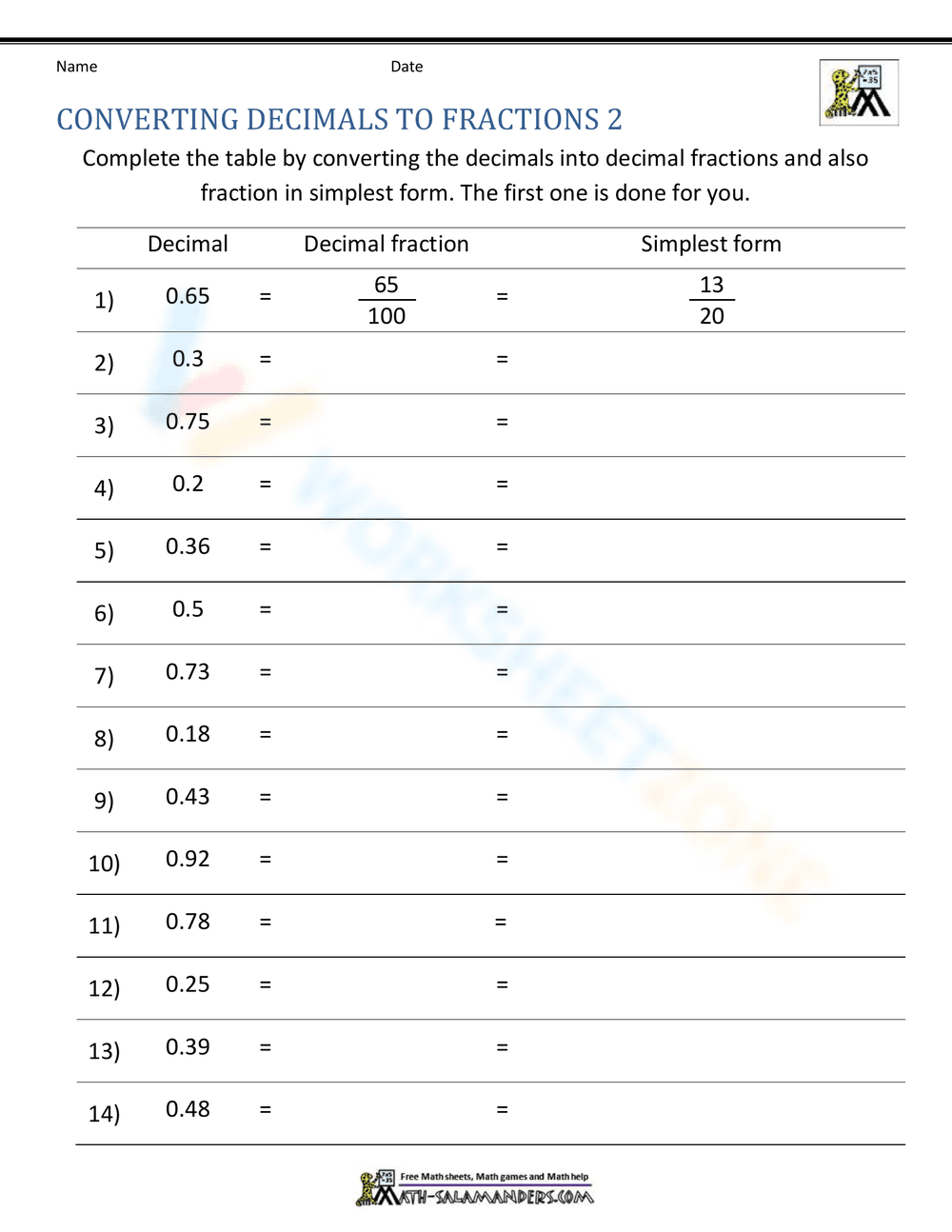
This is a math worksheet titled 'Converting Decimals to Fractions 2.' It presents a table with three columns: Decimal, Decimal Fraction, and Simplest Form. Students are tasked with converting decimals (like 0.3, 0.75, 0.2, 0.36, 0.5, 0.73, 0.18, 0.43, 0.92, 0.78, 0.25, 0.39, and 0.48) into their corresponding decimal fractions and then simplifying those fractions. The first row (0.65 = 65/100 = 13/20) is provided as an example.
Grade Level Suitability:
This worksheet is suitable for grades 4-6. It builds upon basic fraction concepts and introduces the process of converting decimals to fractions and simplifying them. The decimals provided are within a range that is manageable for students in these grade levels.
Why Use It:
This worksheet helps students develop a strong understanding of the relationship between decimals and fractions. It reinforces fraction simplification skills and provides practice in converting between different representations of the same number. It enhances number sense and mathematical fluency.
How to Use It:
Students should first convert each decimal into its equivalent decimal fraction (e.g., 0.3 becomes 3/10). Then, they should simplify the fraction to its simplest form (e.g., 3/10 is already in simplest form, but 0.25 or 25/100 would simplify to 1/4). They write the decimal fraction and simplified fraction in the table.
Target Users:
This worksheet is designed for elementary and middle school students who are learning about decimals and fractions. It's beneficial for students who need extra practice with conversion and simplification. It can also be used for review or as a supplementary activity.
This is a math worksheet titled 'Converting Decimals to Fractions 2.' It presents a table with three columns: Decimal, Decimal Fraction, and Simplest Form. Students are tasked with converting decimals (like 0.3, 0.75, 0.2, 0.36, 0.5, 0.73, 0.18, 0.43, 0.92, 0.78, 0.25, 0.39, and 0.48) into their corresponding decimal fractions and then simplifying those fractions. The first row (0.65 = 65/100 = 13/20) is provided as an example.
Grade Level Suitability:
This worksheet is suitable for grades 4-6. It builds upon basic fraction concepts and introduces the process of converting decimals to fractions and simplifying them. The decimals provided are within a range that is manageable for students in these grade levels.
Why Use It:
This worksheet helps students develop a strong understanding of the relationship between decimals and fractions. It reinforces fraction simplification skills and provides practice in converting between different representations of the same number. It enhances number sense and mathematical fluency.
How to Use It:
Students should first convert each decimal into its equivalent decimal fraction (e.g., 0.3 becomes 3/10). Then, they should simplify the fraction to its simplest form (e.g., 3/10 is already in simplest form, but 0.25 or 25/100 would simplify to 1/4). They write the decimal fraction and simplified fraction in the table.
Target Users:
This worksheet is designed for elementary and middle school students who are learning about decimals and fractions. It's beneficial for students who need extra practice with conversion and simplification. It can also be used for review or as a supplementary activity.


