


























1 / 4
0
Views
0
Downloads




0.0
0
0 Likes
Practice Counting Atoms in Chemical Formulas
0 Views
0 Downloads
Paste this activity's link or code into your existing LMS (Google Classroom, Canvas, Teams, Schoology, Moodle, etc.).
Students can open and work on the activity right away, with no student login required.
You'll still be able to track student progress and results from your teacher account.
Information
Description
What It Is:
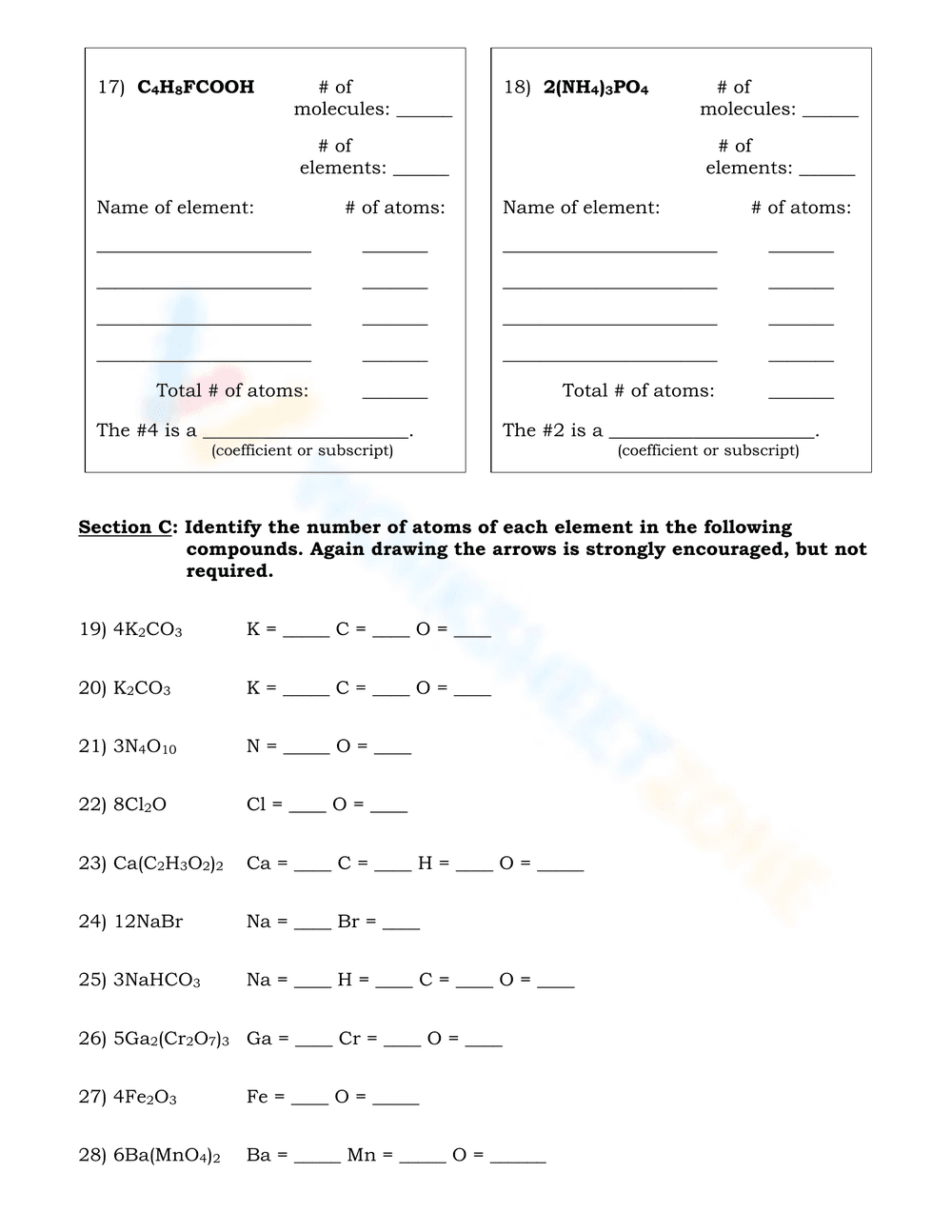
This is a chemistry worksheet focused on 'Counting Atoms Practice.' It provides chemical formulas (e.g., 3MgCl₂) and asks students to identify the coefficient and subscripts for each element within the formula. The worksheet includes spaces for students to write their answers for coefficient and subscripts. The instructions specify that if there is no coefficient or subscript, students should write 'none.'
Grade Level Suitability:
This worksheet is suitable for grades 9-12, specifically for high school chemistry students. It requires an understanding of chemical formulas, coefficients, and subscripts, which are typically introduced in high school chemistry courses.
Why Use It:
This worksheet reinforces the fundamental skill of interpreting chemical formulas and understanding the quantitative relationships between atoms in a molecule or compound. It helps students practice identifying coefficients and subscripts, which is essential for balancing chemical equations and performing stoichiometric calculations.
How to Use It:
Students should use their chemistry notes and a periodic table as references. For each chemical formula provided, they need to identify the coefficient (the number in front of the formula) and the subscript for each element (the small number after the element symbol). If no number is present, they should write 'none.' For example, in 3MgCl₂, the coefficient is 3, the subscript for Mg is 1 (implied), and the subscript for Cl is 2.
Target Users:
The target users are high school chemistry students learning about chemical formulas, coefficients, and subscripts. It is also useful for students who need additional practice in identifying the number of atoms of each element in a given chemical formula.
This is a chemistry worksheet focused on 'Counting Atoms Practice.' It provides chemical formulas (e.g., 3MgCl₂) and asks students to identify the coefficient and subscripts for each element within the formula. The worksheet includes spaces for students to write their answers for coefficient and subscripts. The instructions specify that if there is no coefficient or subscript, students should write 'none.'
Grade Level Suitability:
This worksheet is suitable for grades 9-12, specifically for high school chemistry students. It requires an understanding of chemical formulas, coefficients, and subscripts, which are typically introduced in high school chemistry courses.
Why Use It:
This worksheet reinforces the fundamental skill of interpreting chemical formulas and understanding the quantitative relationships between atoms in a molecule or compound. It helps students practice identifying coefficients and subscripts, which is essential for balancing chemical equations and performing stoichiometric calculations.
How to Use It:
Students should use their chemistry notes and a periodic table as references. For each chemical formula provided, they need to identify the coefficient (the number in front of the formula) and the subscript for each element (the small number after the element symbol). If no number is present, they should write 'none.' For example, in 3MgCl₂, the coefficient is 3, the subscript for Mg is 1 (implied), and the subscript for Cl is 2.
Target Users:
The target users are high school chemistry students learning about chemical formulas, coefficients, and subscripts. It is also useful for students who need additional practice in identifying the number of atoms of each element in a given chemical formula.


