


























0
Views
0
Downloads

0.0
0
0 Likes
Understanding Covalent Compounds Worksheet
0 Views
0 Downloads
Paste this activity's link or code into your existing LMS (Google Classroom, Canvas, Teams, Schoology, Moodle, etc.).
Students can open and work on the activity right away, with no student login required.
You'll still be able to track student progress and results from your teacher account.
Information
Description
What It Is:
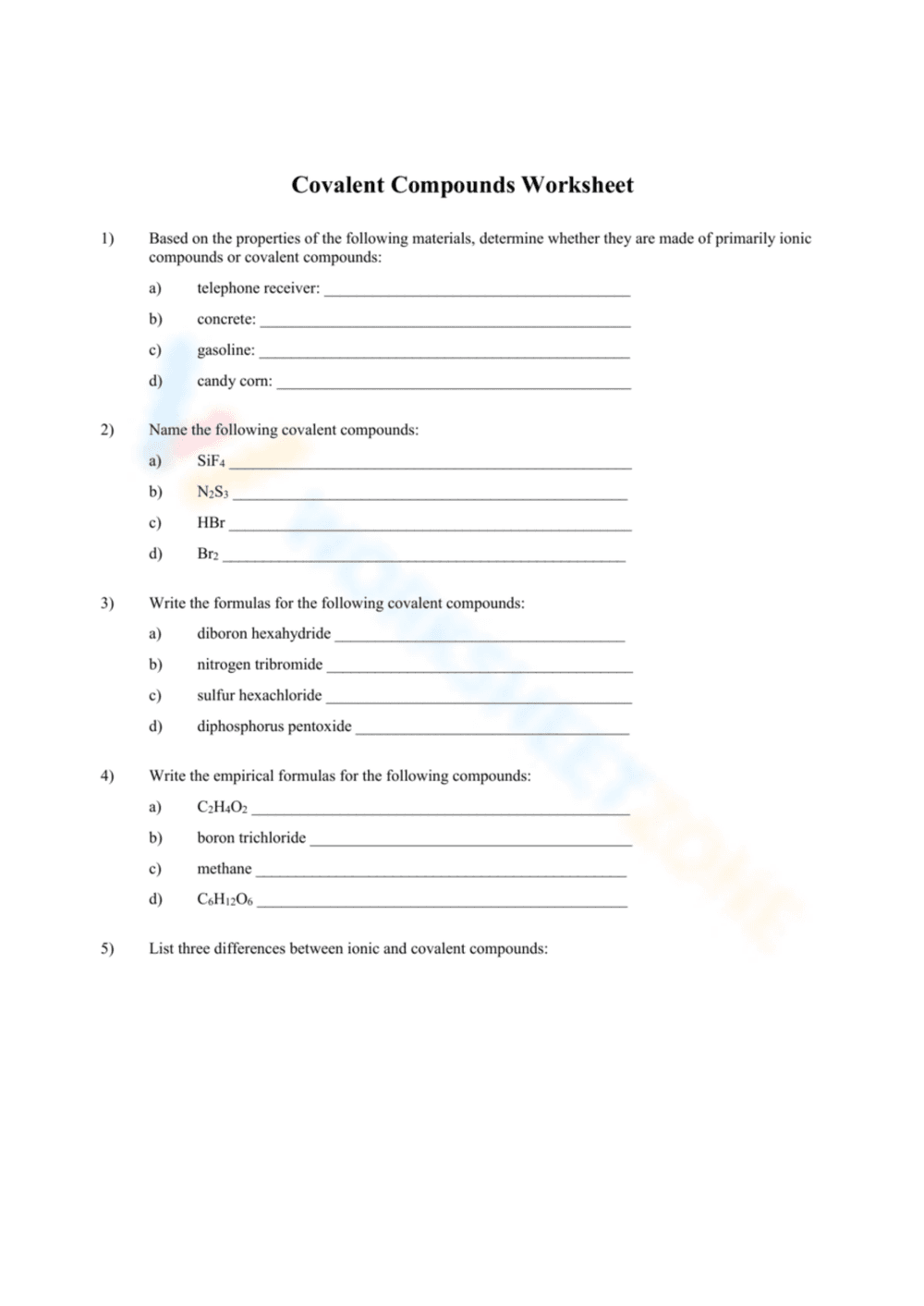
This is a chemistry worksheet focused on covalent compounds. It includes five sections: determining whether materials are ionic or covalent, naming covalent compounds (SiF4, N2S5, HBr, Br2), writing formulas for covalent compounds (diboron hexahydride, nitrogen tribromide, sulfur hexachloride, diphosphorus pentoxide), writing empirical formulas (C2H4O2, boron trichloride, methane, C6H12O6), and listing three differences between ionic and covalent compounds.
Grade Level Suitability:
This worksheet is most suitable for high school chemistry students, typically grades 9-12. It requires knowledge of chemical nomenclature, formula writing, and the properties of ionic and covalent compounds, which are concepts usually covered in high school chemistry courses.
Why Use It:
This worksheet helps students practice identifying and naming covalent compounds, writing chemical formulas, and distinguishing between ionic and covalent bonding. It reinforces key concepts in chemical bonding and nomenclature, improving students' understanding and application of these principles.
How to Use It:
Students should read each question carefully and use their knowledge of chemical nomenclature and bonding to answer. For the first section, they need to analyze the properties of the listed materials and determine if they are primarily ionic or covalent. For sections 2-4, they should name or write formulas based on the given information. For the last section, they should list three differences between ionic and covalent compounds.
Target Users:
The target users are high school chemistry students who are learning about covalent compounds and chemical bonding. It can also be used as a review or practice tool for students who have already learned these concepts.
This is a chemistry worksheet focused on covalent compounds. It includes five sections: determining whether materials are ionic or covalent, naming covalent compounds (SiF4, N2S5, HBr, Br2), writing formulas for covalent compounds (diboron hexahydride, nitrogen tribromide, sulfur hexachloride, diphosphorus pentoxide), writing empirical formulas (C2H4O2, boron trichloride, methane, C6H12O6), and listing three differences between ionic and covalent compounds.
Grade Level Suitability:
This worksheet is most suitable for high school chemistry students, typically grades 9-12. It requires knowledge of chemical nomenclature, formula writing, and the properties of ionic and covalent compounds, which are concepts usually covered in high school chemistry courses.
Why Use It:
This worksheet helps students practice identifying and naming covalent compounds, writing chemical formulas, and distinguishing between ionic and covalent bonding. It reinforces key concepts in chemical bonding and nomenclature, improving students' understanding and application of these principles.
How to Use It:
Students should read each question carefully and use their knowledge of chemical nomenclature and bonding to answer. For the first section, they need to analyze the properties of the listed materials and determine if they are primarily ionic or covalent. For sections 2-4, they should name or write formulas based on the given information. For the last section, they should list three differences between ionic and covalent compounds.
Target Users:
The target users are high school chemistry students who are learning about covalent compounds and chemical bonding. It can also be used as a review or practice tool for students who have already learned these concepts.


