


























1 / 3
0
Views
0
Downloads


0.0
0
0 Likes
Updated Covalent Naming Practice
0 Views
0 Downloads
Paste this activity's link or code into your existing LMS (Google Classroom, Canvas, Teams, Schoology, Moodle, etc.).
Students can open and work on the activity right away, with no student login required.
You'll still be able to track student progress and results from your teacher account.
Information
Description
What It Is:
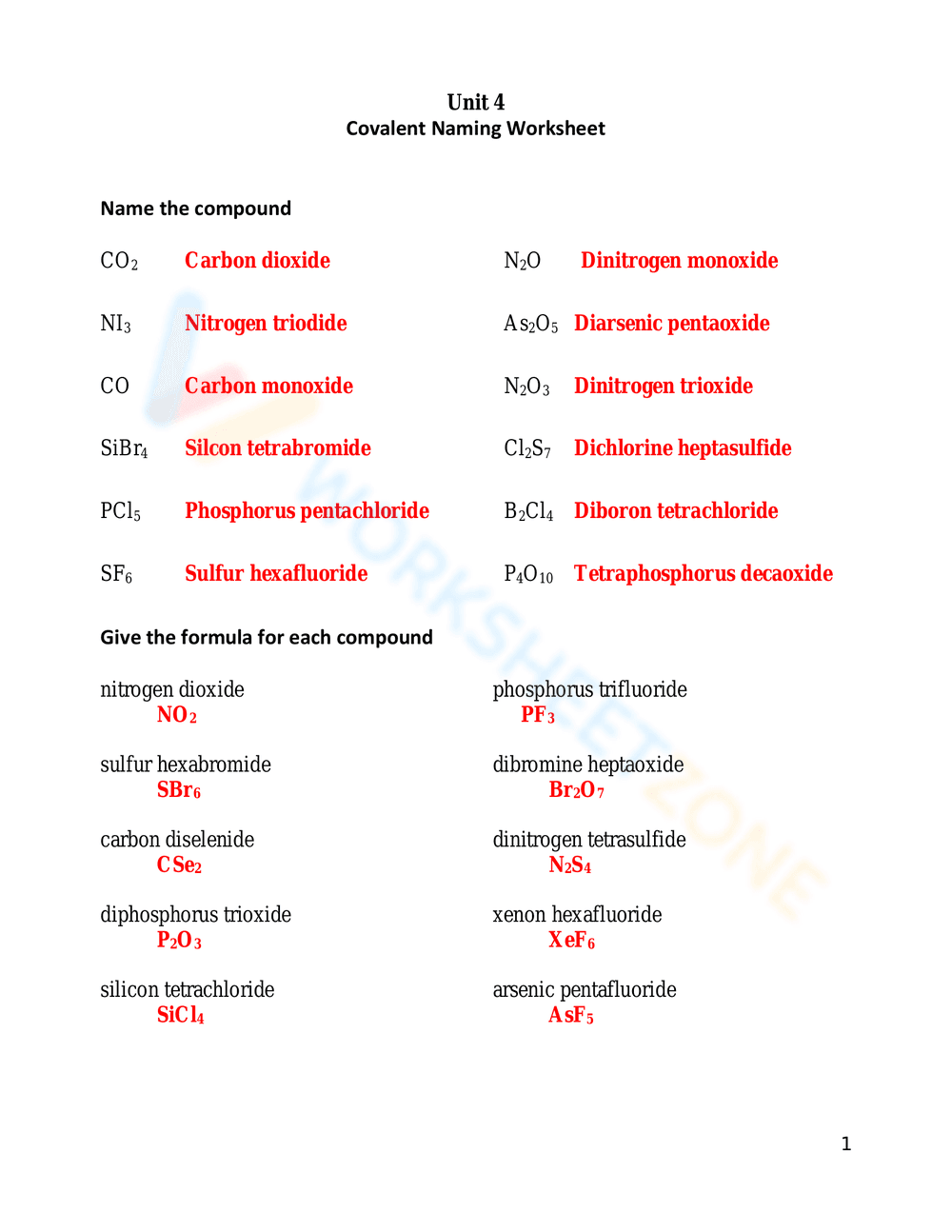
This is a chemistry worksheet focused on covalent naming conventions. The worksheet has two sections. The first section provides chemical formulas (e.g., CO2, N2O) and asks the student to name the compound (e.g., Carbon dioxide, Dinitrogen monoxide). The second section provides the names of chemical compounds (e.g., nitrogen dioxide, phosphorus trifluoride) and asks the student to provide the corresponding chemical formula (e.g., NO2, PF3).
Grade Level Suitability:
This worksheet is suitable for high school chemistry students, typically grades 9-12. It assumes a basic understanding of chemical symbols, prefixes indicating the number of atoms (e.g., di-, tri-, tetra-), and the rules for naming covalent compounds.
Why Use It:
This worksheet provides practice in associating chemical formulas with their corresponding names and vice versa. It reinforces understanding of nomenclature rules for covalent compounds, improving students' ability to communicate chemical information accurately and understand chemical reactions.
How to Use It:
Students should first review the rules for naming covalent compounds. Then, they should work through each section, either naming the compound from the formula or writing the formula from the name. Answers can be checked against a textbook or provided answer key.
Target Users:
The target users are high school chemistry students learning about chemical nomenclature, as well as teachers who need a supplemental exercise to reinforce covalent naming concepts. It can also be used for review or independent study.
This is a chemistry worksheet focused on covalent naming conventions. The worksheet has two sections. The first section provides chemical formulas (e.g., CO2, N2O) and asks the student to name the compound (e.g., Carbon dioxide, Dinitrogen monoxide). The second section provides the names of chemical compounds (e.g., nitrogen dioxide, phosphorus trifluoride) and asks the student to provide the corresponding chemical formula (e.g., NO2, PF3).
Grade Level Suitability:
This worksheet is suitable for high school chemistry students, typically grades 9-12. It assumes a basic understanding of chemical symbols, prefixes indicating the number of atoms (e.g., di-, tri-, tetra-), and the rules for naming covalent compounds.
Why Use It:
This worksheet provides practice in associating chemical formulas with their corresponding names and vice versa. It reinforces understanding of nomenclature rules for covalent compounds, improving students' ability to communicate chemical information accurately and understand chemical reactions.
How to Use It:
Students should first review the rules for naming covalent compounds. Then, they should work through each section, either naming the compound from the formula or writing the formula from the name. Answers can be checked against a textbook or provided answer key.
Target Users:
The target users are high school chemistry students learning about chemical nomenclature, as well as teachers who need a supplemental exercise to reinforce covalent naming concepts. It can also be used for review or independent study.


