


























0
Views
0
Downloads

0 Likes
Practice with Dalton's Law of Partial Pressure
0 Views
0 Downloads
Paste this activity's link or code into your existing LMS (Google Classroom, Canvas, Teams, Schoology, Moodle, etc.).
Students can open and work on the activity right away, with no student login required.
You'll still be able to track student progress and results from your teacher account.
Information
Description
What It Is:
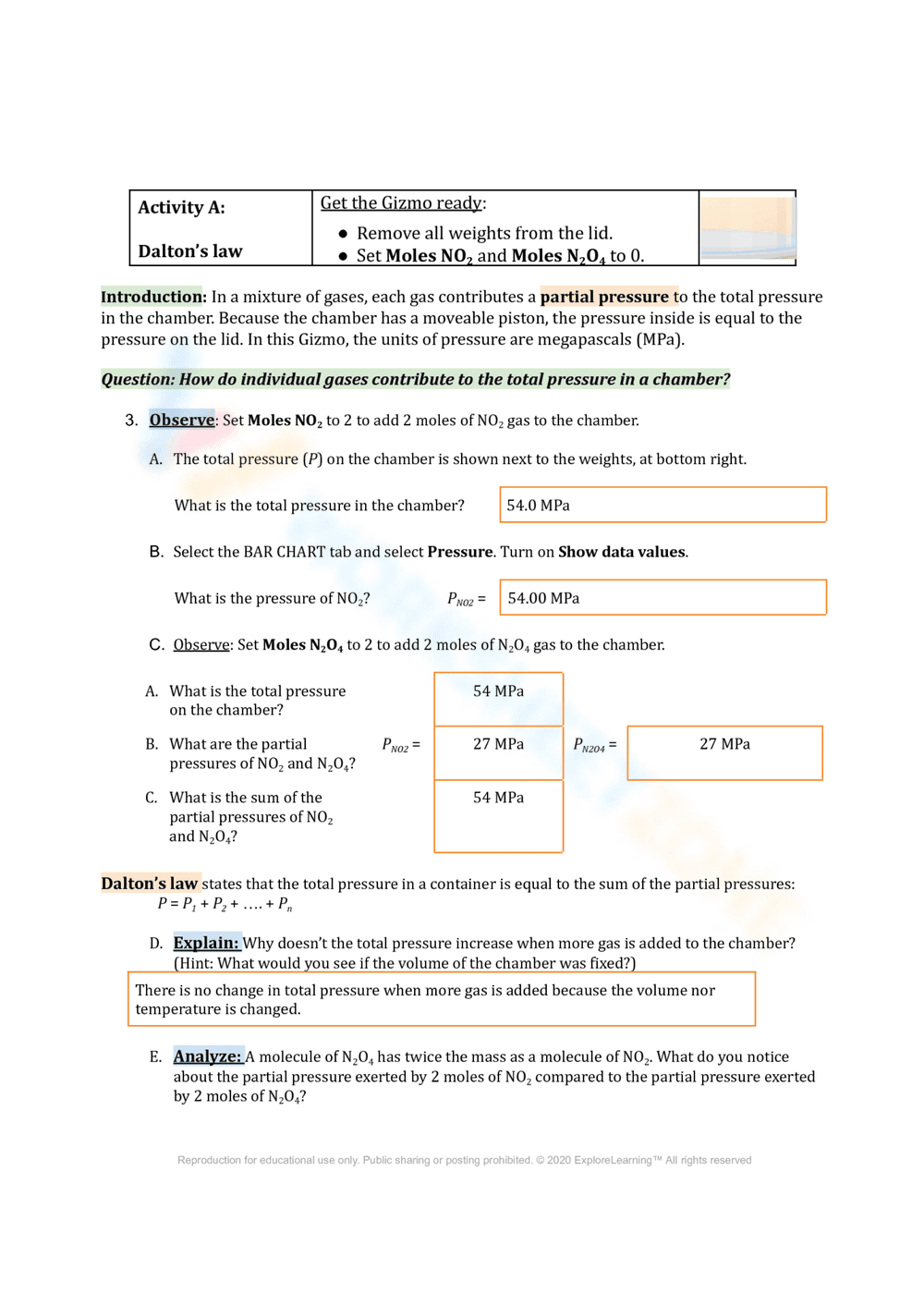
This is a chemistry worksheet focused on Dalton's Law of Partial Pressures. The worksheet guides students through an activity involving setting moles of NO and N2O4 in a chamber. It includes observe, explain, and analyze sections, asking students to calculate total pressure, partial pressures, and explain the relationship between adding gas and total pressure, considering a movable piston. There are questions about the sum of partial pressures and how it relates to total pressure.
Grade Level Suitability:
This worksheet is suitable for high school chemistry, specifically grades 11-12. It requires an understanding of gas laws, partial pressures, and stoichiometry, which are typically covered in advanced chemistry courses.
Why Use It:
This worksheet helps students understand Dalton's Law of Partial Pressures through a guided activity. It reinforces the concept that the total pressure of a gas mixture is the sum of the partial pressures of each component. It also encourages critical thinking by asking students to explain and analyze the relationship between gas addition, volume, and pressure.
How to Use It:
Students should follow the instructions to set the moles of NO and N2O4. They should then observe the resulting total pressure and partial pressures. Students will then answer the questions, calculating total pressure, partial pressures, and explaining the concepts related to Dalton's Law. The worksheet prompts students to analyze the relationship between the molar mass of the gases and the partial pressures they exert.
Target Users:
The target users are high school chemistry students learning about gas laws and partial pressures. It's suitable for students who need practice applying Dalton's Law and understanding the relationship between pressure, volume, and the number of moles of gas.
This is a chemistry worksheet focused on Dalton's Law of Partial Pressures. The worksheet guides students through an activity involving setting moles of NO and N2O4 in a chamber. It includes observe, explain, and analyze sections, asking students to calculate total pressure, partial pressures, and explain the relationship between adding gas and total pressure, considering a movable piston. There are questions about the sum of partial pressures and how it relates to total pressure.
Grade Level Suitability:
This worksheet is suitable for high school chemistry, specifically grades 11-12. It requires an understanding of gas laws, partial pressures, and stoichiometry, which are typically covered in advanced chemistry courses.
Why Use It:
This worksheet helps students understand Dalton's Law of Partial Pressures through a guided activity. It reinforces the concept that the total pressure of a gas mixture is the sum of the partial pressures of each component. It also encourages critical thinking by asking students to explain and analyze the relationship between gas addition, volume, and pressure.
How to Use It:
Students should follow the instructions to set the moles of NO and N2O4. They should then observe the resulting total pressure and partial pressures. Students will then answer the questions, calculating total pressure, partial pressures, and explaining the concepts related to Dalton's Law. The worksheet prompts students to analyze the relationship between the molar mass of the gases and the partial pressures they exert.
Target Users:
The target users are high school chemistry students learning about gas laws and partial pressures. It's suitable for students who need practice applying Dalton's Law and understanding the relationship between pressure, volume, and the number of moles of gas.


