


























0
Views
0
Downloads

0 Likes
DBT Chain Analysis Worksheet
0 Views
0 Downloads
Paste this activity's link or code into your existing LMS (Google Classroom, Canvas, Teams, Schoology, Moodle, etc.).
Students can open and work on the activity right away, with no student login required.
You'll still be able to track student progress and results from your teacher account.
Information
Description
What It Is:
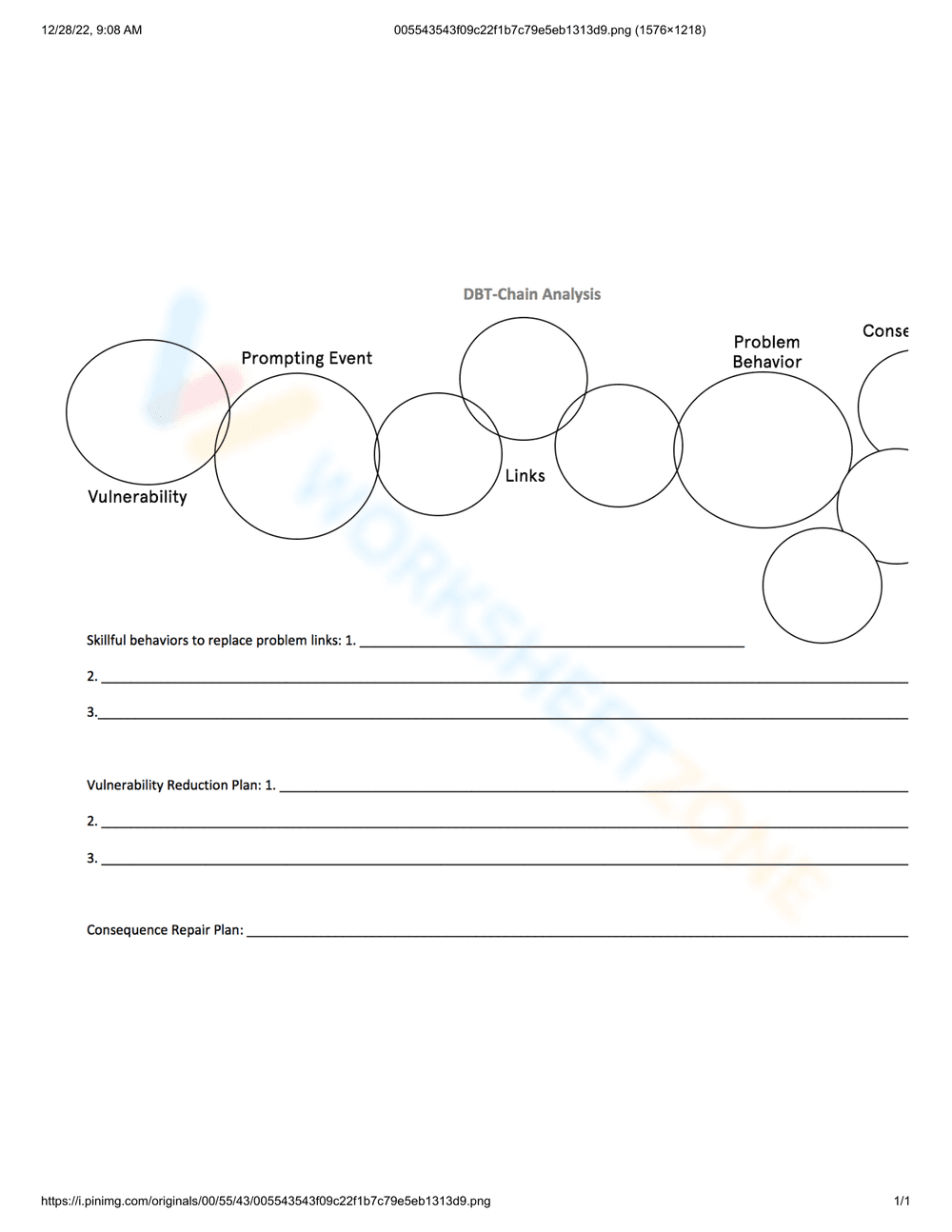
This is a DBT (Dialectical Behavior Therapy) Chain Analysis worksheet. It includes a diagram with connected circles labeled 'Vulnerability,' 'Prompting Event,' 'Links,' 'Problem Behavior,' and 'Consequences.' Below the diagram are blank lines for writing 'Skillful behaviors to replace problem links,' 'Vulnerability Reduction Plan,' and 'Consequence Repair Plan.'
Grade Level Suitability:
This worksheet is most suitable for high school students and adults. The concepts of DBT and chain analysis require a level of cognitive and emotional maturity to understand and apply effectively.
Why Use It:
This worksheet helps individuals analyze a problem behavior by breaking it down into a sequence of events and vulnerabilities. It promotes self-awareness, problem-solving skills, and the development of coping strategies to prevent future occurrences of the problem behavior. It also facilitates the creation of plans to reduce vulnerability and repair consequences.
How to Use It:
Start by identifying a specific problem behavior you want to analyze. Work backward from the problem behavior, filling in the 'Prompting Event' that triggered it. Identify any vulnerabilities that made you susceptible to the prompting event. Trace the 'Links' or chain of events that led from the prompting event to the problem behavior. Note the consequences of the problem behavior. Then, brainstorm skillful behaviors to replace the problem links, a plan to reduce vulnerability in the future, and a plan to repair any negative consequences.
Target Users:
This worksheet is beneficial for individuals in therapy, particularly those learning DBT skills. It can also be used by counselors, therapists, and educators working with individuals who want to understand and change problematic behaviors.
This is a DBT (Dialectical Behavior Therapy) Chain Analysis worksheet. It includes a diagram with connected circles labeled 'Vulnerability,' 'Prompting Event,' 'Links,' 'Problem Behavior,' and 'Consequences.' Below the diagram are blank lines for writing 'Skillful behaviors to replace problem links,' 'Vulnerability Reduction Plan,' and 'Consequence Repair Plan.'
Grade Level Suitability:
This worksheet is most suitable for high school students and adults. The concepts of DBT and chain analysis require a level of cognitive and emotional maturity to understand and apply effectively.
Why Use It:
This worksheet helps individuals analyze a problem behavior by breaking it down into a sequence of events and vulnerabilities. It promotes self-awareness, problem-solving skills, and the development of coping strategies to prevent future occurrences of the problem behavior. It also facilitates the creation of plans to reduce vulnerability and repair consequences.
How to Use It:
Start by identifying a specific problem behavior you want to analyze. Work backward from the problem behavior, filling in the 'Prompting Event' that triggered it. Identify any vulnerabilities that made you susceptible to the prompting event. Trace the 'Links' or chain of events that led from the prompting event to the problem behavior. Note the consequences of the problem behavior. Then, brainstorm skillful behaviors to replace the problem links, a plan to reduce vulnerability in the future, and a plan to repair any negative consequences.
Target Users:
This worksheet is beneficial for individuals in therapy, particularly those learning DBT skills. It can also be used by counselors, therapists, and educators working with individuals who want to understand and change problematic behaviors.


