


























0
Views
0
Downloads

0 Likes
Density and Volume in Metric Worksheet
0 Views
0 Downloads
Paste this activity's link or code into your existing LMS (Google Classroom, Canvas, Teams, Schoology, Moodle, etc.).
Students can open and work on the activity right away, with no student login required.
You'll still be able to track student progress and results from your teacher account.
Information
Description
What It Is:
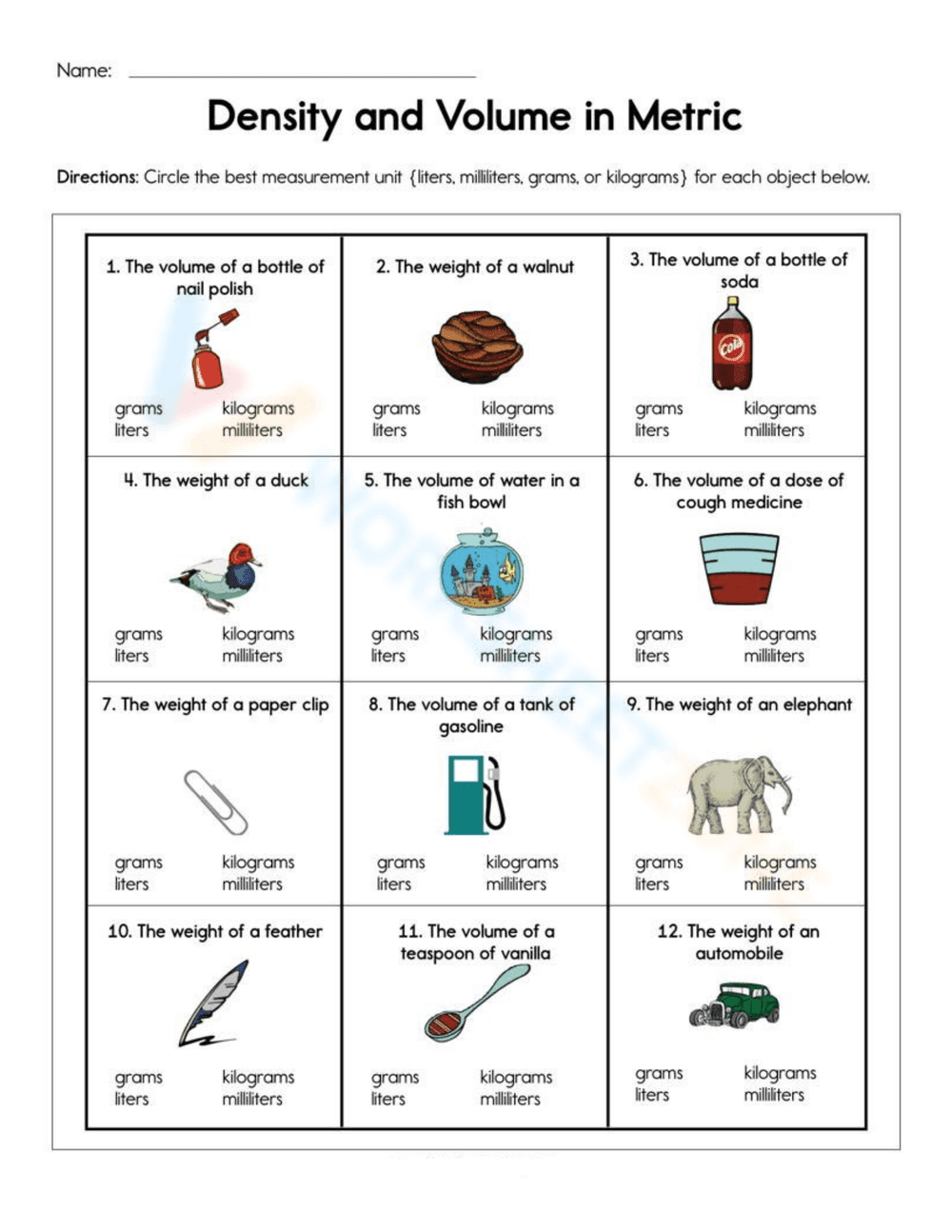
This is a worksheet titled 'Density and Volume in Metric.' It presents 12 different objects (e.g., a bottle of nail polish, a walnut, a bottle of soda, a duck, a fishbowl, cough medicine, a paper clip, a gasoline tank, an elephant, a feather, a teaspoon of vanilla, and an automobile) and asks the student to circle the best measurement unit (liters, milliliters, grams, or kilograms) for each object.
Grade Level Suitability:
This worksheet is suitable for grades 3-5. It requires students to understand the basic units of metric measurement (grams, kilograms, liters, milliliters) and apply them to real-world objects. The objects are familiar, and the task is relatively straightforward, making it accessible to this age group.
Why Use It:
This worksheet helps students develop an intuitive understanding of metric units and their appropriate use in measuring volume and weight/mass. It reinforces the concepts of density and volume by connecting them to tangible objects, improving measurement estimation skills.
How to Use It:
Students should read the directions and then examine each object pictured. For each object, they should consider whether it is best measured by its weight (grams or kilograms) or its volume (liters or milliliters). Then, they should circle the most appropriate unit of measurement from the options provided.
Target Users:
This worksheet is ideal for elementary school students learning about metric measurement, particularly those in grades 3-5. It is also helpful for students who need extra practice in choosing the appropriate units for measuring real-world objects.
This is a worksheet titled 'Density and Volume in Metric.' It presents 12 different objects (e.g., a bottle of nail polish, a walnut, a bottle of soda, a duck, a fishbowl, cough medicine, a paper clip, a gasoline tank, an elephant, a feather, a teaspoon of vanilla, and an automobile) and asks the student to circle the best measurement unit (liters, milliliters, grams, or kilograms) for each object.
Grade Level Suitability:
This worksheet is suitable for grades 3-5. It requires students to understand the basic units of metric measurement (grams, kilograms, liters, milliliters) and apply them to real-world objects. The objects are familiar, and the task is relatively straightforward, making it accessible to this age group.
Why Use It:
This worksheet helps students develop an intuitive understanding of metric units and their appropriate use in measuring volume and weight/mass. It reinforces the concepts of density and volume by connecting them to tangible objects, improving measurement estimation skills.
How to Use It:
Students should read the directions and then examine each object pictured. For each object, they should consider whether it is best measured by its weight (grams or kilograms) or its volume (liters or milliliters). Then, they should circle the most appropriate unit of measurement from the options provided.
Target Users:
This worksheet is ideal for elementary school students learning about metric measurement, particularly those in grades 3-5. It is also helpful for students who need extra practice in choosing the appropriate units for measuring real-world objects.


