


























1 / 2
0
Views
0
Downloads


0.0
0
0 Likes
Comprehensive Density Practice Worksheet
0 Views
0 Downloads
Paste this activity's link or code into your existing LMS (Google Classroom, Canvas, Teams, Schoology, Moodle, etc.).
Students can open and work on the activity right away, with no student login required.
You'll still be able to track student progress and results from your teacher account.
Information
Description
What It Is:
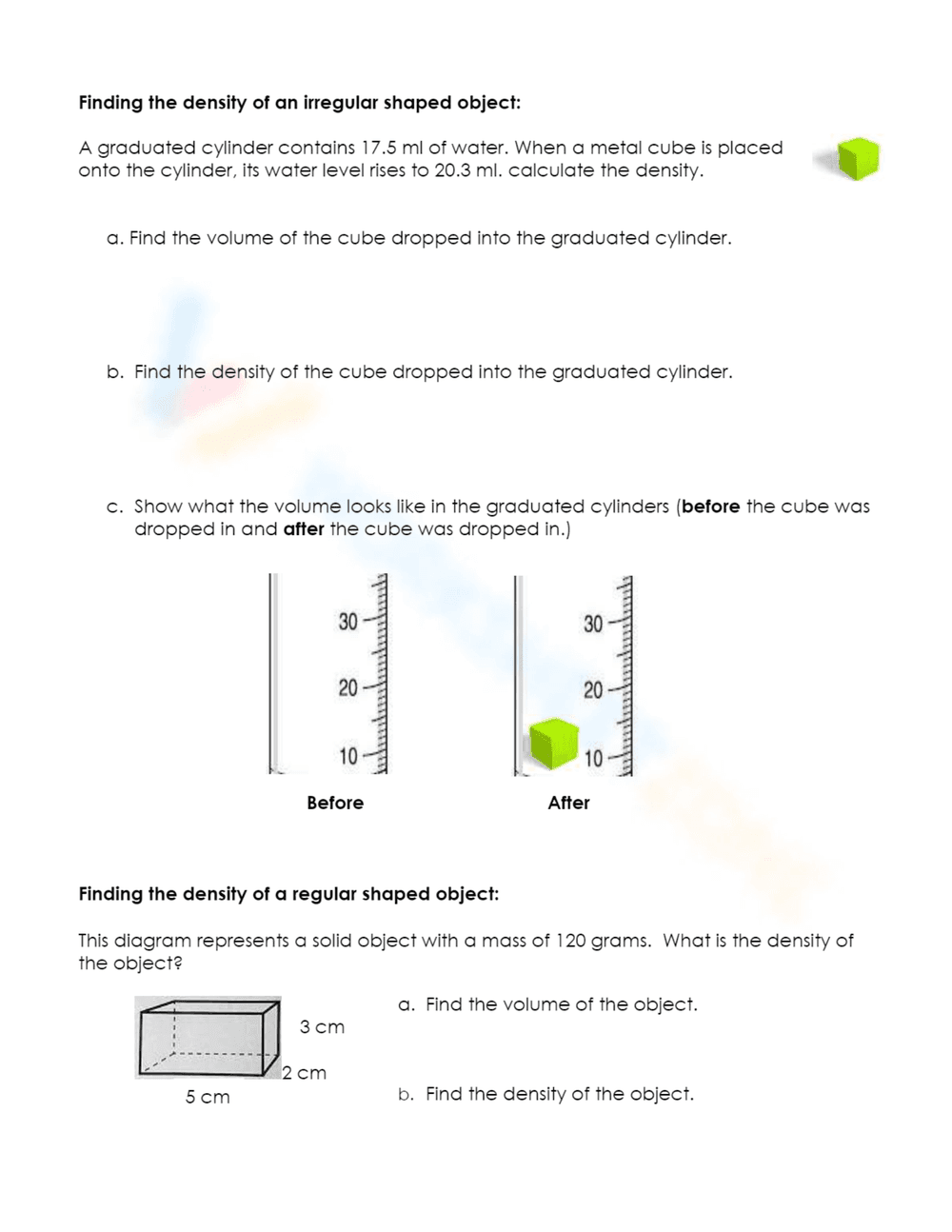
This is a density worksheet. It includes questions asking for the definitions of mass and volume, the units of measurement for mass, liquid volume and solid volume, and the formula to calculate density. It also contains word problems where students calculate the volume and density of a rectangular solid and an irregularly shaped object using the water displacement method in a graduated cylinder.
Grade Level Suitability:
Suitable for grades 6-9. It requires understanding of basic definitions, units of measurement, and applying formulas to calculate volume and density. The word problems involve metric units and require some problem-solving skills.
Why Use It:
This worksheet reinforces the concepts of mass, volume, and density. It helps students learn the correct units of measurement and apply the density formula to solve real-world problems. It also teaches the water displacement method for finding the volume of irregular objects.
How to Use It:
Students should first define mass, volume, and density, and identify the correct units of measurement. Then, they should calculate the volume of the rectangular solid using the given dimensions, and then calculate the density. For the irregular object, they need to subtract the initial water volume from the final volume to find the volume of the object, and then calculate the density.
Target Users:
This worksheet is designed for middle school and early high school students learning about density in science or physics classes. It can be used as a homework assignment, in-class activity, or review worksheet.
This is a density worksheet. It includes questions asking for the definitions of mass and volume, the units of measurement for mass, liquid volume and solid volume, and the formula to calculate density. It also contains word problems where students calculate the volume and density of a rectangular solid and an irregularly shaped object using the water displacement method in a graduated cylinder.
Grade Level Suitability:
Suitable for grades 6-9. It requires understanding of basic definitions, units of measurement, and applying formulas to calculate volume and density. The word problems involve metric units and require some problem-solving skills.
Why Use It:
This worksheet reinforces the concepts of mass, volume, and density. It helps students learn the correct units of measurement and apply the density formula to solve real-world problems. It also teaches the water displacement method for finding the volume of irregular objects.
How to Use It:
Students should first define mass, volume, and density, and identify the correct units of measurement. Then, they should calculate the volume of the rectangular solid using the given dimensions, and then calculate the density. For the irregular object, they need to subtract the initial water volume from the final volume to find the volume of the object, and then calculate the density.
Target Users:
This worksheet is designed for middle school and early high school students learning about density in science or physics classes. It can be used as a homework assignment, in-class activity, or review worksheet.


