


























0
Views
0
Downloads

0.0
0
0 Likes
Determine Oxidation Number: Valence Number Practice
0 Views
0 Downloads
Paste this activity's link or code into your existing LMS (Google Classroom, Canvas, Teams, Schoology, Moodle, etc.).
Students can open and work on the activity right away, with no student login required.
You'll still be able to track student progress and results from your teacher account.
Information
Description
What It Is:
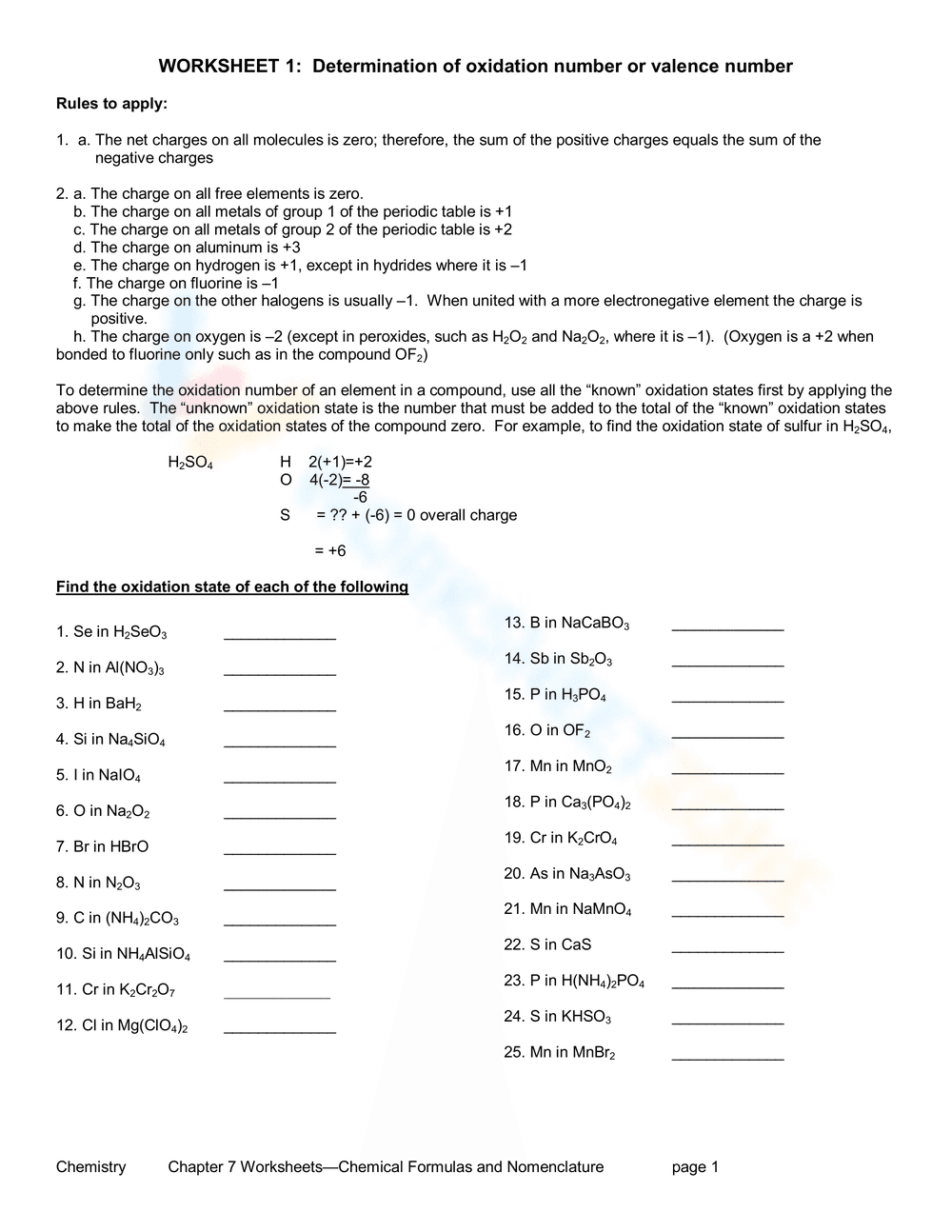
This is a chemistry worksheet titled 'Determination of oxidation number or valence number.' It provides rules for determining oxidation numbers of elements in compounds. It also shows an example calculation for H2SO4. The worksheet then presents a list of 25 chemical formulas, such as Se in H2SeO3 and Mn in MnBr2, and asks the student to find the oxidation state of the specified element in each compound, with space provided for the answers.
Grade Level Suitability:
This worksheet is suitable for high school (Grades 10-12) and introductory college chemistry courses. The concepts of oxidation numbers and chemical formulas are typically introduced at these levels. The complexity of the compounds suggests a good understanding of chemical bonding and nomenclature is needed.
Why Use It:
This worksheet provides practice in applying rules for determining oxidation numbers, a fundamental concept in chemistry. It helps students understand the relationship between chemical formulas and oxidation states, and reinforces their knowledge of chemical nomenclature. Mastering this skill is essential for understanding redox reactions and balancing chemical equations.
How to Use It:
Students should first review the provided rules for determining oxidation numbers. Then, for each compound, they should identify the known oxidation states of the elements present. Using the rule that the sum of oxidation states in a neutral compound is zero, they can calculate the unknown oxidation state of the specified element. The answer should be written in the provided space.
Target Users:
The target users are high school chemistry students, introductory college chemistry students, and anyone who needs to practice or review the concept of oxidation numbers. It is also useful for teachers looking for practice materials for their students.
This is a chemistry worksheet titled 'Determination of oxidation number or valence number.' It provides rules for determining oxidation numbers of elements in compounds. It also shows an example calculation for H2SO4. The worksheet then presents a list of 25 chemical formulas, such as Se in H2SeO3 and Mn in MnBr2, and asks the student to find the oxidation state of the specified element in each compound, with space provided for the answers.
Grade Level Suitability:
This worksheet is suitable for high school (Grades 10-12) and introductory college chemistry courses. The concepts of oxidation numbers and chemical formulas are typically introduced at these levels. The complexity of the compounds suggests a good understanding of chemical bonding and nomenclature is needed.
Why Use It:
This worksheet provides practice in applying rules for determining oxidation numbers, a fundamental concept in chemistry. It helps students understand the relationship between chemical formulas and oxidation states, and reinforces their knowledge of chemical nomenclature. Mastering this skill is essential for understanding redox reactions and balancing chemical equations.
How to Use It:
Students should first review the provided rules for determining oxidation numbers. Then, for each compound, they should identify the known oxidation states of the elements present. Using the rule that the sum of oxidation states in a neutral compound is zero, they can calculate the unknown oxidation state of the specified element. The answer should be written in the provided space.
Target Users:
The target users are high school chemistry students, introductory college chemistry students, and anyone who needs to practice or review the concept of oxidation numbers. It is also useful for teachers looking for practice materials for their students.


