


























0
Views
0
Downloads

0.0
0
0 Likes
Diffusion Osmosis: Understanding Cell Transport
0 Views
0 Downloads
Paste this activity's link or code into your existing LMS (Google Classroom, Canvas, Teams, Schoology, Moodle, etc.).
Students can open and work on the activity right away, with no student login required.
You'll still be able to track student progress and results from your teacher account.
Information
Description
What It Is:
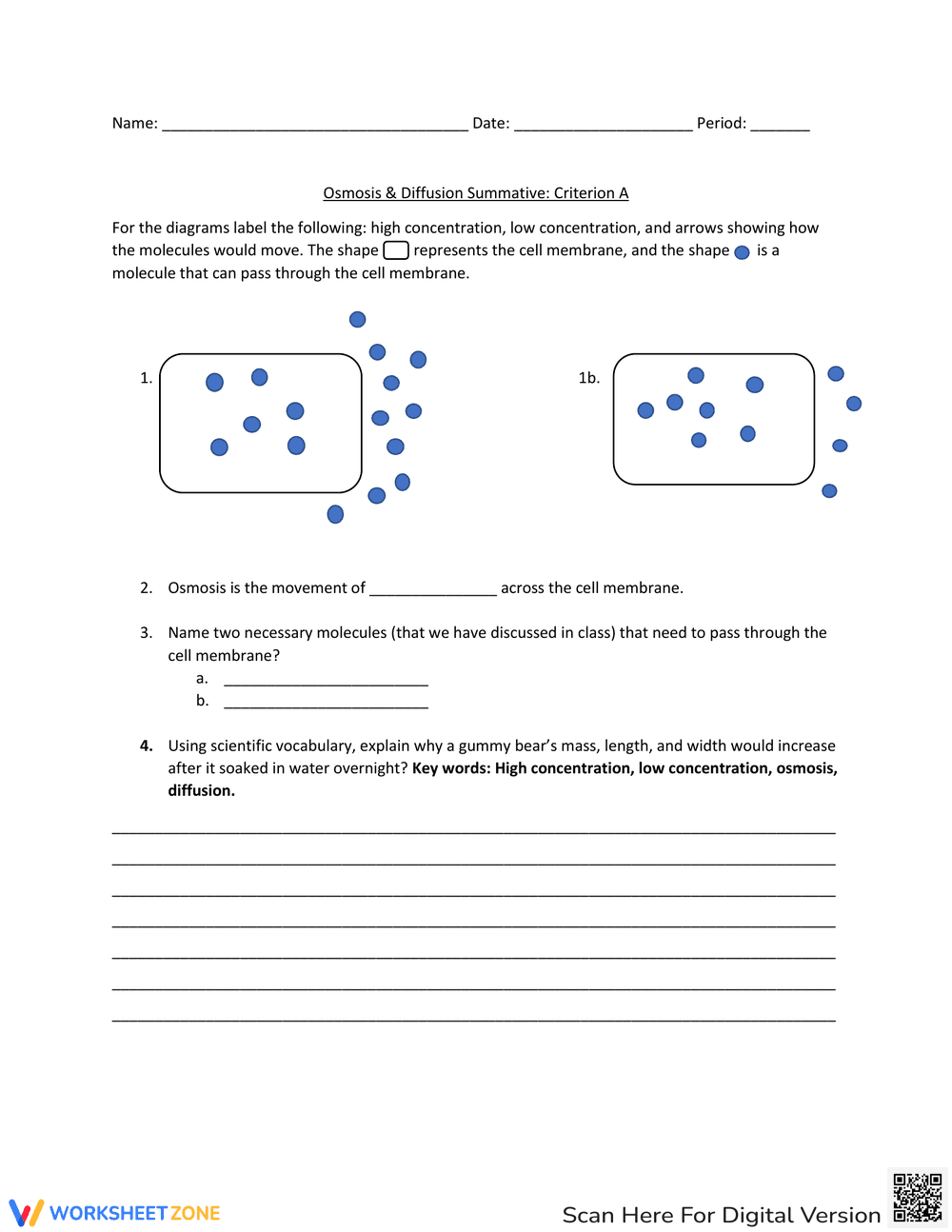
This is a science worksheet focusing on osmosis and diffusion. It includes diagrams where students need to label high and low concentrations and indicate the movement of molecules across a cell membrane. It also has fill-in-the-blank questions about the definition of osmosis and molecules that pass through the cell membrane. Finally, it includes an open-ended question requiring students to explain, using scientific vocabulary, why a gummy bear's mass, length, and width would increase after being soaked in water.
Grade Level Suitability:
This worksheet is suitable for grades 7-9, likely middle school or early high school. The concepts of osmosis and diffusion are typically introduced in these grades, and the worksheet requires students to apply their understanding of these concepts in different contexts.
Why Use It:
This worksheet reinforces understanding of osmosis and diffusion through diagram labeling, definitions, and application of knowledge to a real-world example. It helps students visualize the movement of molecules and understand the factors that influence it. It also encourages the use of scientific vocabulary and critical thinking.
How to Use It:
Students should first read the instructions and definitions provided at the top of the worksheet. They should then label the diagrams, indicating areas of high and low concentration and drawing arrows to show molecule movement. Next, they should complete the fill-in-the-blank questions and finally, write a detailed explanation of the gummy bear phenomenon using the provided keywords: high concentration, low concentration, osmosis, and diffusion.
Target Users:
The target users are middle school and early high school students learning about osmosis and diffusion in a biology or general science class. This worksheet can be used as a formative assessment, homework assignment, or in-class activity to reinforce learning.
This is a science worksheet focusing on osmosis and diffusion. It includes diagrams where students need to label high and low concentrations and indicate the movement of molecules across a cell membrane. It also has fill-in-the-blank questions about the definition of osmosis and molecules that pass through the cell membrane. Finally, it includes an open-ended question requiring students to explain, using scientific vocabulary, why a gummy bear's mass, length, and width would increase after being soaked in water.
Grade Level Suitability:
This worksheet is suitable for grades 7-9, likely middle school or early high school. The concepts of osmosis and diffusion are typically introduced in these grades, and the worksheet requires students to apply their understanding of these concepts in different contexts.
Why Use It:
This worksheet reinforces understanding of osmosis and diffusion through diagram labeling, definitions, and application of knowledge to a real-world example. It helps students visualize the movement of molecules and understand the factors that influence it. It also encourages the use of scientific vocabulary and critical thinking.
How to Use It:
Students should first read the instructions and definitions provided at the top of the worksheet. They should then label the diagrams, indicating areas of high and low concentration and drawing arrows to show molecule movement. Next, they should complete the fill-in-the-blank questions and finally, write a detailed explanation of the gummy bear phenomenon using the provided keywords: high concentration, low concentration, osmosis, and diffusion.
Target Users:
The target users are middle school and early high school students learning about osmosis and diffusion in a biology or general science class. This worksheet can be used as a formative assessment, homework assignment, or in-class activity to reinforce learning.


