


























0
Views
0
Downloads

0 Likes
Solve Dihybrid Cross Problems
0 Views
0 Downloads
Paste this activity's link or code into your existing LMS (Google Classroom, Canvas, Teams, Schoology, Moodle, etc.).
Students can open and work on the activity right away, with no student login required.
You'll still be able to track student progress and results from your teacher account.
Information
Description
What It Is:
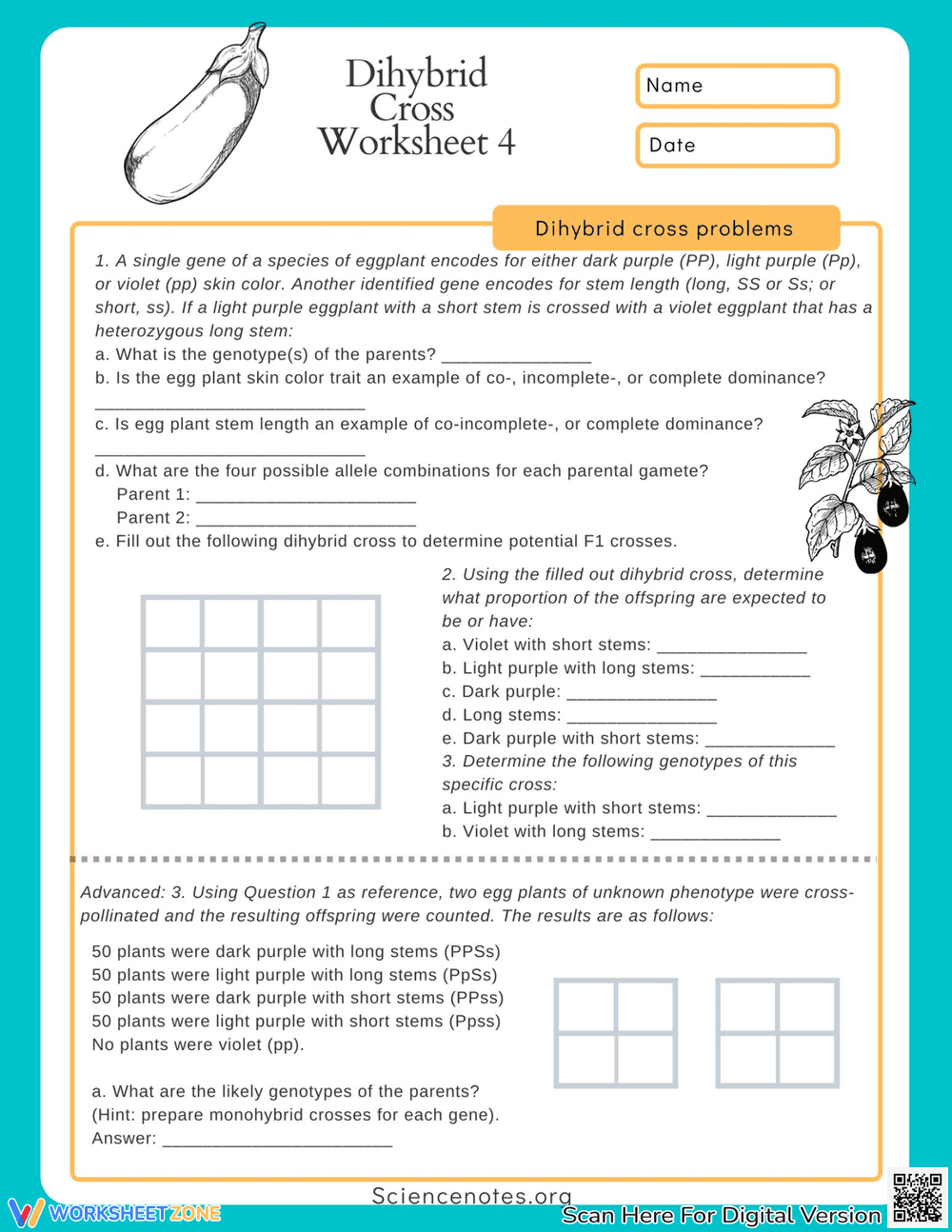
This is a dihybrid cross worksheet, specifically worksheet number 4, focusing on genetics problems involving eggplants. The worksheet includes questions about genotype and phenotype, complete and incomplete dominance, allele combinations, and Punnett squares to determine potential offspring from dihybrid crosses. There's also an advanced section with data on cross-pollinated eggplants and their offspring, requiring students to determine parental genotypes.
Grade Level Suitability:
This worksheet is suitable for high school biology students (Grades 9-12), particularly those studying genetics and heredity. The concepts of dihybrid crosses, Punnett squares, and understanding allele combinations are typically taught at this level. The advanced section might also be appropriate for advanced middle school students (Grade 8).
Why Use It:
This worksheet helps students practice and reinforce their understanding of dihybrid crosses and Mendelian genetics. It encourages problem-solving skills by requiring students to apply their knowledge to determine genotypes, phenotypes, and the probability of offspring traits. It also promotes critical thinking through the advanced section, which requires analyzing data to infer parental genotypes.
How to Use It:
Students should first read the introductory information about eggplant genetics. Then, they should answer the questions sequentially, starting with determining genotypes and phenotypes. They should use the provided Punnett square to complete the dihybrid cross and calculate the expected proportions of offspring. Finally, they should analyze the data in the advanced section to determine the likely genotypes of the parent plants, possibly using monohybrid crosses as a hint.
Target Users:
The target users are high school biology students learning about genetics, heredity, and dihybrid crosses. It's also useful for teachers looking for practice problems to supplement their genetics lessons. It can also be used by students who need extra practice with Punnett squares and genetic analysis.
This is a dihybrid cross worksheet, specifically worksheet number 4, focusing on genetics problems involving eggplants. The worksheet includes questions about genotype and phenotype, complete and incomplete dominance, allele combinations, and Punnett squares to determine potential offspring from dihybrid crosses. There's also an advanced section with data on cross-pollinated eggplants and their offspring, requiring students to determine parental genotypes.
Grade Level Suitability:
This worksheet is suitable for high school biology students (Grades 9-12), particularly those studying genetics and heredity. The concepts of dihybrid crosses, Punnett squares, and understanding allele combinations are typically taught at this level. The advanced section might also be appropriate for advanced middle school students (Grade 8).
Why Use It:
This worksheet helps students practice and reinforce their understanding of dihybrid crosses and Mendelian genetics. It encourages problem-solving skills by requiring students to apply their knowledge to determine genotypes, phenotypes, and the probability of offspring traits. It also promotes critical thinking through the advanced section, which requires analyzing data to infer parental genotypes.
How to Use It:
Students should first read the introductory information about eggplant genetics. Then, they should answer the questions sequentially, starting with determining genotypes and phenotypes. They should use the provided Punnett square to complete the dihybrid cross and calculate the expected proportions of offspring. Finally, they should analyze the data in the advanced section to determine the likely genotypes of the parent plants, possibly using monohybrid crosses as a hint.
Target Users:
The target users are high school biology students learning about genetics, heredity, and dihybrid crosses. It's also useful for teachers looking for practice problems to supplement their genetics lessons. It can also be used by students who need extra practice with Punnett squares and genetic analysis.


