


























1 / 3
0
Views
0
Downloads



0.0
0
0 Likes
Dihybrid Cross Punnett Square Practice - Genetics Worksheet
0 Views
0 Downloads
Paste this activity's link or code into your existing LMS (Google Classroom, Canvas, Teams, Schoology, Moodle, etc.).
Students can open and work on the activity right away, with no student login required.
You'll still be able to track student progress and results from your teacher account.
Information
Description
What It Is:
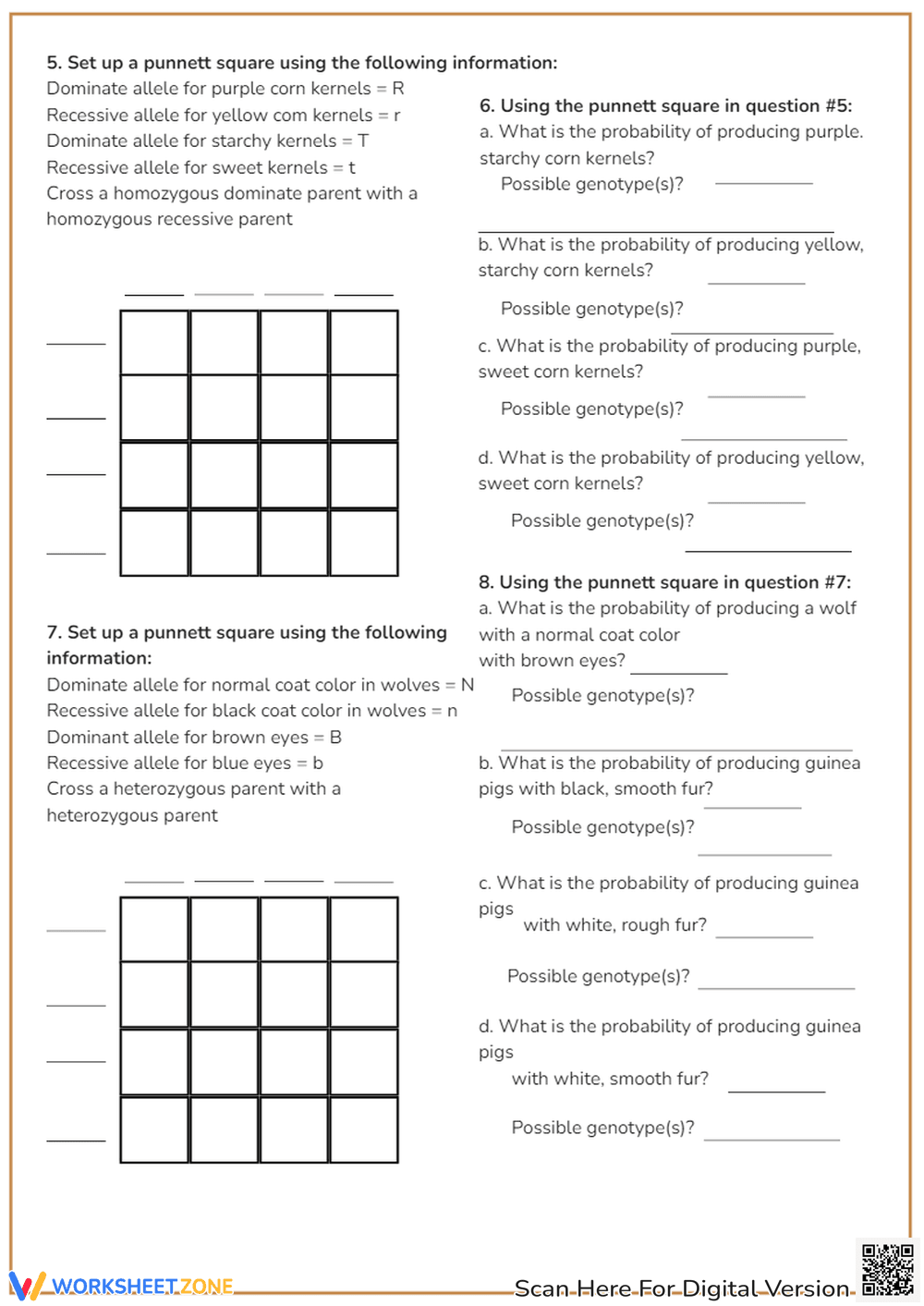
This is a dihybrid cross worksheet. It includes two Punnett square problems. The first problem involves crossing a homozygous dominant plant (DDWW) with a homozygous recessive plant (ddww), where D/d represent tall/dwarf plants and W/w represent purple/white flowers. The second problem involves crossing two heterozygous guinea pigs (BbRr x BbRr), where B/b represent black/white fur and R/r represent rough/smooth fur. Students are asked to determine the probability and possible genotypes for different phenotypes in each cross.
Grade Level Suitability:
This worksheet is suitable for high school biology, specifically grades 9-12. It requires understanding of genetics, alleles, dominance, recessiveness, Punnett squares, and probability, concepts typically covered in high school biology courses.
Why Use It:
This worksheet provides practice in setting up and using Punnett squares to predict the outcome of dihybrid crosses. It reinforces understanding of Mendelian genetics, allele combinations, and probability calculations. It helps students visualize and apply genetic principles to solve problems.
How to Use It:
Students should first read the given information about the alleles for each trait. Then, they should fill in the Punnett square with the correct allele combinations from the parents. Next, they should use the completed Punnett square to determine the probability of each phenotype and list the possible genotypes for each phenotype, answering the questions for each problem.
Target Users:
The target users are high school students studying biology, particularly genetics. It is suitable for students learning about dihybrid crosses and Punnett square analysis. It can be used as a practice activity, homework assignment, or review tool.
This is a dihybrid cross worksheet. It includes two Punnett square problems. The first problem involves crossing a homozygous dominant plant (DDWW) with a homozygous recessive plant (ddww), where D/d represent tall/dwarf plants and W/w represent purple/white flowers. The second problem involves crossing two heterozygous guinea pigs (BbRr x BbRr), where B/b represent black/white fur and R/r represent rough/smooth fur. Students are asked to determine the probability and possible genotypes for different phenotypes in each cross.
Grade Level Suitability:
This worksheet is suitable for high school biology, specifically grades 9-12. It requires understanding of genetics, alleles, dominance, recessiveness, Punnett squares, and probability, concepts typically covered in high school biology courses.
Why Use It:
This worksheet provides practice in setting up and using Punnett squares to predict the outcome of dihybrid crosses. It reinforces understanding of Mendelian genetics, allele combinations, and probability calculations. It helps students visualize and apply genetic principles to solve problems.
How to Use It:
Students should first read the given information about the alleles for each trait. Then, they should fill in the Punnett square with the correct allele combinations from the parents. Next, they should use the completed Punnett square to determine the probability of each phenotype and list the possible genotypes for each phenotype, answering the questions for each problem.
Target Users:
The target users are high school students studying biology, particularly genetics. It is suitable for students learning about dihybrid crosses and Punnett square analysis. It can be used as a practice activity, homework assignment, or review tool.


