


























0
Views
0
Downloads

0.0
0
0 Likes
Distinguishing Persuasive Assertions Worksheet
0 Views
0 Downloads
Paste this activity's link or code into your existing LMS (Google Classroom, Canvas, Teams, Schoology, Moodle, etc.).
Students can open and work on the activity right away, with no student login required.
You'll still be able to track student progress and results from your teacher account.
Information
Description
What It Is:
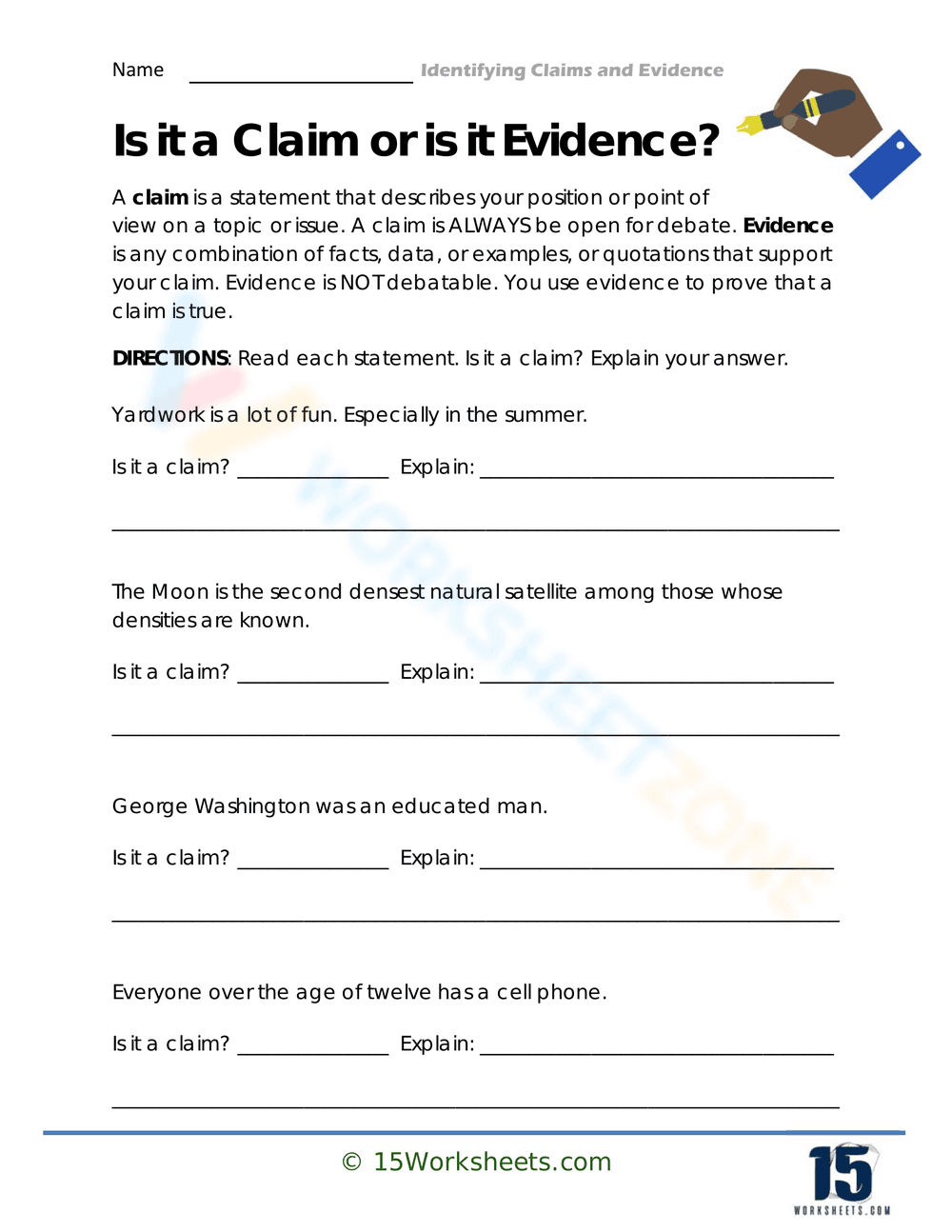
This is an educational worksheet designed to help students differentiate between claims and evidence. It provides a brief definition of each term and then presents several statements. Students must identify whether each statement is a claim or evidence and explain their reasoning. The statements include examples such as 'Yardwork is a lot of fun. Especially in the summer,' 'The Moon is the second densest natural satellite among those whose densities are known,' 'George Washington was an educated man,' and 'Everyone over the age of twelve has a cellphone.'
Grade Level Suitability:
This worksheet is suitable for grades 6-8. The concepts of claims and evidence are typically introduced in middle school as part of developing critical thinking and argumentative writing skills. The complexity of the statements and the need to explain reasoning make it appropriate for this age range.
Why Use It:
This worksheet helps students develop critical thinking skills, improve their ability to analyze statements, and understand the difference between subjective claims and objective evidence. It also reinforces the importance of providing reasoning or justification for their answers, which is a crucial skill for argumentation and debate.
How to Use It:
Students should first read the definitions of 'claim' and 'evidence' provided at the top of the worksheet. Then, they should read each statement carefully and determine whether it is a claim or evidence. Finally, they should write their answer (claim or evidence) and provide a brief explanation of their reasoning in the space provided.
Target Users:
The target users for this worksheet are middle school students (grades 6-8), particularly those learning about argumentative writing, critical thinking, and the difference between claims and evidence. It is also useful for teachers looking for resources to reinforce these concepts in their classrooms.
This is an educational worksheet designed to help students differentiate between claims and evidence. It provides a brief definition of each term and then presents several statements. Students must identify whether each statement is a claim or evidence and explain their reasoning. The statements include examples such as 'Yardwork is a lot of fun. Especially in the summer,' 'The Moon is the second densest natural satellite among those whose densities are known,' 'George Washington was an educated man,' and 'Everyone over the age of twelve has a cellphone.'
Grade Level Suitability:
This worksheet is suitable for grades 6-8. The concepts of claims and evidence are typically introduced in middle school as part of developing critical thinking and argumentative writing skills. The complexity of the statements and the need to explain reasoning make it appropriate for this age range.
Why Use It:
This worksheet helps students develop critical thinking skills, improve their ability to analyze statements, and understand the difference between subjective claims and objective evidence. It also reinforces the importance of providing reasoning or justification for their answers, which is a crucial skill for argumentation and debate.
How to Use It:
Students should first read the definitions of 'claim' and 'evidence' provided at the top of the worksheet. Then, they should read each statement carefully and determine whether it is a claim or evidence. Finally, they should write their answer (claim or evidence) and provide a brief explanation of their reasoning in the space provided.
Target Users:
The target users for this worksheet are middle school students (grades 6-8), particularly those learning about argumentative writing, critical thinking, and the difference between claims and evidence. It is also useful for teachers looking for resources to reinforce these concepts in their classrooms.


