


























0
Views
0
Downloads

0.0
0
0 Likes
Fundamentals of DNA Structure
0 Views
0 Downloads
Paste this activity's link or code into your existing LMS (Google Classroom, Canvas, Teams, Schoology, Moodle, etc.).
Students can open and work on the activity right away, with no student login required.
You'll still be able to track student progress and results from your teacher account.
Information
Description
What It Is:
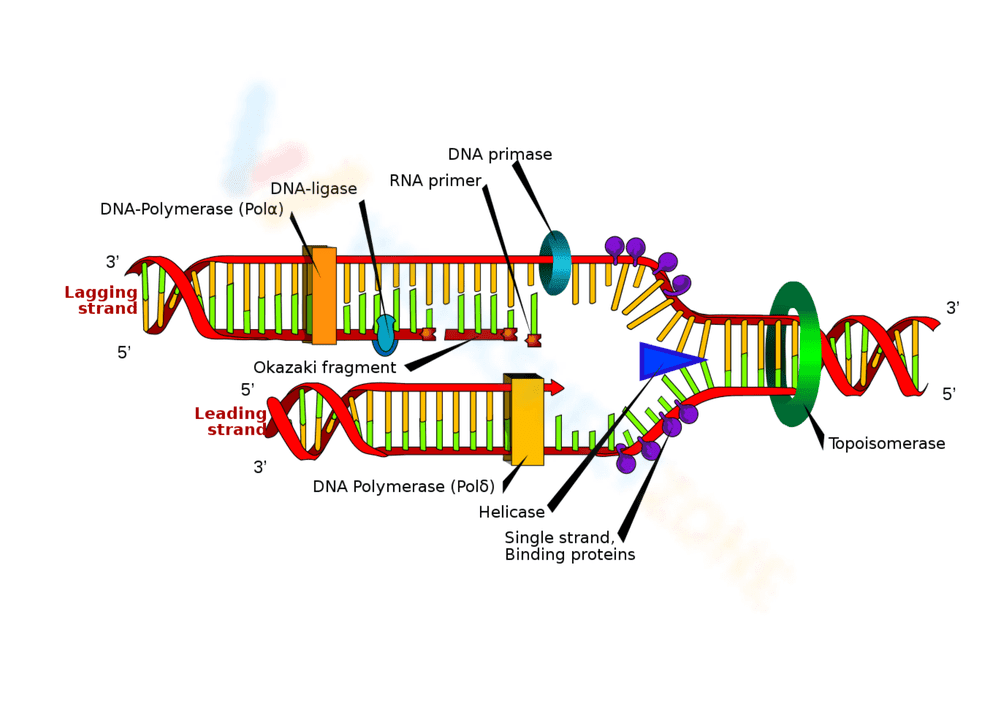
This is a diagram of DNA replication. It illustrates the leading and lagging strands, Okazaki fragments, and various enzymes involved in the process. Key components labeled include DNA polymerase (Pola and Poll), DNA ligase, DNA primase, RNA primer, helicase, single-strand binding proteins, and topoisomerase. The 5' and 3' ends of the strands are also indicated.
Grade Level Suitability:
This diagram is suitable for high school biology (grades 9-12) and introductory college biology courses. The complexity of the process and the specific enzymes involved require a foundational understanding of DNA structure and function.
Why Use It:
This diagram visually explains the complex process of DNA replication, clarifying the roles of different enzymes and the difference between leading and lagging strand synthesis. It aids in understanding the directionality of replication and the formation of Okazaki fragments.
How to Use It:
Use this diagram as a visual aid during lectures or independent study on DNA replication. Students can use it to trace the steps of replication, identify the enzymes involved at each stage, and understand the difference between continuous and discontinuous synthesis. It can also be used as a review tool or a quiz to test knowledge of the process.
Target Users:
The target users are high school and college students studying biology, particularly those learning about molecular biology and genetics. Teachers can also use it as a teaching resource.
This is a diagram of DNA replication. It illustrates the leading and lagging strands, Okazaki fragments, and various enzymes involved in the process. Key components labeled include DNA polymerase (Pola and Poll), DNA ligase, DNA primase, RNA primer, helicase, single-strand binding proteins, and topoisomerase. The 5' and 3' ends of the strands are also indicated.
Grade Level Suitability:
This diagram is suitable for high school biology (grades 9-12) and introductory college biology courses. The complexity of the process and the specific enzymes involved require a foundational understanding of DNA structure and function.
Why Use It:
This diagram visually explains the complex process of DNA replication, clarifying the roles of different enzymes and the difference between leading and lagging strand synthesis. It aids in understanding the directionality of replication and the formation of Okazaki fragments.
How to Use It:
Use this diagram as a visual aid during lectures or independent study on DNA replication. Students can use it to trace the steps of replication, identify the enzymes involved at each stage, and understand the difference between continuous and discontinuous synthesis. It can also be used as a review tool or a quiz to test knowledge of the process.
Target Users:
The target users are high school and college students studying biology, particularly those learning about molecular biology and genetics. Teachers can also use it as a teaching resource.


