


























0
Views
0
Downloads

0.0
0
0 Likes
Matching Ecological Relationships: Worksheet Activity
0 Views
0 Downloads
Paste this activity's link or code into your existing LMS (Google Classroom, Canvas, Teams, Schoology, Moodle, etc.).
Students can open and work on the activity right away, with no student login required.
You'll still be able to track student progress and results from your teacher account.
Information
Description
What It Is:
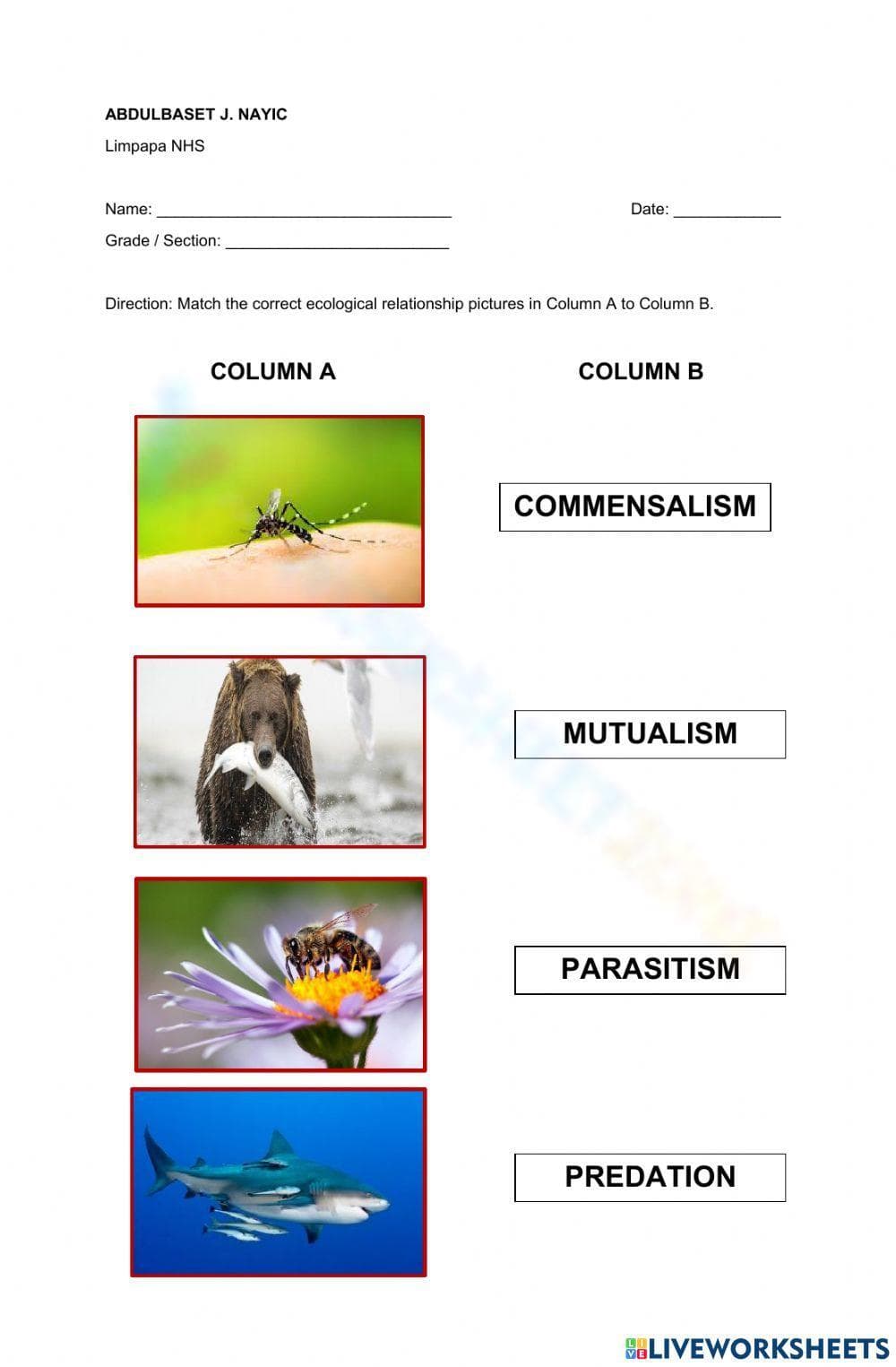
This is an educational worksheet focused on ecological relationships. The worksheet presents a matching activity where students must match pictures in Column A to the correct type of ecological relationship in Column B. Column A contains images depicting: a mosquito on skin, a bear catching a fish, a bee on a flower, and a shark with smaller fish. Column B lists the ecological relationships: Commensalism, Mutualism, Parasitism, and Predation.
Grade Level Suitability:
This worksheet is suitable for grades 6-8. The concepts of ecological relationships are typically introduced in middle school science curricula. The matching activity and visual aids make it accessible for this age group.
Why Use It:
This worksheet helps students understand and differentiate between various ecological relationships (commensalism, mutualism, parasitism, and predation) through visual examples. It reinforces vocabulary and encourages critical thinking by matching real-world scenarios to scientific terms.
How to Use It:
Students should carefully examine each picture in Column A and determine the type of ecological relationship it represents. Then, they should draw a line or write the corresponding letter of the ecological relationship from Column B next to the matching picture in Column A.
Target Users:
The target users are middle school students (grades 6-8) learning about ecology and ecological relationships in a science class. It is also beneficial for students needing visual aids to grasp abstract concepts.
This is an educational worksheet focused on ecological relationships. The worksheet presents a matching activity where students must match pictures in Column A to the correct type of ecological relationship in Column B. Column A contains images depicting: a mosquito on skin, a bear catching a fish, a bee on a flower, and a shark with smaller fish. Column B lists the ecological relationships: Commensalism, Mutualism, Parasitism, and Predation.
Grade Level Suitability:
This worksheet is suitable for grades 6-8. The concepts of ecological relationships are typically introduced in middle school science curricula. The matching activity and visual aids make it accessible for this age group.
Why Use It:
This worksheet helps students understand and differentiate between various ecological relationships (commensalism, mutualism, parasitism, and predation) through visual examples. It reinforces vocabulary and encourages critical thinking by matching real-world scenarios to scientific terms.
How to Use It:
Students should carefully examine each picture in Column A and determine the type of ecological relationship it represents. Then, they should draw a line or write the corresponding letter of the ecological relationship from Column B next to the matching picture in Column A.
Target Users:
The target users are middle school students (grades 6-8) learning about ecology and ecological relationships in a science class. It is also beneficial for students needing visual aids to grasp abstract concepts.


