


























0
Views
0
Downloads

0 Likes
Ecological Relationships: Understanding Ecosystems
0 Views
0 Downloads
Paste this activity's link or code into your existing LMS (Google Classroom, Canvas, Teams, Schoology, Moodle, etc.).
Students can open and work on the activity right away, with no student login required.
You'll still be able to track student progress and results from your teacher account.
Information
Description
What It Is:
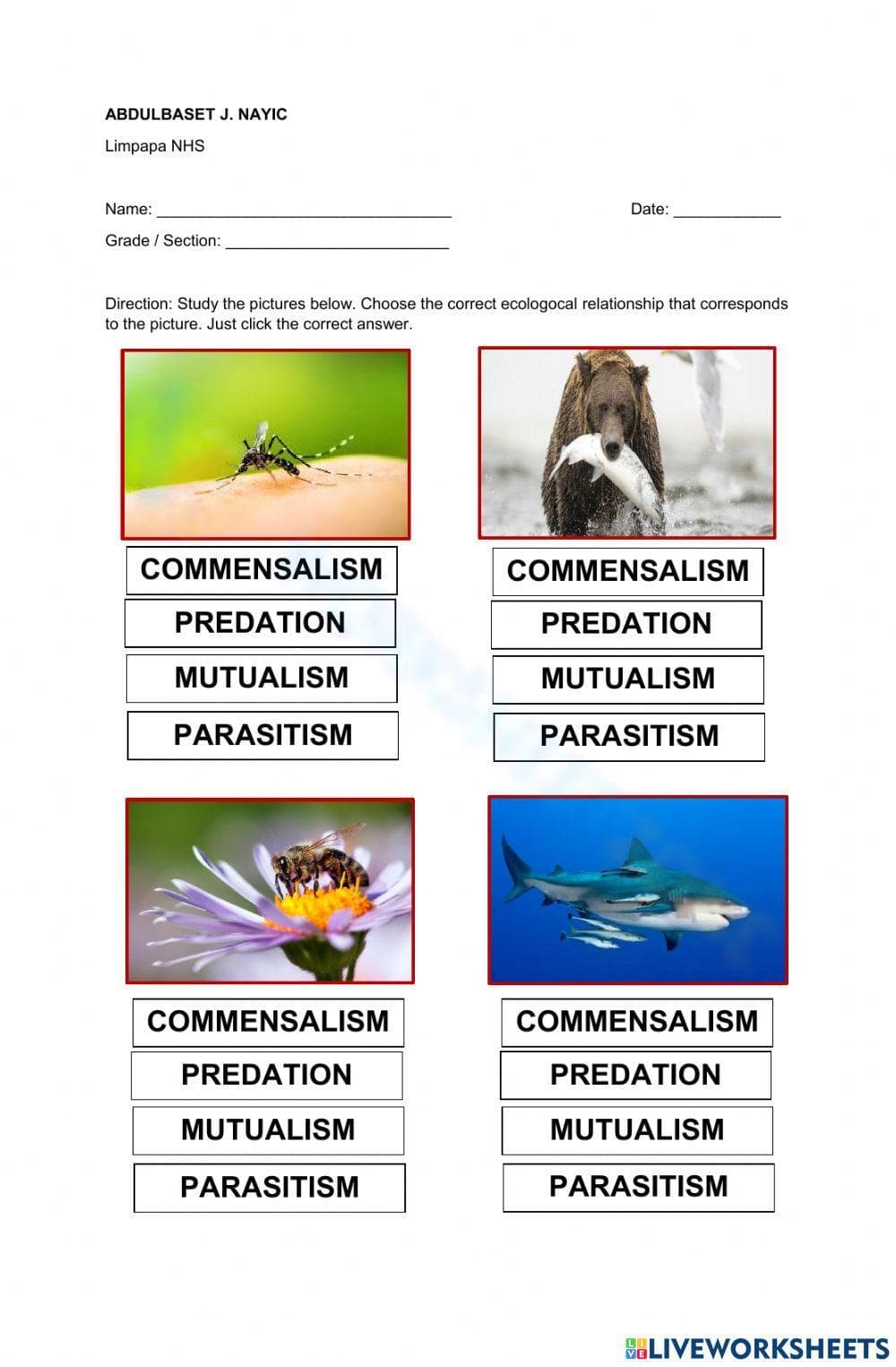
This is an ecology worksheet featuring four different images depicting ecological relationships between organisms. Below each image are four options: Commensalism, Predation, Mutualism, and Parasitism. The student must choose the correct ecological relationship for each image. The images show a mosquito biting a human, a bear catching a fish, a bee on a flower, and a shark with remora fish.
Grade Level Suitability:
This worksheet is suitable for grades 6-9, particularly middle school life science or biology classes. The concepts of commensalism, predation, mutualism, and parasitism are typically introduced at this level. The visual examples aid understanding.
Why Use It:
This worksheet reinforces understanding of different types of ecological relationships. It encourages students to apply their knowledge by analyzing real-world examples and identifying the correct type of interaction. It also improves critical thinking and observational skills.
How to Use It:
Students should first study the images provided. Then, for each image, they should select the term (Commensalism, Predation, Mutualism, or Parasitism) that best describes the ecological relationship shown. The worksheet can be completed individually or in small groups.
Target Users:
This worksheet is designed for middle school students learning about ecology and ecological relationships. It can be used by science teachers, homeschool educators, or students studying independently.
This is an ecology worksheet featuring four different images depicting ecological relationships between organisms. Below each image are four options: Commensalism, Predation, Mutualism, and Parasitism. The student must choose the correct ecological relationship for each image. The images show a mosquito biting a human, a bear catching a fish, a bee on a flower, and a shark with remora fish.
Grade Level Suitability:
This worksheet is suitable for grades 6-9, particularly middle school life science or biology classes. The concepts of commensalism, predation, mutualism, and parasitism are typically introduced at this level. The visual examples aid understanding.
Why Use It:
This worksheet reinforces understanding of different types of ecological relationships. It encourages students to apply their knowledge by analyzing real-world examples and identifying the correct type of interaction. It also improves critical thinking and observational skills.
How to Use It:
Students should first study the images provided. Then, for each image, they should select the term (Commensalism, Predation, Mutualism, or Parasitism) that best describes the ecological relationship shown. The worksheet can be completed individually or in small groups.
Target Users:
This worksheet is designed for middle school students learning about ecology and ecological relationships. It can be used by science teachers, homeschool educators, or students studying independently.


